Peter Capaldi's Doctor Who – unpredictable, embattled, mercurial - has raised many fresh issues for followers of the Time Lord. In this book, the first to address the Capaldi era in depth, international experts on the show explore Capaldi's portrayal of the Doctor, and Steven Moffat's role as show writer and executive producer.
They evaluate the effect of Capaldi's older age on the series' pace and themes; his Scottishness and representations of Scotland in Doctor Who's history, and the roles of the Doctor's female companions, particularly Clara Oswald as played by Jenna Coleman. The politics of war are addressed, as is the development of the alien-fighting military organisation UNIT in the show, as well as controversial portrayals of the afterlife and of immortality. There's discussion of promotional discourses, the imagining of the Twelfth Doctor in fan fiction and fan art, fan responses to the re-gendering of the Master as female, and of Christmas television and the uncanny. For fans, scholars and students alike, this book is a fitting tribute to and assessment of Peter Capaldi's Doctor Who.
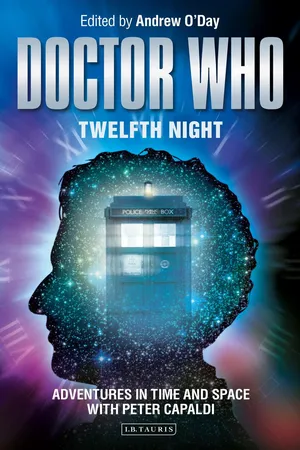
- 288 pages
- English
- ePUB (mobile friendly)
- Available on iOS & Android
eBook - ePub
About this book
Trusted by 375,005 students
Access to over 1.5 million titles for a fair monthly price.
Study more efficiently using our study tools.
Information
Part One
The Doctor and His Companions
1
A Young–Old Face
Out with the New and in with the Old in Doctor Who
Introduction
‘I approve of your new face, Doctor – so much more like mine.’ This line, spoken by the now ancient, enervated and seemingly dying Davros in ‘The Magician’s Apprentice’, is just one of many age-related barbs directed at the Twelfth Doctor during Peter Capaldi’s reign, serving as a constant reminder that the Time Lord is no longer (if, indeed, his on-screen self ever was) a young man.1 Throughout his tenure, friends and foes alike highlighted the latest incarnation’s wrinkled, somewhat cadaverous visage, grey hair and scrawny body, the Doctor being variously described as a ‘desiccated man crone’ (‘Robot of Sherwood’), a ‘grey-haired stick insect’ (‘Listen’) and a ‘skeleton man’ (‘Last Christmas’). Although she ultimately comes to regard him affectionately as a ‘daft old man’ (‘The Woman Who Lived’), in ‘Deep Breath’ Clara (Jenna Coleman) struggles to comprehend how the Doctor’s face can have so many wrinkles when it is brand new (much to the similarly long-lived Madame Vastra’s [Neve McIntosh] disapproval). Stalwart ally Kate Lethbridge-Stewart (Jemma Redgrave) and former spouse River Song (Alex Kingston) both suggest it might be advisable for the Time Lord to touch up his roots (‘Death in Heaven’; ‘The Husbands of River Song’), and even a mildly embarrassed Bill (Pearl Mackie) feels the need to pass the Doctor off as her grandfather in front of contemporaries (‘Knock Knock’).2
Announced in 2013, Peter Capaldi’s appointment as the Doctor added a new dimension to the frenzy of media coverage already surrounding Doctor Who’s 50th anniversary. Much of this centred around the fact that, at 55, Capaldi was the same age original Doctor William Hartnell had been when he took on the role, and showrunner Steven Moffat swiftly claimed this as his USP (unique selling point), stating that ‘to emphasise the senior consultant over the medical student for once reminds people that he’s actually a terrifying old beast’.3
Establishing the Doctor’s exact age is problematic. As given on screen, it veered between 450 and 953 in the original series, but by ‘The End of Time’ (2010) had been retconned to a reassuringly precise 906.4 However, the Eleventh Doctor’s (Matt Smith) extensive off-screen adventures made it increasingly difficult to pin down accurately – something the Time Lord himself admits in ‘The Day of the Doctor’ (2013). His lengthy sojourn on Trenzalore only added to the confusion, though by ‘The Zygon Inversion’ the Twelfth Doctor is able to state with confidence that he is ‘over two thousand years old.’ This approximation still stands in the later ‘Smile’ and ‘Thin Ice’, despite the Doctor having previously been trapped in his Confession Dial for four and a half billion years (‘Heaven Sent’).
Perhaps appropriately, the apparent age of the Doctor’s physical body has also varied wildly. While it was possible that the first ‘regeneration’, in ‘The Tenth Planet’, was indeed a ‘renewal’ – as the Doctor himself described it – in the sense of his body becoming younger, this has not always been the case since; the Doctor can also grow visibly older, as occurred with Jon Pertwee and Colin Baker’s incarnations.5 However, it is the casting of a younger actor that is usually deemed most newsworthy, Peter Davison and Matt Smith having received particular coverage on these grounds. Since its own ‘renewal’ in 2005 the series has placed the emphasis more firmly on youth, with the then 40-year-old Christopher Eccleston the most senior of the lead actors prior to Capaldi’s casting.
This was a trend that showrunner Steven Moffat initially intended to reverse upon taking the helm in 2009, but his plan to cast an older Doctor was sidelined when the 26-year-old Matt Smith impressed him during auditions. However, the introduction in the 2013 anniversary special ‘The Day of the Doctor’ of John Hurt as the grizzled War Doctor could be seen as paving the way for a more mature actor to take the lead – a move compounded by Capaldi’s own (brief) appearance in the episode, the return of a visibly older Tom Baker as the ‘Curator’ (a possible future incarnation of the Doctor) at the narrative’s close, and the subsequent ageing of Smith’s incarnation while on Trenzalore (‘The Time of the Doctor’, 2013).
Although in the original era the pace of the show was often constrained by its multi-camera studio format, which made scenes of physical combat challenging to stage convincingly, the single-camera model of the Davies and Moffat series has often seen the Doctor functioning more as high-octane action hero than cerebral sage, complete with elaborate post-production special effects that could only have been dreamed of by the original series production team. Capaldi’s arrival, therefore, raised several questions with regard to age and ageing in Doctor Who, in terms of both characterisation and narrative form. With the Doctor played by younger men for so much of his recent tenure, Moffat’s re-establishment of the Doctor as a middle-aged hero was a daring move in a televisual era that featured few such role models, even the quinquagenarian Inspector Morse having been replaced by his twenty-something counterpart in Endeavour (ITV, 2013–). This chapter will therefore investigate the narrative and performative strategies employed to accommodate this approach, and the impact Capaldi’s arrival had upon the pace and style of Doctor Who.
In need of assistants?
In a direct mirroring of the 1963 series, Capaldi’s era saw the Doctor initially accompanied by a teacher from London’s Coal Hill School, Clara Oswald ostensibly representing a counterpart to original series companion and history tutor Barbara Wright (Jacqueline Hill). While Clara was a hangover from the Matt Smith years, her role at Coal Hill had only been established in Smith’s penultimate adventure, ‘The Day of the Doctor’, and at first seemed little more than a nostalgic nod to the classic series in its anniversary special. When it was announced that she would be joined in Capaldi’s first year by soldier turned maths teacher Danny Pink (Samuel Anderson), it could have been surmised that Danny’s inclusion in the regular cast was intended to replicate the role originally played by science master Ian Chesterton (William Russell), who had been included in the TARDIS crew to take care of any physical business that may have proved too demanding for Hartnell/the First Doctor.6 Following Ian’s departure, the Doctor was similarly ‘assisted’, first by astronaut Steven Taylor (Peter Purves), and latterly by sailor Ben Jackson (Michael Craze). Although in 1966 Hartnell was replaced by the younger Patrick Troughton, the new lead’s cerebral approach meant that action sequences were for the most part undertaken by brawny Scot Jamie McCrimmon (Frazer Hines), the Second Doctor rarely embarking upon any form of physical engagement. This formula was attempted again in 1974, the character of naval surgeon Harry Sullivan (Ian Marter) having been conceived before the Fourth Doctor was cast. In the event, Tom Baker’s incarnation proved perfectly adept at handling combat scenes, and Harry’s stay proved brief indeed. John Tulloch and Manuel Alvarado have previously highlighted the issue of the ‘running and punching’ role of the male companion, but in the event this satellite archetype was one that Danny Pink would largely deviate from.7
Ultimately, Clara and Danny were less the mature guides envisaged by the 1963 production team than a youthful counterpoint to the casting of Capaldi, their ill-fated romance providing an emotional spine to the new Doctor’s first year and reminding the audience (and Clara) that the Doctor was, in his own words, not her boyfriend (‘Deep Breath’). The programme’s move to a later time slot meant that the need for youthful points of identification had become increasingly moot, and any similarities between Clara and Danny and the original Coal Hill duo proved superficial at best. Indeed, Danny Pink could only be said to play a ‘traditional’ companion role (i.e. assisting the Doctor in his endeavours) in two stories: ‘The Caretaker’ and ‘In the Forest of the Night’. In the former, Danny’s efforts serve only to frustrate the Doctor’s plan to neutralise the Skovox Blitzer, sparking a mutually antagonistic relationship atypical of that enjoyed by the Time Lord with the majority of his previous male companions, while in the latter the spirit is more one of competition than collaboration.8
Much of the Twelfth Doctor’s resentment of Danny seems to stem from the latter’s former career as a soldier, and from this perspective it is interesting to compare the Twelfth Doc...
Table of contents
- List of Figures
- Contributors
- Note on Terminology
- Acknowledgements
- Introduction
- Part One • The Doctor and His Companions
- 1 • A Young–Old Face
- 2 • ‘I’m Scottish … I can really complain about things now’
- 3 • Clara’s Choice
- Part Two • Further Politics and Themes
- 4 • A Good Man Goes to War?
- 5 • ‘Chap with wings there, five rounds rapid’
- 6 • Heaven Sent?
- 7 • Comfort and Joy?
- Part Three • Promotional Discourses
- 8 • ‘Please welcome the Twelfth Doctor’
- 9 • The Transcultural Fan
- Part Four • Fandom
- 10 • ‘Doctor Who belongs to all of us’
- 11 • Hit or Miss?
- Appendix • Audience Data
- List of Episodes • The Steven Moffat/Peter Capaldi era
Frequently asked questions
Yes, you can cancel anytime from the Subscription tab in your account settings on the Perlego website. Your subscription will stay active until the end of your current billing period. Learn how to cancel your subscription
No, books cannot be downloaded as external files, such as PDFs, for use outside of Perlego. However, you can download books within the Perlego app for offline reading on mobile or tablet. Learn how to download books offline
Perlego offers two plans: Essential and Complete
- Essential is ideal for learners and professionals who enjoy exploring a wide range of subjects. Access the Essential Library with 800,000+ trusted titles and best-sellers across business, personal growth, and the humanities. Includes unlimited reading time and Standard Read Aloud voice.
- Complete: Perfect for advanced learners and researchers needing full, unrestricted access. Unlock 1.5M+ books across hundreds of subjects, including academic and specialized titles. The Complete Plan also includes advanced features like Premium Read Aloud and Research Assistant.
We are an online textbook subscription service, where you can get access to an entire online library for less than the price of a single book per month. With over 1.5 million books across 990+ topics, we’ve got you covered! Learn about our mission
Look out for the read-aloud symbol on your next book to see if you can listen to it. The read-aloud tool reads text aloud for you, highlighting the text as it is being read. You can pause it, speed it up and slow it down. Learn more about Read Aloud
Yes! You can use the Perlego app on both iOS and Android devices to read anytime, anywhere — even offline. Perfect for commutes or when you’re on the go.
Please note we cannot support devices running on iOS 13 and Android 7 or earlier. Learn more about using the app
Please note we cannot support devices running on iOS 13 and Android 7 or earlier. Learn more about using the app
Yes, you can access Doctor Who - Twelfth Night by Andrew O'Day in PDF and/or ePUB format, as well as other popular books in Médias et arts de la scène & Télévision. We have over 1.5 million books available in our catalogue for you to explore.