eBook - ePub
Antelope Conservation
From Diagnosis to Action
- English
- ePUB (mobile friendly)
- Available on iOS & Android
eBook - ePub
Antelope Conservation
From Diagnosis to Action
About this book
Antelopes constitute a fundamental part of ecosystems throughout Africa and Asia where they act as habitat architects, dispersers of seeds, and prey for large carnivores. The fascication they hold in the human mind is evident from prehistoric rock paintings and ancient Egyptian art to today's wildlife documentaries and popularity in zoos. In recent years, however, the spectacular herds of the past have been decimated or extripated over wide areas in the wilds, and urgent conservation action is needed to preserve this world heritage for generations to come.
As the first book dedicated to antelope conservation, this volume sets out to diagnose the causes of the drastic declines in antelope biodiversity and on this basis identify the most effective points of action. In doing so, the book covers central issues in the current conservation debate, especially related to the management of overexploitation, habitat fragmentation, disease transmission, climate change, populations genetics, and reintroductions. The contributions are authored by world-leading experts in the field, and the book is a useful resource to conservation scientists and practitioners, researchers, and students in related disciplines as well as interested lay people.
As the first book dedicated to antelope conservation, this volume sets out to diagnose the causes of the drastic declines in antelope biodiversity and on this basis identify the most effective points of action. In doing so, the book covers central issues in the current conservation debate, especially related to the management of overexploitation, habitat fragmentation, disease transmission, climate change, populations genetics, and reintroductions. The contributions are authored by world-leading experts in the field, and the book is a useful resource to conservation scientists and practitioners, researchers, and students in related disciplines as well as interested lay people.
Tools to learn more effectively

Saving Books

Keyword Search

Annotating Text

Listen to it instead
Information
1
Our Antelope Heritage – Why the Fuss?
Jakob Bro‐Jørgensen
Mammalian Behaviour and Evolution Group, Department of Evolution, Ecology and Behaviour, Institute of Integrative Biology, University of Liverpool, United Kingdom
Introduction
Why a book dedicated to antelope conservation? Our planet has witnessed a decrease of more than 50% in its vertebrate populations since 1970, and this drastic decline has hit antelopes particularly hard, according to the Living Planet Index (BBC, 2008; McLellan, 2014; see also Craigie et al., 2010). Many will agree that antelopes constitute an outstanding aspect of the world’s biodiversity and that the prospect of losing this heritage is a concern in its own right. A savanna bereft of flickering herds of gazelles (Figure 1) or a rainforest where duikers no longer lurk in the understorey may be likened to bodies that have lost their souls. But leaving subjective sentiments aside, antelopes are also of fundamental importance for the functioning of many ecosystems across Africa and Asia. They have important roles as architects of habitats, as dispersers of seed, as the prey base for endangered carnivores and indeed in nutrient cycling in general (Sinclair & Arcese, 1995; Sinclair et al., 2008; Gallagher, 2013). Maintaining healthy antelope populations is therefore vital for the management of many ecosystems, and the motivation for this book comes from an urgent concern not only at the species level but also relating to wider repercussions at the ecosystem level.

Figure 1 Thomson gazelles and impalas in Maasai Mara National Reserve, Kenya
(© Jakob Bro‐Jørgensen).
Antelopes moreover provide a well‐suited model to obtain insights into the operation of threat processes affecting wildlife populations more generally. Because they share the same basic biology, yet display a striking variation in habitats and threats, this species‐rich group presents an extraordinary opportunity to pinpoint how human impact on wildlife populations depends on the interaction between threats and specific species traits. Many of the issues facing antelopes are central to the current conservation debate, including the sustainable use of wildlife (for meat and trophies), protection of migratory as well as highly habitat‐specific species in a world of climate change and habitat fragmentation, and the coexistence of wildlife with people and their livestock without conflict. Typically, antelope conservation takes place in developing countries with growing human populations and severely under‐resourced wildlife authorities, which brings the issue of how to integrate conservation and development to the forefront. Valuable long‐term data sets are present for several antelope species, placing them in a strong position to provide some general lessons for conservation biology, especially in relation to the particular challenge of preserving large mammals (MacDonald et al., 2013).
However, following a surge in pioneering field studies of many antelope species in the 1960s and 1970s, the reality is that antelope research seems to have lost its general appeal, and the attention from the general public is modest compared to that received by many of their mammalian relatives, such as carnivores and primates, which are widely seen as more charismatic. This book is intended to reinvigorate the interest in antelope research and give a deeper understanding of the threat drivers facing antelopes today, thereby providing a basis for reflection on common best practices in conservation. As a background, this introductory chapter will first take an evolutionary perspective to understanding the ecological importance of global antelope biodiversity and then outline the current conservation status of this world heritage.
Antelopes – an evolutionary success story … so far
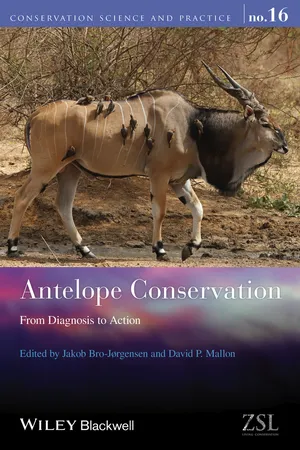
A green world presents a tremendous opportunity for the evolution of efficient plant‐eaters, and here antelopes have been an extraordinary success story. A major evolutionary breakthrough took place in the Eocene some 50 Myrs BP when the compartmentalized ruminant stomach evolved (Fernández & Vrba, 2005). This enabled a more efficient breakdown of fibrous plant material by chewing cud and using microbial symbionts to digest cellulose. The antelopes are members of the ruminant family Bovidae, characterized by permanent horns consisting of a bone core covered by a sheath of keratin. The first known bovid fossil, Eotragus, dates back to the early Miocene some 20 Myrs BP (Gentry, 2000; Fernandez & Vrba, 2005), and since then, an astonishing adaptive radiation has taken place as bovid species have evolved to occupy a wide range of ecological niches. The majority of these species are antelopes: 88 extant species are represented by 14 species in Asia and 75 species in their main stronghold in Africa, with only the dorcas gazelle (Gazella dorcas) found on both continents. Antelopes vary in size from the 1.5 kg of a royal antelope (Neotragus pygmaeus) (Plate 3) to nearly a ton in a full‐grown giant eland bull (Tragelaphus derbianus) (cover).
So what distinguishes antelopes? Treating antelopes as a group is questionable from a strict evolutionary perspective because it violates the ideal of keeping together all species descending from a given distinctive ancestor. The group is created by cutting off two distinct monophyletic branches from the bovid tree: (i) the wild oxen Bovini, characterized by their heavier build and water‐dependence, and (ii) the wild goats and sheep Caprinae, characterized by their extreme adaptation to rocky habitats (Figure 2). However, antelopes are not defined only by what they are not (i.e., as a bovid that is neither an oxen nor a goat). They can be succinctly described as horned ruminants lightly built for swift movement in habitats with predominantly even ground. This has resulted in a characteristic graceful and elegant morphology, often adorned with spectacular ornaments and weapons due to strong sexual selection in the more social species (Stoner et al., 2003; Bro‐Jørgensen, 2007).
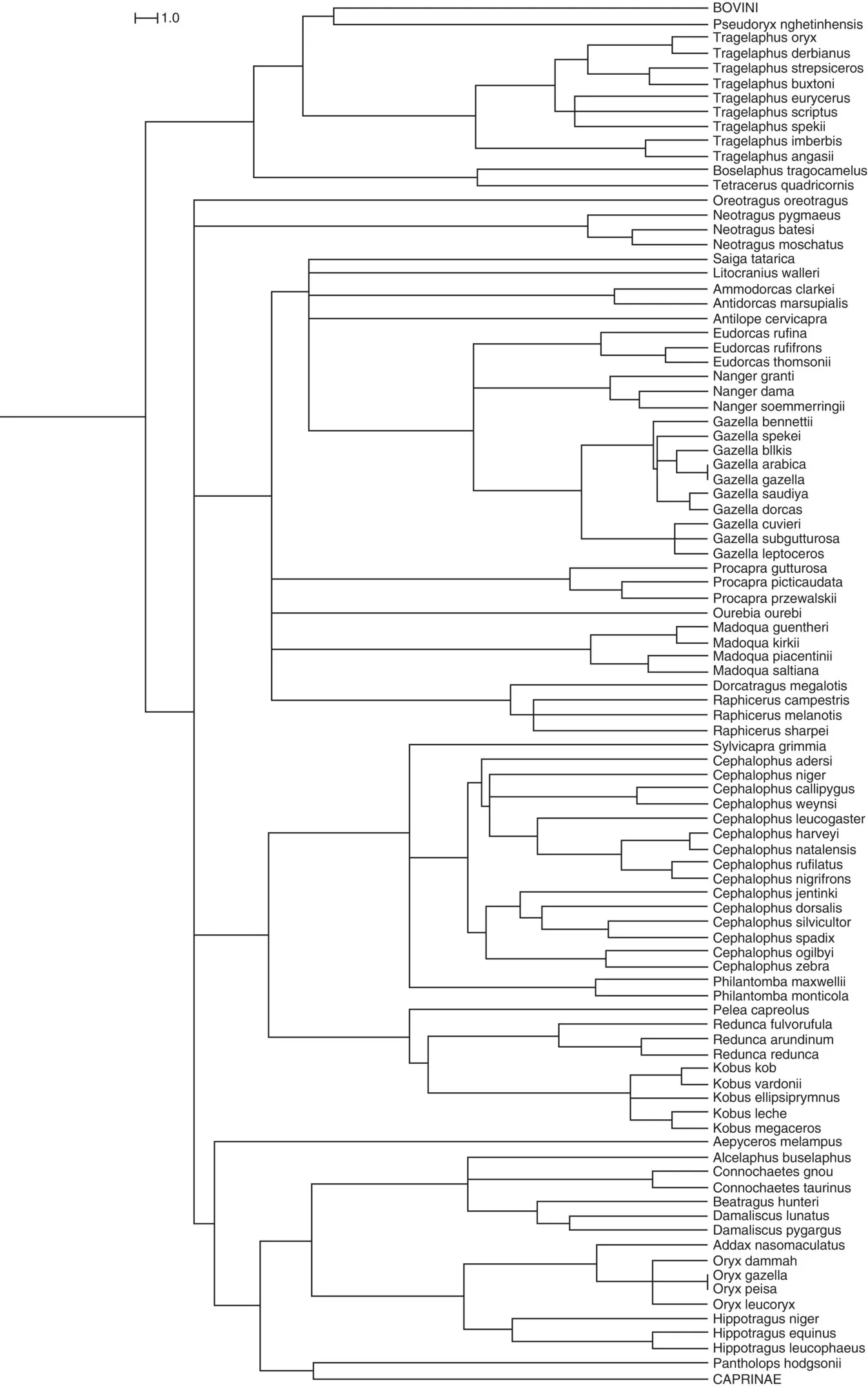
Figure 2 The evolution within Bovidae since the divergence from deer 32 million years ago (for common names, see the Appendix). Bar indicates one million years.
Based on Fernández & Vrba 2005; drawn in Dendroscope, Huson & Scornavacca 2012.
The broad array of ecological adaptations in antelopes is apparent when considering the variety between the 12 tribes (Plates 1, 2, & 3). The spiral‐horned antelopes of Africa Tragelaphini (elands, kudus, nyalas and allies), together with their Asian relatives Pseudorygini (saola Pseudoryx nghetinhensis) and Boselaphini (nilgai Boselaphus tragocamelus, four‐horned antelope Tetracerus quadricornis), represent a highly diverse ancient line from within which the wild oxen descended. Except for the browsing saola, they are mixed feeders; that is, feeding on both browse and grass. They vary more than tenfold in size and are found from dense forests (bongo Tragelaphus eurycerus, saola) to semi‐deserts (common eland Tragelaphus oryx), and from swamps (sitatunga Tragelaphus spekii) to mountains (mountain nyala Tragelaphus buxtoni). Other mixed feeders include the arid‐adapted gazelles Antilopini which span from hot to rather cold regions, and the horse antelopes Hippotragini, which predominantly graze and occur from relatively moist savannas (roan Hippotragus equinus and sable antelope Hippotragus niger) to semi‐deserts (oryxes) and deserts (addax Addax nasomaculatus). Both the latter tribes have representatives in Africa as well as Asia. Also mixed‐feeders, the African impala (Aepyceros melampus) and rhebok (Pelea capreolus) are the only living representatives of the tribes Aepycerotini and Peleini respectively. The grazing tribes include the reduncines Reduncini (lechwes, reedbucks and allies), adapted to relatively moist savannas and wetlands, and the alcelaphines Alcelaphini (wildebeests and allies), adapted to drier savannas; both are exclusively African. The Tibetan antelope (Pantholops hod...
Table of contents
- Cover
- Title Page
- Table of Contents
- Contributors
- Preface and Acknowledgements
- Foreword
- 1 Our Antelope Heritage – Why the Fuss?
- 2 Conservation Challenges Facing African Savanna Ecosystems
- 3 Population Regulation and Climate Change: The Future of Africa’s Antelope
- 4 Interspecific Resource Competition in Antelopes: Search for Evidence
- 5 Importance of Antelope Bushmeat Consumption in African Wet and Moist Tropical Forests
- 6 Opportunities and Pitfalls in Realising the Potential Contribution of Trophy Hunting to Antelope Conservation
- 7 Antelope Diseases – the Good, the Bad and the Ugly
- 8 Hands‐on Approaches to Managing Antelopes and their Ecosystems: A South African Perspective
- 9 DNA in the Conservation and Management of African Antelope
- 10 Biological Conservation Founded on Landscape Genetics
- 11 The Use of Camera‐Traps to Monitor Forest Antelope Species
- 12 Reintroduction as an Antelope Conservation Solution
- 13 Desert Antelopes on the Brink
- 14 The Fall and Rise of the Scimitar‐Horned Oryx
- 15 Two Decades of Saiga Antelope Research
- 16 Synthesis: Antelope Conservation – Realising the Potential
- Appendix
- Index
- End User License Agreement
Frequently asked questions
Yes, you can cancel anytime from the Subscription tab in your account settings on the Perlego website. Your subscription will stay active until the end of your current billing period. Learn how to cancel your subscription
No, books cannot be downloaded as external files, such as PDFs, for use outside of Perlego. However, you can download books within the Perlego app for offline reading on mobile or tablet. Learn how to download books offline
Perlego offers two plans: Essential and Complete
- Essential is ideal for learners and professionals who enjoy exploring a wide range of subjects. Access the Essential Library with 800,000+ trusted titles and best-sellers across business, personal growth, and the humanities. Includes unlimited reading time and Standard Read Aloud voice.
- Complete: Perfect for advanced learners and researchers needing full, unrestricted access. Unlock 1.4M+ books across hundreds of subjects, including academic and specialized titles. The Complete Plan also includes advanced features like Premium Read Aloud and Research Assistant.
We are an online textbook subscription service, where you can get access to an entire online library for less than the price of a single book per month. With over 1 million books across 990+ topics, we’ve got you covered! Learn about our mission
Look out for the read-aloud symbol on your next book to see if you can listen to it. The read-aloud tool reads text aloud for you, highlighting the text as it is being read. You can pause it, speed it up and slow it down. Learn more about Read Aloud
Yes! You can use the Perlego app on both iOS and Android devices to read anytime, anywhere — even offline. Perfect for commutes or when you’re on the go.
Please note we cannot support devices running on iOS 13 and Android 7 or earlier. Learn more about using the app
Please note we cannot support devices running on iOS 13 and Android 7 or earlier. Learn more about using the app
Yes, you can access Antelope Conservation by Jakob Bro-Jorgensen, David P. Mallon, Jakob Bro-Jorgensen,David P. Mallon in PDF and/or ePUB format, as well as other popular books in Biological Sciences & Biology. We have over one million books available in our catalogue for you to explore.