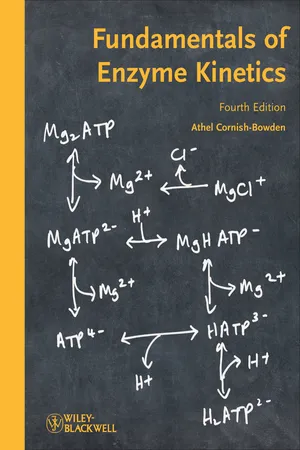
Now in its fourth edition, this textbook is one of the few titles worldwide to cover enzyme kinetics in its entire scope and the only one to include its implications for bioinformatics and systems biology. Multi-enzyme complexes and cooperativity are therefore treated in more detail than in any other textbook on the market.
The respected and well known author is one of the most experienced researchers into the topic and writes with outstanding style and didactic clarity. As with the previous editions, he presents here steady-state kinetics and fast reactions, supplementing each chapter with problems and solutions. For the first time, this edition features a companion website providing all figures in colour
www.wiley-vch.de/home/fundenzykinet
- English
- ePUB (mobile friendly)
- Available on iOS & Android
eBook - ePub
Fundamentals of Enzyme Kinetics
About this book
Information
Chapter 1
Basic Principles of Chemical Kinetics
1.1 Symbols, terminology and abbreviations
This book follows as far as possible the recommendations of the International Union of Biochemistry and Molecular Biology. However, as these allow some latitude and in any case do not cover all of the cases that we shall need, it is useful to begin by noting some points that apply generally in the book. First of all, it is important to recognize that a chemical substance and its concentration are two different entities and need to be represented by different symbols. The recommendations allow square brackets around the chemical name to be used without definition for its concentration, so [glucose] is the concentration of glucose, [A] is the concentration of a substance A, and so on. In this book I shall use this convention for names that consist of more than a single letter, but it has the disadvantage that the profusion of square brackets can lead to forbiddingly complicated equations in enzyme kinetics (see some of the equations in Chapter 8, for example, and imagine how they would look with square brackets). Two simple alternatives are possible: one is just to put the name in italics, so the concentration of A is A, for example, and this accords well with the standard convention that chemical names are written in roman (upright) type and algebraic symbols are written in italics. However, experience shows that many readers barely notice whether a particular symbol is roman or italic, and so it discriminates less well than one would hope between the two kinds of entity. For this reason I shall use the lower-case italic letter that corresponds to the symbol for the chemical entity, so a is the concentration of A, for example. If the chemical symbol has any subscripts, these apply unchanged to the concentration symbol, so a0 is the concentration of A0, for example. Both of these systems (and others) are permitted by the recommendations as long as each symbol is defined when first used. This provision is satisfied in this book, and it is good to follow it in general, because almost nothing that authors consider obvious is perceived as obvious by all their readers. In the problems at the ends of the chapters, incidentally, the symbols may not be the same as those used in the corresponding chapters: this is intentional, because in the real world one cannot always expect the questions that one has to answer to be presented in familiar terms.
Chapter 8, pages 189–226
As we shall see, an enzyme-catalyzed reaction virtually always consists of two or more steps, and as we shall need symbols to refer to the different steps it is necessary to have some convenient indexing system to show which symbol refers to which step. The recommendations do not impose any particular system, but, most important, they do require the system in use to be stated. Because of the different ways in which, for example, the symbol k2 has been used in the biochemical literature one should never assume in the absence of a clear definition what is intended. In this book I use the system preferred by the recommendations: for a reaction of n steps, these are numbered 1, 2 … n; lower-case italic k with a positive subscript refers to the kinetic properties of the forward step corresponding to the subscript, for example, k2 refers to the forward direction of the second step; the same with a negative subscript refers to the corresponding reverse reaction, for example, k−2 for the second step; a capital italic K with a subscript refers to the thermodynamic (equilibrium) properties of the whole step and is typically the ratio of the two kinetic constants, for example, K2 = k2/k−2.
The polic...
Table of contents
- Cover
- Table of Contents
- Related Titles
- Title
- Copyright
- Preface
- Chapter 1: Basic Principles of Chemical Kinetics
- Chapter 2: Introduction to Enzyme Kinetics
- Chapter 3: “Alternative” enzymes
- Chapter 4: Practical Aspects of Kinetics
- Chapter 5: Deriving Steady-state Rate Equations
- Chapter 6: Reversible Inhibition and Activation
- Chapter 7: Tight-binding and Irreversible Inhibitors
- Chapter 8: Reactions of More than One Substrate
- Chapter 9: Use of Isotopes for Studying Enzyme Mechanisms
- Chapter 10: Effect of pH on Enzyme Activity
- Chapter 11: Temperature Effects on Enzyme Activity
- Chapter 12: Regulation of Enzyme Activity
- Chapter 13: Multienzyme Systems
- Chapter 14: Fast Reactions
- Chapter 15: Estimation of Kinetic Constants
- APPENDIX: Standards for Reporting Enzymology Data
- Solutions and Notes to Problems
- Index
- End User License Agreement
Trusted by 375,005 students
Access to over 1.5 million titles for a fair monthly price.
Study more efficiently using our study tools.
Frequently asked questions
Yes, you can cancel anytime from the Subscription tab in your account settings on the Perlego website. Your subscription will stay active until the end of your current billing period. Learn how to cancel your subscription
No, books cannot be downloaded as external files, such as PDFs, for use outside of Perlego. However, you can download books within the Perlego app for offline reading on mobile or tablet. Learn how to download books offline
Perlego offers two plans: Essential and Complete
- Essential is ideal for learners and professionals who enjoy exploring a wide range of subjects. Access the Essential Library with 800,000+ trusted titles and best-sellers across business, personal growth, and the humanities. Includes unlimited reading time and Standard Read Aloud voice.
- Complete: Perfect for advanced learners and researchers needing full, unrestricted access. Unlock 1.5M+ books across hundreds of subjects, including academic and specialized titles. The Complete Plan also includes advanced features like Premium Read Aloud and Research Assistant.
We are an online textbook subscription service, where you can get access to an entire online library for less than the price of a single book per month. With over 1.5 million books across 990+ topics, we’ve got you covered! Learn about our mission
Look out for the read-aloud symbol on your next book to see if you can listen to it. The read-aloud tool reads text aloud for you, highlighting the text as it is being read. You can pause it, speed it up and slow it down. Learn more about Read Aloud
Yes! You can use the Perlego app on both iOS and Android devices to read anytime, anywhere — even offline. Perfect for commutes or when you’re on the go.
Please note we cannot support devices running on iOS 13 and Android 7 or earlier. Learn more about using the app
Please note we cannot support devices running on iOS 13 and Android 7 or earlier. Learn more about using the app
Yes, you can access Fundamentals of Enzyme Kinetics by Athel Cornish-Bowden in PDF and/or ePUB format, as well as other popular books in Biological Sciences & Biotechnology. We have over 1.5 million books available in our catalogue for you to explore.