FROM THE FOREWORD by James Birren:
"Gaining understanding of aging is one of the most complex issues facing twenty-first century science. This book addresses the complexity of the factors that interact and influence the course of our longer life expectancy….How we humans grow old is a product of our genetic background as members of a species and our families. But the genome expresses itself in physical and social environments that modulate the appearance of heredity traits. In a sense aging is an ecological problem in which the dynamics are often difficult to explain….This book brings information from the sciences together in a way that is rarely done…..It provides an integration of knowledge about the dynamics of aging and can promote wisdom about how we can modify the life course to our advantage."
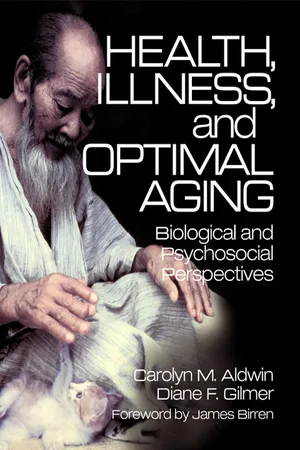
In Health, Illness, and Optimal Aging: Biological and Psychosocial Perspectives, Carolyn M. Aldwin and Diane F. Gilmer undertake the challenging task of assembling an objective and holistic picture of human aging. The authors provide comprehensive, multidisciplinary coverage of the physical aspects of aging, including age-related changes and disease-related processes, the demography of the aging population, theories of aging, and the promotion of optimal aging. In addition, the book covers the psychosocial aspects of aging, including mental health, stress and coping, spirituality, and care giving in later years.
Features of this book:
- Integrated. Discusses both the biological aspects and psychosocial factors of aging, thus providing integrated coverage of information from the fields of biology, psychology, and the social sciences. Discusses both the biological aspects and psychosocial factors of aging, thus providing integrated coverage of information from the fields of biology, psychology, and the social sciences.
- Comprehensive. Covers every part of the aging process including the physical effect on the different systems of the human body, quality of life, social support, and health promotion programs. Covers every part of the aging process including the physical effect on the different systems of the human body, quality of life, social support, and health promotion programs.
- Pedagogical. Examples in each chapter enhance students? understanding of real-life situations, and methodological issues help students become more critical consumers of research and data.Examples in each chapter enhance students? understanding of real-life situations, and methodological issues help students become more critical consumers of research and data. Discusses both the biological aspects and psychosocial factors of aging, thus providing integrated coverage of information from the fields of biology, psychology, and the social sciences. Covers every part of the aging process including the physical effect on the different systems of the human body, quality of life, social support, and health promotion programs. Examples in each chapter enhance students? understanding of real-life situations, and methodological issues help students become more critical consumers of research and data.
Discusses both the biological aspects and psychosocial factors of aging, thus providing integrated coverage of information from the fields of biology, psychology, and the social sciences. Covers every part of the aging process including the physical effect on the different systems of the human body, quality of life, social support, and health promotion programs. Examples in each chapter enhance students? understanding of real-life situations, and methodological issues help students become more critical consumers of research and data. - Comprehensive. Covers every part of the aging process including the physical effect on the different systems of the human body, quality of life, social support, and health promotion programs. Covers every part of the aging process including the physical effect on the different systems of the human body, quality of life, social support, and health promotion programs.
Health, Illness and Optimal Aging is recommended for researchers seeking an overview of health psychology and aging, as well as undergraduate and graduate students taking classes in the social, behavioral, and health sciences. This text is also valuable for practitioners working with the elderly in fields such as nursing, social work, occupational and physical therapy, day-care and nursing home administration, psychology, and rehabilitation.