Click ?Additional Materials? for downloadable samples
Although there is a plethora of studies on crime and punishment, law enforcement is a relatively new field of serious research. When courts, sentencing, prisons, jails, and other areas of the criminal justice system are studied, often the first point of entry into the system is through police and law enforcement agencies. Unfortunately, understanding of the important issues in law enforcement has little general literature to draw on. Currently available reference works on policing are narrowly focused and sorely out-of-date. To this end, a distinguished roster of authors, representing many years of knowledge and practice in the field, draw on the latest research and methods to delineate, describe, and analyze all areas of law enforcement.
This three-volume Encyclopedia of Law Enforcement provides a comprehensive, critical, and descriptive examination of all facets of law enforcement on the state and local, federal and national, and international stages. This work is a unique reference source that provides readers with informed discussions on the practice and theory of policing in an historical and contemporary framework. The volumes treat subjects that are particular to the area of state and local, federal and national, and international policing. Many of the themes and issues of policing cut across disciplinary borders, however, and several entries provide comparative information that places the subject in context.
Key Features
• Three volumes cover state and local, federal, and international law enforcement
• More than 250 contributors composed over 400 essays on all facets of law enforcement
• An editorial board made up of the leading scholars, researchers, and practitioners in the field of law enforcement
• Descriptions of United States Federal Agency law enforcement components
• Comprehensive and inclusive coverage, exploring concepts and social and legal patterns within the larger topical concern
• Global, multidisciplinary analysis
Key Themes
• Agencies, Associations, and Organizations
• Civilian/Private Involvement
• Communications
• Crime Statistics
• Culture/Media
• Drug Enforcement
• Federal Agencies/Organizations
• International
• Investigation, Techniques
• Types of Investigation
• Investigative Commissions
• Law and Justice
• Legislation/Legal Issues
• Military
• Minority Issues
• Personnel Issues
• Police Conduct
• Police Procedure
• Policing Strategies
• Safety and Security
• Specialized Law Enforcement Agencies
• Tactics
• Terrorism
• Victims/Witnesses
Editors
Marie Simonetti Rosen
Dorothy Moses Schulz
M. R. Haberfeld
John Jay College of Criminal Justice
Editorial Board
Geoffrey Alpert, University of South Carolina
Thomas Feltes, University of Applied Police Sciences, Spaichingen, Germany
Lorie A. Fridell, Police Executive Research Forum, Washington, DC
James J. Fyfe, John Jay College of Criminal Justice
David T. Johnson, University of Hawaii at Manoa
Peter K. Manning, Northeastern University
Stephen D. Mastrofski, George Mason University
Rob Mawby, University of Plymouth, U.K.
Mark Moore, Harvard University
Maurice Punch, London School of Economics, U.K.
Wesley G. Skogan, Northwestern University
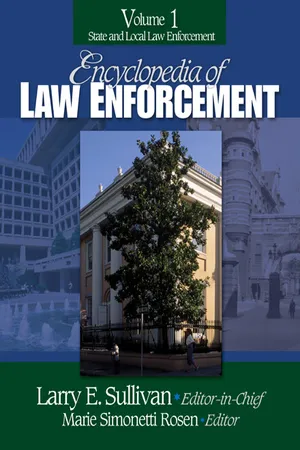
eBook - PDF
Encyclopedia of Law Enforcement
- 1,729 pages
- English
- PDF
- Available on iOS & Android
eBook - PDF
Encyclopedia of Law Enforcement
About this book
Information
Table of contents
- Cover
- Volume 1
- Contents
- List of Entries
- Reader’s Guide
- Introduction
- About the Editors
- A
- B
- C
- D
- E
- F
- G
- H
- I
- J
- K
- L
- M
- N
- O
- P
- Q
- R
- S
- T
- U
- V
- W
- Z
- Master Bibliography
- Appendix: Law Enforcement News - 15 Years in Review (1989–2003)
- Master Index
- Volume 2
- Contents
- List of Entries
- Reader’s Guide
- Introduction
- A
- B
- C
- D
- E
- F
- G
- H
- I
- J
- L
- M
- N
- O
- P
- R
- S
- T
- U
- V
- W
- Master Bibliography
- Appendix: Law Enforcement News - 15 Years in Review (1989–2003)
- Master Index
- VOLUME 3
- Contents
- List of Entries
- Reader’s Guide
- Introduction
- A
- B
- C
- D
- E
- F
- G
- H
- I
- J
- K
- L
- M
- N
- O
- P
- Q
- R
- S
- T
- U
- V
- W
- Y
- Z
- Master Bibliography
- Master Index
Trusted by 375,005 students
Access to over 1.5 million titles for a fair monthly price.
Study more efficiently using our study tools.
Frequently asked questions
Yes, you can cancel anytime from the Subscription tab in your account settings on the Perlego website. Your subscription will stay active until the end of your current billing period. Learn how to cancel your subscription
No, books cannot be downloaded as external files, such as PDFs, for use outside of Perlego. However, you can download books within the Perlego app for offline reading on mobile or tablet. Learn how to download books offline
Perlego offers two plans: Essential and Complete
- Essential is ideal for learners and professionals who enjoy exploring a wide range of subjects. Access the Essential Library with 800,000+ trusted titles and best-sellers across business, personal growth, and the humanities. Includes unlimited reading time and Standard Read Aloud voice.
- Complete: Perfect for advanced learners and researchers needing full, unrestricted access. Unlock 1.5M+ books across hundreds of subjects, including academic and specialized titles. The Complete Plan also includes advanced features like Premium Read Aloud and Research Assistant.
We are an online textbook subscription service, where you can get access to an entire online library for less than the price of a single book per month. With over 1.5 million books across 990+ topics, we’ve got you covered! Learn about our mission
Look out for the read-aloud symbol on your next book to see if you can listen to it. The read-aloud tool reads text aloud for you, highlighting the text as it is being read. You can pause it, speed it up and slow it down. Learn more about Read Aloud
Yes! You can use the Perlego app on both iOS and Android devices to read anytime, anywhere — even offline. Perfect for commutes or when you’re on the go.
Please note we cannot support devices running on iOS 13 and Android 7 or earlier. Learn more about using the app
Please note we cannot support devices running on iOS 13 and Android 7 or earlier. Learn more about using the app
Yes, you can access Encyclopedia of Law Enforcement by Larry E Sullivan,Marie Simonetti Rosen,Dorothy M Schulz,M. R. Haberfeld, Larry E. Sullivan, Marie Simonetti Rosen, Dorothy Moses Schulz, Maria (Maki) Haberfeld in PDF and/or ePUB format, as well as other popular books in Social Sciences & Criminology. We have over 1.5 million books available in our catalogue for you to explore.