![]()
chapter 1
WHAT, WHO, and HOW of YOUR SCHOOL COUNSELING PROGRAM
Scenario 1.1: Why Are Counselors in Schools?
Some parents were meeting, and one asked, “Why do we need counselors in schools?” Another followed with, “What is a counselor’s primary purpose in providing services in the school?” These were not new questions. Educators, counselors, parents, policymakers, and others had asked similar questions countless times before. If you were listening to this conversation, how would you, as a school counselor, respond? Why are you working in a school, and what is your purpose?
One possible response to Scenario 1.1 is that you work in a school to help people become “more able” in their respective roles. As a school counselor, you help students become more able learners; assist parents in their nurturing roles; support teachers in providing beneficial instruction for all students; and, with administrators, help lead schools in becoming a more effective part of the community. In sum, everything you do as a school counselor—every program you plan and every service you deliver—aims at helping students, parents, teachers, and schools in the process of human development and learning.
If you agree with this conclusion—that you are in a school to help people become more able—you might also agree that to accomplish this goal, you too need to become more able in your professional knowledge and skills. To become more able as a professional counselor, you want to move beyond survival toward a confident stance that permits you to become identifiable, capable, available, and accountable—four characteristics of a successful school counselor. Being identifiable means knowing who you are and what you do in schools as a professional counselor. It also means letting others know about this identity. Being capable means practicing at a high level of skill while recognizing the limits of your competencies and professional role in schools. When you are available, you are accessible to the students, parents, and teachers you serve. Accountability brings together the first three abilities when you assess how you spend your time and measure the effectiveness of the programs you plan and the services you provide. Throughout this Survival Guide you will learn ways to accomplish these goals in becoming a successful school counselor. To begin, Chapter One explores the role and identity of counselors in schools.
Scenario 1.2: Role Identity
You are an elementary or middle school counselor. A new principal has arrived at the school to start the year, and you have asked to schedule a conference to talk about the counseling program. At the start of your meeting with the new principal, she begins, “I had a good guidance counselor at my previous school, but was never quite sure how he spent most of his time. He was good at helping out in the main office when we were short on staff, and he was quite sociable with the faculty. It was my first position as a principal, however, and I was uncertain how to direct his time and duties. My goal at this school is to take more of a leadership role in all special services, including guidance.” How would you begin responding to the principal’s statements? What key points would you make about the school counseling program, your leadership role, an advisory committee, program evaluation, and consultation with the principal?
Scenario 1.2 depicts a situation that many school counselors experience during their careers—explaining their roles in their schools and in their comprehensive counseling programs. This chapter will help you both answer the questions in the above scenario and establish your leadership role and identity as a school counselor.
Since its birth during the Industrial Revolution at the turn of the twentieth century, the school counseling profession has searched for an identity and role among the helping professions. Today such questions as Why are counselors in schools? and What are they supposed to do? are as prominent as they were over one hundred years ago. As a member of this profession, you now face the same questions: Why are you here? What are you supposed to do?
As an elementary or middle school counselor, you belong to an expanding profession that includes many areas of professional helping and service. The counseling profession of the twenty-first century has become an important member of mental health services, and school counselors are essential partners in this effort (Falls & Muro, 2009; Schmidt, 2008). Today’s professional counselors work in settings that include mental health centers, family agencies, prisons, hospitals, funeral homes, crisis centers, employment agencies, colleges, and schools, to name a few.
In preparing to become a school counselor, you studied many areas of knowledge, including human development, psychology, career information and development, tests and measurement, and social and cultural foundations. In addition, you acquired skills in specific helping processes, such as individual and group counseling, consulting, and facilitative teaching. These skills and knowledge provide a framework within which you are able to establish and clarify your professional role and deliver specific services to students, parents, teachers, and others.
Unlike counseling programs in prisons, hospitals, and mental health centers that narrowly focus specific services for particular populations, your services span a broad program of activities to assist several populations. Your program includes preventive services, developmental activities, and remedial interventions for students, parents, teachers, administrators, and others. The challenge of offering such a wide range of responsive services to different populations renders you unique in your practice of elementary or middle school counseling. This notion of a program of services is a key element in school counseling, and your ability to define and describe your school’s counseling program to students, parents, teachers, administrators, and community stakeholders is vital to your survival and ultimate success.
DESCRIBING THE PROGRAM
Although the range and diversity of the expectations placed on you illustrate the need for counselors in our schools, they can also threaten your effectiveness by pulling you in too many directions and spreading services across too broad an area. Among the most important steps you take each year, therefore, will be describing and defining the school’s counseling program.
One element that influences how clearly you describe your program is the language you choose. Because school counseling is a relatively young profession, its practitioners sometimes struggle to articulate what it is and what it does. As a school counselor, you want to explain your program in language that is both consistent with your professional vision and understandable for students, parents, teachers, and others in the school community.
Choosing a Language
Over the profession’s life span, such terms as pupil personnel services, guidance program, and student services have categorized and classified school counseling services. You, like many practitioners, probably identify yourself according to labels and language you learned in your graduate studies or encountered in your school system. What do you call yourself? How do you describe what you do? Why?
My preference is to call myself a school counselor, and the services I provide are part of a school counseling program. I belong to a student services team, which consists of other helping professionals, including the school nurse, school social worker, and school psychologist. For me, these terms accurately label the program of services I provide in schools. They are also consistent with the language of our profession, as used by the American School Counselor Association (ASCA) and its journal, Professional School Counseling. They are contemporary and more definitive than such older terms as personnel services and guidance programs, which are vague and often encompass conflicting roles and services for school counselors. For example, personnel services frequently imply and include record keeping, class scheduling, attendance monitoring, testing coordination, and other functions that detract from direct responsive services for students, parents, teachers, and others. Similarly, the term guidance is confusing and does not clearly indicate what counselors do in schools. Yet the word guidance has historical significance and remains prevalent in the school counseling profession.
Everything in schools relates in some way to the notion of “guiding students.” Teachers guide students in daily instruction, as well as in their personal relationships with others—yet we do not call them “guidance teachers.” Administrators guide students in regard to school policy, curriculum, discipline, and programs, but we do not refer to them as “guidance principals.” Why then use the term “guidance counselor” instead of “school counselor”? Because guidance permeates every facet of the school, no single person or program has ownership of it.
In my view, a school counseling program encompasses a broad area of responsive services, including preventive services, developmental activities, and remedial assistance. The common ground for these three areas lies in counselors’ prominent role in providing direct services to students, parents, teachers, and others. Some counselors believe that the term school counseling program is too restrictive because it limits services to remedial relationships. However, a more encompassing view is that counseling relationships are for everyone, not only for people who have problems, and they provide ways to help healthy, functioning people capitalize on their strengths and reach higher levels of achievement. In recent school counseling literature, this has been called “strengths-based counseling.” For example, Galassi and Akos (2007) note that a strengths-based school counseling program allows counselors to design and deliver services that reach a larger percentage of students in their schools. It moves from a restricted emphasis on a few students’ problems and deficits to a commitment to help all students identify their strengths and take positive steps to capitalize on those abilities. In this guide you will find suggestions for how to use counseling processes in preventive services, for developmental learning, and to remedy existing concerns.
Here are some helpful guidelines for selecting a language and vocabulary that describe accurately your role and function in the school:
1. Understand the language. The terms you choose—counseling, guidance, personnel, strengths-based programs, or whatever—should have meaning to you. You should be clear about the words you use to describe yourself professionally and be able to defend the language you choose.
2. Educate the audience. Once you choose the language of your program, teach it to the people you serve. Let students, parents, teachers, administrators, and others know what you mean by counseling, group guidance, consulting, and other terms. A language is useful only if the people with whom you communicate understand it, accept it, and use it.
3. Use consistent language. It is confusing to students and others when you use terms inconsistently. Consistency may be difficult at first, particularly if you have decided to change to new terms. Stick with it, and correct yourself when you confuse the language. Your audience will be as consistent as you are.
If you replaced another counselor who once served the school, the decision about language requires careful consideration. For example, if the previous counselor used terminology different from yours, you may need to adjust your thinking for a while. This is particularly true if your predecessor was at the school for many years and is well thought of by students and faculty. You may feel strongly about the terms you want to use to describe who you are and what you do, and these beliefs may be a healthy sign of your professionalism. Nevertheless, move slowly and explain your rationale as you introduce new terms. By being considerate and winning students, parents, teachers, and administrators’ trust and confidence, you will be more likely to have your ideas and suggestions accepted.
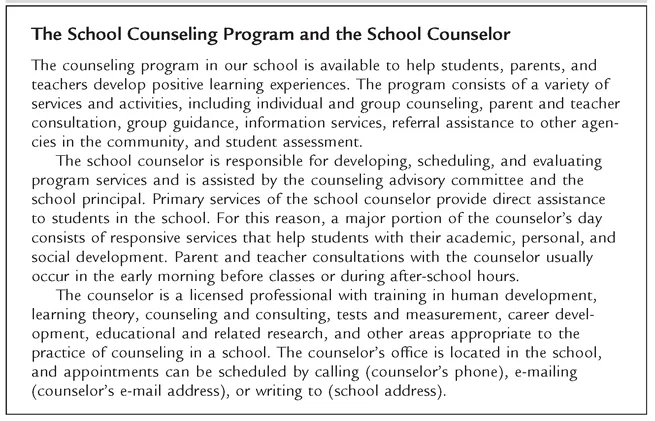
Exhibit 1.1 presents a sample description for a school counseling program and the role of a counselor. You might use this description as part of a school brochure, student handbook, or faculty manual.
EXHIBIT 1.1
Leading the Charge
Regardless of the language you choose or how long it takes your school to adopt it, an important aspect of describing a program of services is the leadership role you take in the process. Remember that your leadership ability is paramount in helping the school build a successful program.
To survive and flourish as an elementary or middle school counselor, it is essential to identify and embrace the leadership role you have in the program and the larger school community. School counseling in the twenty-first century is not simply providing individual and group services to students. Rather, it is the orchestration of many services, some provided by you, the counselor, and some provided by other professionals. This orchestration, much like leading a major symphony, requires leadership characteristics and skills to develop working relationships, identify goals and objectives, and create appropriate action to demonstrate that everyone is playing the same tune and in the correct key (Baker & Gerler, 2008).
A first step in developing your leadership role is to assess your strengths in taking on this responsibility. What skills and knowledge do you already possess that will enable you to persuade people to create a comprehensive program of services and commit their involvement in carrying out its objectives? Next is to determine what additional knowledge you need to be a successful leader in your school. How can you obtain this knowledge—through workshops, professional associations, or more graduate training? A third step to consider is how to begin developing support for your ideas as a school leader. What will you need to do to win the confidence of your administration? Which teachers, support staff, and other school personnel are likely to suppo...