eBook - ePub
About this book
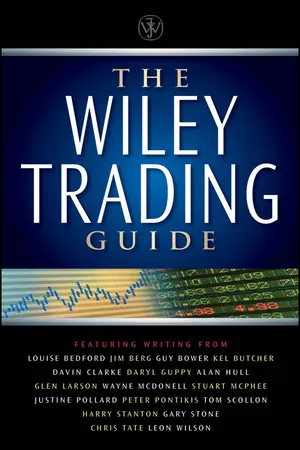
Australia's #1 business publisher is proud to publish The Wiley Trading Guide including writing from some of the best trading authors and professionals operating in Australia and the US. With new material from some of Wiley's best-selling trading authors including Louise Bedford, Daryl Guppy, Chris Tate, Stuart McPhee and more, this guide is the must-have book for traders looking to capitalise on the market recovery in 2010. Hot topics covered include Forex, futures, charting, CFDs, computerised trading, trading plans and trading psychology.
Trusted by 375,005 students
Access to over 1.5 million titles for a fair monthly price.
Study more efficiently using our study tools.
Chapter 1: Financial markets as complex adaptive systems
Using the right tactics at the right time
As most modern-day traders will attest, there is an overwhelming array of choices when it comes to the different trading techniques and tactics that one can employ when dealing with financial markets. In fact this ‘compilation’ book is testament to this recent trend with about 20 acknowledged experts all offering up their different strategies on how to take profits from the markets. And indeed I make my own contribution to this wide array of choices by offering Australian equity traders and investors three different investment newsletter services.
Some traders will search through this plethora of trading systems and philosophies trying to filter out what works as opposed to what doesn’t work. But alas, this approach will only lead to more frustration as you will inevitably discover that there is some validity to just about every technique ever invented. The reality is that success or failure of virtually all systems is largely dependent on the prevailing broad market conditions. And these conditions change over time, therefore the effectiveness of any trading system will fluctuate accordingly.
So what we really need to do is take a step back for a moment and try to get a handle on how the broad market behaves. Because if we can better understand how the broader market works then it logically follows that we should know which are the most suitable trading and investing tactics to apply at what time. Simple … well, not quite.
Now we’re striving to comprehend the real nature of financial markets, and this is the crux of this discussion. And while I’d like to say that it is a simple matter to understand the underlying nature of financial markets, unfortunately we are about to enter the world of chaos theory and complex adaptive systems. But fear not, as I will make every effort to maintain clarity when dealing with these somewhat esoteric topics. And so let’s start at the simplest point: the beginning.
Straight lines and curvy bits
The word linear essentially means straight line or straight line progression, and in order to simplify everything we see and observe mankind has a profound tendency to view the world from a linear perspective. The main reason we want everything to be linear, or to progress in a straight line, is so we can both easily understand it and predict what it is likely to do in the future.
In more recent times, thanks largely to the computational power of modern computers, we have also pretty much mastered the ability to get our heads around curvy things as well. Of course, this is largely on the proviso that they are either constantly curvy or consistently changing, such as the case of an exponential curve like the one pictured in figure 1.1.
We can even project lines and curvy things into the future with a reasonably high degree of accuracy and determine if, when and where they’re likely to intersect. Although there is one proviso: that there aren’t too many variables to consider.
Figure 1.1: exponential curve

But there’s another problem that even the scientific community doesn’t like to talk about and that’s the possibility of things changing but not doing so in a consistent way. In other words, the rate of change is not constant. It’s bad enough that something can be ‘dynamic’ rather than ‘static’ (thus rendering statistical analysis and the bell curve largely useless), but when the rate of change itself isn’t linear or at least constant then everyone starts to get really scared. This is known as non-periodic behaviour, as shown in figure 1.2.
Figure 1.2: non-periodic behaviour

Source: Does God Play Dice? The New Mathematics of Chaos, Ian Stewart, Blackwell UK, 1989, p. 141.
But let’s sidetrack for a moment and look at the idea of a system being dynamic as opposed to static. Take the average life expectancy of the Australian population, for example. If you wanted to know the average number of years we’re all expected to live then you would most likely use data available from the past 10 years or so:

But what about using recorded deaths from the last 100 years instead of just the past 10? Surely this larger sample of data will give us a more accurate and reliable answer:

Put simply, no … because over this expanse of time factors that impact our lifespan such as our diet and medical advances have changed significantly, making this sample period non-static and invalidating any averages taken. So let’s go to the other extreme now and just use some very recent data. This should definitely give us the most up-to-date and accurate answer possible:

But unfortunately we now have the problem of insufficient data to work with. Thus any sample of data that we subject to statistical analysis must be from a static system or a representative snapshot that allows for the dynamic nature of a system. Hence using the average lifespan of Australians over the past 10 years to reflect today’s average is in fact a snapshot approach and a compromise of sorts.
This is a pity because everyone held out so much hope that statistical analysis was a universal solution for problems of randomisation. So the stock market, like other irregular phenomena, gets labelled as being unpredictable and that’s that. Just like weather patterns and the human heart, the stock market has too many variables and is a dynamic system that’s not always linear by nature. Hence figure 1.3 shows how the Australian stock market index, the All Ords, is forever changing its behaviour.
Figure 1.3: the All Ords

Source: Created with TradeStation. © TradeStation Technologies, Inc. All rights reserved.
Thus if we can’t get our heads around it then it’s random or so close to random it doesn’t matter. Another neat way of dismissing things we can’t fully comprehend and/or predict is by calling it noise, interference or turbulence. Thus an engineer working in fluid dynamics will most likely attempt to eliminate turbulent flow rather than try to understand it.
Introducing chaos theory
So you can imagine ever...
Table of contents
- Cover
- Table of Contents
- Title Page
- About the Authors
- Preface
- Chapter 1: Financial markets as complex adaptive systems
- Chapter 2: Planning your trade to success
- Chapter 3: Lies my broker told me
- Chapter 4: Devising a trading strategy
- Chapter 5: The pursuit of profit
- Chapter 6: Getting the edge using intermarket technical analysis
- Chapter 7: ETF power trading strategies
- Chapter 8: Sustained profitable trading
- Chapter 9: Trading chicks are doing it for themselves!
- Chapter 10: With the click of a mouse
- Chapter 11: Combining analysis methods
- Chapter 12: The psychology of success
- Chapter 13: Mentality matters
- Chapter 14: Of motorbikes and trading types
- Chapter 15: Forex strategies and tactics
- Chapter 16: The risky business of forex
- Chapter 17: Stepping into futures
Frequently asked questions
Yes, you can cancel anytime from the Subscription tab in your account settings on the Perlego website. Your subscription will stay active until the end of your current billing period. Learn how to cancel your subscription
No, books cannot be downloaded as external files, such as PDFs, for use outside of Perlego. However, you can download books within the Perlego app for offline reading on mobile or tablet. Learn how to download books offline
Perlego offers two plans: Essential and Complete
- Essential is ideal for learners and professionals who enjoy exploring a wide range of subjects. Access the Essential Library with 800,000+ trusted titles and best-sellers across business, personal growth, and the humanities. Includes unlimited reading time and Standard Read Aloud voice.
- Complete: Perfect for advanced learners and researchers needing full, unrestricted access. Unlock 1.5M+ books across hundreds of subjects, including academic and specialized titles. The Complete Plan also includes advanced features like Premium Read Aloud and Research Assistant.
We are an online textbook subscription service, where you can get access to an entire online library for less than the price of a single book per month. With over 1.5 million books across 990+ topics, we’ve got you covered! Learn about our mission
Look out for the read-aloud symbol on your next book to see if you can listen to it. The read-aloud tool reads text aloud for you, highlighting the text as it is being read. You can pause it, speed it up and slow it down. Learn more about Read Aloud
Yes! You can use the Perlego app on both iOS and Android devices to read anytime, anywhere — even offline. Perfect for commutes or when you’re on the go.
Please note we cannot support devices running on iOS 13 and Android 7 or earlier. Learn more about using the app
Please note we cannot support devices running on iOS 13 and Android 7 or earlier. Learn more about using the app
Yes, you can access The Wiley Trading Guide by in PDF and/or ePUB format, as well as other popular books in Business & Finance. We have over 1.5 million books available in our catalogue for you to explore.