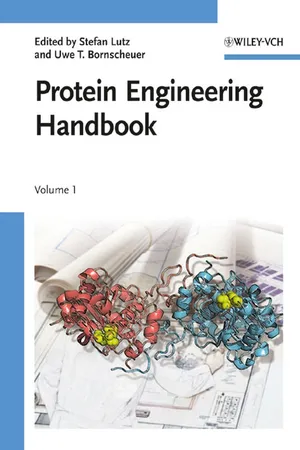
- English
- ePUB (mobile friendly)
- Available on iOS & Android
eBook - ePub
Protein Engineering Handbook
About this book
Unparalleled in size and scope, this new major reference integrates academic and industrial knowledge into a single resource, allowing for a unique overview of the entire field. Adopting a systematic and practice-oriented approach, and including a wide range of technical and methodological information, this highly accessible handbook is an invaluable 'toolbox' for any bioengineer. In two massive volumes, it covers the full spectrum of current concepts, methods and application areas.
Information
Table of contents
- Cover
- Title page
- Copyright page
- Preface
- List of contributors
- Chapter 1: Guidelines for the Functional Analysis of Engineered and Mutant Enzymes
- Chapter 2: Engineering Enantioselectivity in Enzyme-Catalyzed Reactions
- Chapter 3: Mechanism and Catalytic Promiscuity: Emerging Mechanistic Principles for Identification and Manipulation of Catalytically Promiscuous Enzymes
- Chapter 4: Φ-Value Analysis of Protein Folding Transition States
- Chapter 5: Protein Folding and Solubility: Pathways and High-Throughput Assays
- Chapter 6: Protein Dynamics and the Evolution of Novel Protein Function
- Chapter 7: Gaining Insight into Enzyme Function through Correlation with Protein Motions
- Chapter 8: Structural Frameworks Suitable for Engineering
- Chapter 9: Microbes and Enzymes: Recent Trends and New Directions to Expand Protein Space
- Chapter 10: Inteins in Protein Engineering
- Chapter 11: From Prospecting to Product–Industrial Metagenomics Is Coming of Age
- Chapter 12: Computational Protein Design
- Chapter 13: Assessing and Exploiting the Persistence of Substrate Ambiguity in Modern Protein Catalysts
- Chapter 14: Designing Programmable Protein Switches
- Chapter 15: The Cyclization of Peptides and Proteins with Inteins
- Chapter 16: A Method for Rapid Directed Evolution
- Chapter 17: Evolution of Enantioselective Bacillus subtilis Lipase
- Chapter 18: Circular Permutation of Proteins
- Chapter 19: Incorporating Synthetic Oligonucleotides via Gene Reassembly (ISOR): A Versatile Tool for Generating Targeted Libraries
- Chapter 20: Protein Engineering by Structure-Guided SCHEMA Recombination
- Chapter 21: Chimeragenesis in Protein Engineering
- Chapter 22: Protein Generation Using a Reconstituted System
- Chapter 23: Equipping in vivo Selection Systems with Tunable Stringency
- Chapter 24: Protein Engineering by Phage Display
- Chapter 25: Screening Methodologies for Glycosidic Bond Formation
- Chapter 26: Yeast Surface Display in Protein Engineering and Analysis
- Chapter 27: In Vitro Compartmentalization (IVC) and Other High-Throughput Screens of Enzyme Libraries
- Chapter 28: Colorimetric and Fluorescence-Based Screening
- Chapter 29: Confocal and Conventional Fluorescence-Based High Throughput Screening in Protein Engineering
- Chapter 30: Alteration of Substrate Specificity and Stereoselectivity of Lipases and Esterases
- Chapter 31: Altering Enzyme Substrate and Cofactor Specificity via Protein Engineering
- Chapter 32: Protein Engineering of Modular Polyketide Synthases
- Chapter 33: Cyanophycin Synthetases
- Chapter 34: Biosynthetic Pathway Engineering Strategies
- Chapter 35: Natural Polyester-Related Proteins: Structure, Function, Evolution and Engineering
- Chapter 36: Bioengineering of Sequence-Repetitive Polypeptides: Synthetic Routes to Protein-Based Materials of Novel Structure and Function
- Chapter 37: Silk Proteins – Biomaterials and Bioengineering
- Index
Trusted by 375,005 students
Access to over 1.5 million titles for a fair monthly price.
Study more efficiently using our study tools.
Frequently asked questions
Yes, you can cancel anytime from the Subscription tab in your account settings on the Perlego website. Your subscription will stay active until the end of your current billing period. Learn how to cancel your subscription
No, books cannot be downloaded as external files, such as PDFs, for use outside of Perlego. However, you can download books within the Perlego app for offline reading on mobile or tablet. Learn how to download books offline
Perlego offers two plans: Essential and Complete
- Essential is ideal for learners and professionals who enjoy exploring a wide range of subjects. Access the Essential Library with 800,000+ trusted titles and best-sellers across business, personal growth, and the humanities. Includes unlimited reading time and Standard Read Aloud voice.
- Complete: Perfect for advanced learners and researchers needing full, unrestricted access. Unlock 1.5M+ books across hundreds of subjects, including academic and specialized titles. The Complete Plan also includes advanced features like Premium Read Aloud and Research Assistant.
We are an online textbook subscription service, where you can get access to an entire online library for less than the price of a single book per month. With over 1.5 million books across 990+ topics, we’ve got you covered! Learn about our mission
Look out for the read-aloud symbol on your next book to see if you can listen to it. The read-aloud tool reads text aloud for you, highlighting the text as it is being read. You can pause it, speed it up and slow it down. Learn more about Read Aloud
Yes! You can use the Perlego app on both iOS and Android devices to read anytime, anywhere — even offline. Perfect for commutes or when you’re on the go.
Please note we cannot support devices running on iOS 13 and Android 7 or earlier. Learn more about using the app
Please note we cannot support devices running on iOS 13 and Android 7 or earlier. Learn more about using the app
Yes, you can access Protein Engineering Handbook by Stefan Lutz,Uwe Theo Bornscheuer in PDF and/or ePUB format, as well as other popular books in Biological Sciences & Molecular Biology. We have over 1.5 million books available in our catalogue for you to explore.