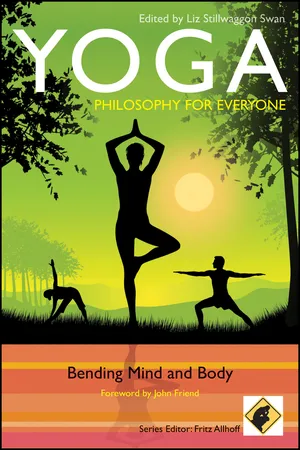
Yoga — Philosophy for Everyone presents a wide array of perspectives by people whose lives have been touched by yoga. Addressing myriad aspects of yoga's divergent paths, topics include body image for men and women; the religious and spiritual aspects of yoga; and issues relating to ethics, personal growth, and the teaching of yoga. Written by philosophers and non-philosophers alike, with contributions from professional yoga instructors, lifelong practitioners, and first-timers, Yoga — Philosophy for Everyone offers a wealth of material for both enjoyment and deep reflection.
eBook - ePub
Yoga - Philosophy for Everyone
Bending Mind and Body
- English
- ePUB (mobile friendly)
- Available on iOS & Android
eBook - ePub
Yoga - Philosophy for Everyone
Bending Mind and Body
About this book
Stimulates thoughts and expands awareness of the philosophical dimensions of yoga in its many forms and practices
Trusted by 375,005 students
Access to over 1.5 million titles for a fair monthly price.
Study more efficiently using our study tools.
Information
PART 1
COMING INTO THE SPACE: WHAT IS YOGA?
CHAPTER 1
HOW YOGA WON THE WEST
In the Beginning…
‘Will yoga make me thin and happy?’ Thus, my path of yoga began. I didn’t find yoga because I was interested in union with some divine ultimate reality. I wasn’t a philosophy or religious studies student searching for answers to the existential nature of my being. I didn’t stumble onto the path of yoga because I happened to be born into a family who practiced it. I didn’t even know I was looking for yoga. I was a depressed and overweight twenty-one-year-old searching for a way to get thin, because I believed that was the key to my happiness. At the time I worked in a flower shop and a woman there befriended me. She watched me struggle with myself and after a few weeks asked whether I had ever tried yoga. I answered no and asked her my most important question: would it make me thin and happy? Now, a decade later, every time I step on my mat, I offer gratitude to my first teacher, Ute, whose response to that question was: You never know what will unfold when you step on the mat.
What brought you to your mat for the first time? And, if you have yet to step on a mat, what kinds of curiosities lead you to pick up this book? Today, it seems like yoga is the solution to everything. We hear doctors telling us it’s good for our health; psychologists say it’s good for our emotional well-being; yoga teachers talk about union with something bigger than the human experience; gurus talk about alternative states of consciousness; and perhaps your friends have shared with you how yoga has changed their lives. Can a practice really do all of that? With all these different experiences of it, and prescriptions of why to use it, what is yoga anyway?
Throughout the history of humankind, we have attempted, in myriad ways, to answer three questions: Who am I? Where did I come from? How should I live my life? When I was searching for the key to my happiness, unconsciously I was in the throes of trying to answer these questions. Up until that point in my life, I had searched for the answers to those questions everywhere, except within myself. I was so used to looking to my parents for answers, or to academia, to the church, or to what my peers were doing, that I never stopped to think that, if I could learn to listen to that faint whisper inside myself, I would have my own answers to those questions.
Stepping on the Mat
When I stood on my mat for the first time, I experienced anger, frustration, sadness, curiosity, overwhelming peace, silence, and an inner critic with an incredibly loud voice. I know: a lot was happening! Despite the crowd of voices and experiences, what really happened on the mat was that for the first time I witnessed the entirety of what was happening inside of me. And because I could witness it, another part of me awoke – an aspect of myself that had incredible compassion, tolerance, and patience for the part of me that was hurting.
As I reached for my toes (intent on going further into the stretch than anyone else in the room) and my hamstrings sung out in defiance, for a brief moment I was able to make a connection between how hard I was pushing myself to ‘look the best’ in the pose and how hard I was pushing myself in life to live up to some idealized version of me. That awareness only lasted a moment, but it was enough to bring me back to my mat, again and again. I was hooked; I wanted to know why bending forward to touch my toes brought up such a large inner experience. And what was it about being aware of my body in this way that allowed me to witness my thoughts and feelings, instead of unconsciously and habitually reacting to them? What was it about the practice that brought forth that witnessing consciousness? Ute was right: There is no telling what will unfold when I am being present with myself, and being on the mat teaches me that.
It is this mystery of myself that has kept me going for the past decade. After that first class, I knew yoga was about much more than twisting my body into a pretzel. I had a sense it was about something much bigger even than losing weight. There was a resonance with something bigger than me, a sensation that felt oddly familiar. It was the sensation I once had of the Holy Spirit. It was the same sensation I felt after a long, exhausting climb to the top of a mountain. It was the same depth of silence I felt after a fresh snowfall. That sensation was there in the last gaze my grandma ever gave me. It has been called many names throughout the course of human history, and, whatever it is, I recognized that something about presence and reaching for my toes allowed me to experience it, within myself, again.
The Exploration of Yoga
As yoga becomes more and more mainstream in the West, there are more and more attempts to define and explain what this ancient practice is. To some people it is a hippie movement, to others a cult religion, and to still others a new fad in the exercise industry. There are numerous commentaries on the practice, a multitude of scholastic research papers and books, several scientific studies on its physical effects, and myriad individual stories about its personal effects. More often than not, the more visible something becomes, the more questions there are about it. Many of my new students ask questions like: ‘I’m not really flexible, can I still do yoga?’ ‘Will practicing yoga make my stress go away?’ and ‘Why can’t I breathe deeply?’
Western culture tends to like answers, looking for physical proof and experiencing trepidation about trusting the unknown. Further, Westerners tend to thrive on experience, sensations, and a depth of curiosity that drives us toward creative endeavors. It makes sense that the majority of Westerners want to know a bit about what they are going to do before they do it. And learning a bit about yoga philosophy before, or while, engaging with a practice is supportive of a fuller embodiment of the practice. The benefits of yoga are greatly enhanced when there is an understanding of the intention (and philosophy) behind it. I hope this essay will offer you some explanations of the ever-evolving nature of yoga, evoke further curiosity about what it is, and shed light on how this current form of yoga is both the same and different from its traditional roots.
It’s All a Matter of Perspective
Over thousands of years, as the practice of yoga has moved from culture to culture, the expression and perception of yoga have changed several times. There are undeniable core truths to the philosophy and practice of yoga, and as it moves between cultures and continents the practice is flexible enough to use the current language and cultural consciousness to adapt its image. Just as you might dress up for a wedding or down for pizza night while who you are remains intact, yoga may be dressed differently in each culture, or in each tradition, while its core remains the same. Modern definitions and attempts to explain the path of yoga are filtered through cultural and individual experience.
While this essay might offer you a general overview of how yoga became what it is today, keep in mind that the explanations I offer come through the filter of my own experience. While you might read all about yoga from others’ perspectives, stepping onto your mat will reveal your own mystery and give you a deeper meaning of yoga than I, or any other author, might be able to provide for you. As the great teacher K. Pattabhi Jois used to say, ‘Practice, practice, practice. Ninety-nine percent practice. One percent theory.’ My hope is that, as a result of reading this essay, a spark of curiosity will be lit and you will take it upon yourself to seek out your own experience of yoga.
The filter of experience through which you will be reading comes from a white, middle-class, fourth-generation-American female, who has spent only a decade of her life in self-study (svadhyaya), practice (tapas), and letting go to something bigger than her (ishvara pranidhanani ). Almost all of the teachers I have had the privilege of learning from learned from someone who learned from someone who trained with a teacher in India. My path of yoga is unique to me, and has provided me with opportunities to experience some of the depth of what yoga is ultimately translated as: union.
The Birth of Yoga
In its most literal translation, yoga means ‘to yoke’ or ‘to unite.’ A broad, encompassing definition refers to the joining together of one’s physical experience with universal energy. To gather a sense of what this means, let’s start at the beginning and explore the historical roots of yoga. Perhaps reading the story of the evolution of this practice will provide some insight into how our innate human urge to understand and unite with the unknown took shape in what became called the practice of yoga. Perhaps this way of telling the story will enable you to see the ever-evolving nature of yoga, and how its essence has stayed the same while its form has changed to meet the demands of each evolving time period.
The first sign of anything that resembled what we now think of as yoga was an emblem on a business-card-like impression called the Pashupati seal. Imagine the body of a man, sitting in padmasana (lotus position: legs crossed with ankles by hip creases), wearing a striped tunic, a mask, and a huge headdress in the shape of two large horns. The Pashupati seal was created in the Indus Valley in around 6500 BCE, a period known as the Pre-Vedic Age. The Pre-Vedic Age encompassed the time period before the written word (which meant that the only way to pass anything on was through symbols and oral recitation), before traditionally recognized religions such as Hinduism, and at a time in human history when we were connected (or united) with nature in a way that is now mostly foreign to us.
In part because there was not yet any written language, there were many great and layered meanings behind symbols such as the Pashupati seal. In lieu of written narratives, these symbols held rich stories within their images. Perhaps this was the beginning of the long history of using symbolism to describe experiences that seem to be indescribable. Using symbols allowed each person to pass on both the well-defined rituals of a yoga practice and the personal (story-like) experiences embedded within the teachings. One of the stories of this seal had to do with the image of Shiva, an aspect of divine consciousness, who sat in the woods to expound upon a path that would lead individuals to divine realization. This particular symbol of Shiva spoke of being in union with both his higher and lower natures and is the platform for many of the yogic rituals of meditation that seek to bring unity between the human and divine aspects of oneself.
What does ‘Divine’ Mean to You?
It feels prudent to take a moment to pause in this history to define what I mean when I say ‘divine.’ When I use the word ‘divine,’ I am speaking about a great mystery – about an ineffable experience humans are incapable of describing with words. Because divine experience is beyond description, the divine has been embodied into forms so that it is easier to speak about and relate to. As humans, we use form, whether that is words, symbols, or movements, to communicate with one another. Experiences that go beyond words necessitate form. The form, as a symbol of the ineffable experience, may then be used to speak about the ineffable experience. When I mention the divine throughout this essay I am referring to whatever symbol or form you might use to describe your experience of something that feels indescribable to you.
In human history, we have tried several different ways to speak about these kinds of experience. This is evidenced by the numerous religions and philosophies that all attempt to give form and name to the eternal essence that is the common thread through them all. This is what has happened with yoga. Its essence remains unchanged, while its form has evolved throughout history. Yoga’s essence adapts to fit the familiar symbols in each culture and time period.
A New Era Begins…
After the Pre-Vedic Age, the written word was developed. From this time period, known as the Vedic Age, several important evolutionary steps in yoga occurred. At this time, those adept at practicing and guiding others along the path of yoga were not the priests but the rishis and sages. They were people who lived in union (in yoga) in nature. They took a natural way of life and modeled a discipline after it that came to be known as yoga. Their teachings led to the first glimpses of how internal inquiry could guide an individual on the path of living in union with the divine. Their wisdom was written and became known as the Vedas.
The study of the Vedas is non-dual, meaning that the Vedas explain the inherent nature of the divine within physical experience. There is no separation (no dualistic relationship) between this reality and the divine. There are four main texts that make up the Vedas – the Rigveda, Yajurveda, Samaveda, and Atharyaveda. The Vedas were regarded as a form of sacred knowledge – thus rendering the actual Sanskrit words as sacred themselves. These texts spelled out the proper performance of sacrifices and rituals while also recording incantations meant to bring about union with the divine.
For thousands of years, humans had been living in union with nature, learning from it and communing with it. Humans who were sensitive to the ways of the Earth (e.g., the seasons, cycles, and patterns) and those who were able to spend time contemplating their existence within nature had cultivated great experiential wisdom from yoga. These abilities and practices had been passed down the generations through spoken word and symbols alone. Then, the advent of the written word made available the ability to write down these ancient secrets and practices. Thus the recorded history of yoga began.
The Vedic Age was also the beginning of what we now know in the yoga world as mantra. Mantra is the painstaking memorization and recitation of the exact tone and enunciation of the Vedic scriptures, and is used by a path of yoga we have come to know as Japa yoga. In this form the divine makes itself known through the devotion of precise recitation. Japa yoga is integral to the devotional form of yoga known as Bhakti yoga. Cultivated by reciting the Vedas, performing and attending ritual sacrifices, and through the devotional practice of Bhakti yoga, these now-familiar ideas of what yoga is associated with emerged in the Vedic time period: concentration, watchfulness, austerity, watching the breath (meditation), and devotion. Spiritual life flourished in the Vedic Age.
What Goes Up Must Come Down
The essence of evolution is being able to adapt to environmental change. As change is inherent in life, what adapts well will survive. Have you ever noticed that, after a while, when it feels like your ...
Table of contents
- Cover
- Editor’s Page
- Series Page
- Title page
- Copyright page
- Dedication
- FOREWORD
- EDITOR’S INTRODUCTION
- ACKNOWLEDGMENTS
- PART 1: COMING INTO THE SPACE: WHAT IS YOGA?
- PART 2: THE ASANAS: YOGA AND THE BODY
- PART 3: PRANA: YOGA’S VITAL ENERGY
- PART 4: YAMAS AND NIYAMAS: ETHICS AND YOGA
- NOTES ON CONTRIBUTORS
Frequently asked questions
Yes, you can cancel anytime from the Subscription tab in your account settings on the Perlego website. Your subscription will stay active until the end of your current billing period. Learn how to cancel your subscription
No, books cannot be downloaded as external files, such as PDFs, for use outside of Perlego. However, you can download books within the Perlego app for offline reading on mobile or tablet. Learn how to download books offline
Perlego offers two plans: Essential and Complete
- Essential is ideal for learners and professionals who enjoy exploring a wide range of subjects. Access the Essential Library with 800,000+ trusted titles and best-sellers across business, personal growth, and the humanities. Includes unlimited reading time and Standard Read Aloud voice.
- Complete: Perfect for advanced learners and researchers needing full, unrestricted access. Unlock 1.5M+ books across hundreds of subjects, including academic and specialized titles. The Complete Plan also includes advanced features like Premium Read Aloud and Research Assistant.
We are an online textbook subscription service, where you can get access to an entire online library for less than the price of a single book per month. With over 1.5 million books across 990+ topics, we’ve got you covered! Learn about our mission
Look out for the read-aloud symbol on your next book to see if you can listen to it. The read-aloud tool reads text aloud for you, highlighting the text as it is being read. You can pause it, speed it up and slow it down. Learn more about Read Aloud
Yes! You can use the Perlego app on both iOS and Android devices to read anytime, anywhere — even offline. Perfect for commutes or when you’re on the go.
Please note we cannot support devices running on iOS 13 and Android 7 or earlier. Learn more about using the app
Please note we cannot support devices running on iOS 13 and Android 7 or earlier. Learn more about using the app
Yes, you can access Yoga - Philosophy for Everyone by Fritz Allhoff, Liz Stillwaggon Swan, Fritz Allhoff,Liz Stillwaggon Swan, Fritz Allhoff in PDF and/or ePUB format, as well as other popular books in Philosophy & Philosophy History & Theory. We have over 1.5 million books available in our catalogue for you to explore.