- Places key authors and novels in their cultural and historical context
- Includes studies of major topics such as race, gender, melodrama, theatre, poetry, realism in fiction, and connections to other art forms
- Contributions from top international scholars approach an important literary genre from a range of perspectives
- Offers both a pre and post-history of the genre to situate it in the larger tradition of Victorian publishing and literature
- Incorporates coverage of traditional research and cutting-edge contemporary scholarship
- English
- ePUB (mobile friendly)
- Available on iOS & Android
eBook - ePub
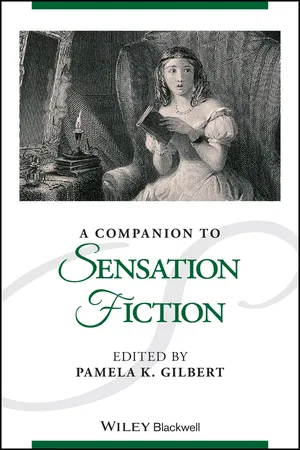
A Companion to Sensation Fiction
About this book
This comprehensive collection offers a complete introduction to one of the most popular literary forms of the Victorian period, its key authors and works, its major themes, and its lasting legacy.
Information
Part I: Before Sensation, 1830–1860
1
“The Aristocracy and Upholstery”: The Silver Fork Novel
One of the progenitors of the sensation novel was the “silver fork” or “fashionable” novel. These novels, perhaps the first bestsellers, portray in detail the social lives of aristocratic exclusives during the Regency. They reigned from the mid-1820s to the mid-1840s and survived through the 1850s. As late as 1887, Marianne Stanhope’s 1827 novel Almack’s was reprinted in a three-volume edition, which the Athenaeum thought worthwhile in order to take the sense of a wider audience on this chronicle of haut ton in the reign of George IV (review of Almack’s, 1887: 253). In 1890 “H.R.H.” authored Lothair’s Children, a novel which Graves derided for its devotion to “the aristocracy & upholstery” (Graves 1890: 433).
These late Victorian comments echo the responses made by reviewers of silver fork novels sixty years earlier. Those reviewers saw fashionable novels as realistic, but dismissed them as trivial and often attacked them as immoral. The novels also provoked parodies, notably by Thomas Carlyle, Charles Dickens, and William Makepeace Thackeray. After 1850, however, silver fork novels were largely ignored. It was not until 1936 that Matthew Rosa published the first book on them, The Silver-Fork School: Novels of Fashion Preceding Vanity Fair. Rosa does a thorough job of describing silver fork novelists and summarizing their works, but, as his subtitle suggests, he sees fashionable novels as an interesting popular phenomenon with little intrinsic value. For him their primary importance lies in leading to the apogee of the genre, Thackeray’s 1848 masterpiece, Vanity Fair. Kathleen Tillotson’s Novels of the Eighteen-Forties similarly suggests that silver fork novels are important only as they increase our understanding of those authors, such as Thackeray, who reacted against them (1954: 5).
It was almost fifty years later, in 1983, that the next significant work on these novels appeared: Alison Adburgham’s Silver Fork Society: Fashionable Life and Literature from 1814–1849. Like Rosa and Tillotson, Adburgham dismisses silver fork novels as essentially trivial. While she provides much useful information, she is primarily interested in using the novels as a source of historical information, a task for which their verisimilitude makes them well suited.
Recently, however, fashionable novels have received renewed attention and a critical re-evaluation. In 2005, Harriet Devine Jump edited Silverfork Novels, 1826–1841. Jump’s collection includes six novels: Granby by Thomas Henry Lister (1826); Romance and Reality by Letitia Elizabeth Landon (1831); Godolphin by Edward Bulwer, later Bulwer-Lytton (1833); The Victims of Society by Marguerite, Countess of Blessington (1837); Cheveley: A Man of Honour by Rosina Bulwer (1839); and Cecil, or the Adventures of a Coxcomb by Catherine Gore (1841). (In addition to authoritative texts, the collection provides a general introduction to the genre and an essay on each novel.) Silver fork novels were the subject of a special edition of Women’s Writing in 2009, edited by Tamara S. Wagner. These essays trace the novels’ reception by Victorian reviewers and elaborate on contemporary references such as Almack’s, the exclusive dance club run by Lady Patronesses. Most importantly they discuss the genre’s literary legacies, both individual novelists such as Charlotte Brontë, Dickens, Thackeray, and George Eliot, and later genres such as the Victorian domestic and sensation novels.
Besides Wagner, the most significant critics of silver fork fiction are Winifred Hughes, April Kendra, and Muireann O’Cinneide. These critics reject the notion that fashionable novels are inherently trivial or important only for providing historical information or leading to Vanity Fair. Rather, they examine the genre as important evidence in the transition from the Romantic to the Victorian novel. They interrogate the grounds for excluding fashionable novels from the literary canon, place them in the context of the shift from the novels of Jane Austen and Sir Walter Scott to those of Dickens, Thackeray, and Eliot, and examine their influence on subsequent fiction, especially the Victorian novel of domestic realism.
The descriptor “silver fork” was coined by William Hazlitt in his 1827 Examiner article, “The Dandy School.” In this attack on the genre, Hazlitt’s primary targets were Theodore Hook’s Sayings and Doings (1834) and Disraeli’s Vivian Grey (1826–7). Perhaps alluding to the Don Quixote proverb that “Every man is not born with a silver spoon in his mouth,” Hazlitt insists that the fashionable novelist is concerned only with “the admiration of the folly, caprice, insolence, and affectation of a certain class” and that “provided a few select persons eat fish with silver-forks, he considers it a circumstance of no consequence if a whole country starves” (Works, 11: 353, 355).
Hook’s Sayings and Doings, a three-volume collection of stories, was the first work of silver fork fiction. His tales of “the balls, the dinners, the hunts, the teas, the gossip, the electioneering, the opera, the theater, the clubs, the marriage settlements, the love marriages, the fashionable marriages, the gambling, and the dissipation” contained all the components of fashionable fiction and proved so popular that they were followed with two subsequent collections in 1825 and 1828 (Rosa 1964: 62). The first full-fledged fashionable novel was Robert Plumer Ward’s Tremaine, or the Man of Refinement (1825), an atypically moralistic tale which traces the search of a wealthy young man for an appropriate occupation.
Other early examples of fashionable fiction were Lord Normanby’s Matilda (1825), Lister’s Granby, and Disraeli’s Vivian Grey. Matilda traces the love story of Lady Matilda Delaval and Augustus Arlingford, later Lord Ormsby. Persuaded that Arlingford is unworthy, Matilda marries Sir James Dornton, only to re-encounter Ormsby, realize her mistake, and elope with him, eventually dying in childbirth. Granby is a courtship novel, in which Sir Thomas and Lady Jermyn consent to their daughter’s marriage to Harry Granby only when he rather than his cousin is proven to be the rightful heir to a title. Vivian Grey is a Bildungsroman which follows the adventures of a precocious young man who, searching for a vocation, settles on politics and becomes organizer in chief of the political faction headed by the Marquis of Carabas. After the scheme collapses, Vivian kills a political rival in a duel and escapes to Germany, where he drinks with Rhineland dukes and meets Beckendorf, prime minister of Reisenberg, whose success leads Vivian to reflect on his own failures.
Collectively these early examples illustrate the typical plots of the silver fork novel. Intellectual and self-educated young men, searching for an appropriate way to distinguish themselves, settle on politics. Beautiful and wealthy young women, searching for appropriate husbands, are pressured by family and friends into inappropriate matches. All of these tales are set against vivid descriptions of balls, dinner parties, teas, clothes, food, and shopping.
At the height of their popularity, silver forks dominated the circulating libraries. In 1838, the London Statistical Society tabulated the volumes held by ten of the humbler libraries. Of the 2,191 volumes available, 1,488 (68 percent) were fashionable novels. Forty-one were by “Theodore Hook, Lytton Bulwer, etc.,” 439 were “Fashionable Novels, well known,” and 1,008 were “novels of the lowest character, being chiefly imitation of Fashionable Novels, containing no good, although probably nothing decidedly bad” (Altick 1957: 217–18). While this list counts volumes and not titles, it still attests to the popularity of fashionable novels, as well as indicating the breadth of that popularity.
Despite these large numbers, only two handfuls of fashionable authors have survived. Rosa suggests that only eight of them deserve attention; Hook, Ward, Lister, Disraeli, Bulwer, Blessington, Lady Charlotte Bury, and Catherine Gore. Further, he allows only Disraeli, Bulwer, and Gore more than historical interest. Of these three, Disraeli and Bulwer wrote only two fashionable novels apiece, Vivian Grey and The Young Duke (1831), and Pelham (1828) and Godolphin (1833), respectively. After that, Disraeli moved to political and social problem novels, while Bulwer turned to historical and mystical ones.
Gore, on the other hand, wrote a substantial number of silver fork novels and was the only one of the three who continued writing them into the 1840s. Among Gore’s best novels are The Hamiltons (1834), the story of a heartless dandy who marries a young girl and is then unfaithful; Mrs. Armytage, or Female Domination (1836), which tells of a wealthy mother who attempts to rule her son’s life; Cecil, Or the Adventures of a Coxcomb (1841), the memoir of an aging roué; and The Banker’s Wife, Or Court and City (1843), which traces the life of an ambitious and dishonest banker.
Of Rosa’s eight authors, Jump’s six-novel collection keeps Lister, Bulwer, Blessington, and Gore, and adds Landon and Rosina Bulwer. Lost are such authors as Charles White, who wrote Almack’s Revisited (1828) and The Adventures of a King’s Page (1829); Samuel Beazley, who wrote The Roué (1828) and The Oxonians: A Glance at Society (1830); Robert Pierce Gillies, who wrote Basil Barrington and his Friends (1830); and Caroline and Henrietta Beauclerk, who together wrote Tales of Fashion and Reality (1836). Even more completely lost are the many anonymous authors whose identities have not been unmasked.
It must be noted that the majority of fashionable novels were published anonymously, or at most as by “the author of” a previous novel. This enabled publishers to exploit the possibility that the authors were actually aristocrats, and readers to presume that the material in the novels was the expression of inside knowledge, which was a major attraction to readers of fashionable novels. It was assumed that the novels were romans-à-clef, a belief reinforced by the publication of “keys” to the more popular of them, such as Vivian Grey (1826), The Exclusives (1829), and Blessington’s The Repealers (1833).
While some of the fashionable novelists such as Lady Charlotte Bury, the daughter of the Duke of Argyll, and Constantine Phipps, the first Marquess of Normanby, were actual aristocrats, many others were, at best, on the edge of aristocratic society. Marguerite, the Countess of Blessington, for example, began life as Margaret Power, the daughter of a newspaper publisher. She married the abusive Captain Maurice St. Leger Farmer and was rescued from him by Captain Thomas Jenkins, with whom she lived for about six years. She then attracted the attention of the Earl of Blessington, with whom she lived until the death of her husband in 1817 enabled them to marry (Rosa 1964: 159–61).
Despite this questionable and scandalous biography, Blessington’s title was enough to assure her insider authority. The value of such authority is indicated by the differing amounts paid by publishers depending on an author’s title. In 1836, for example, Lady Blessington was paid £800 for a novel and Mrs. Gore only £120 (O’Cinneide 2008: 53). This was so even though most of Blessington’s novels “would never have been published if she had been untitled and obscure” (Rosa 1964: 159).
The dubious qualifications of fashionable authors were often recognized by reviewers, and piercing their anonymity became a game for them, though their identifications were often inaccurate. As a reviewer of Matilda indicates:
It has been much the fashion, of late years, to ascribe anonymous novels to persons moving in the higher ranks of life. Thus Tremaine has been imputed to several noblemen, without being as yet owned by any body; thus, too, Matilda has already glittered under four or five distinguished names …
(review of Matilda, 1825: 435)
Besides identifying anonymous authors, reviewers also delighted in suggesting that the authors of silver fork fiction were not aristocrats but rather their footmen or maids. The Athenaeum suggested that some of the novels
were produced by the fashionables themselves, and some by the footmen of those fashionables; some by literary young gentlemen, who occupy fourth stories, in retired situations, and whose knowledge of the great world is acquired through the medium of Sunday promenades in Hyde Park, and a rare visit to the Opera, when their finances permit the sacrifice of half a guinea.
(review of The Exclusives [1829]: 782)
The following year the Athenaeum went even further. Andrew Picken proclaimed that since “every lady or gentleman, no matter how incapable, who was known, or was supposed to be known, in the fashionable world” was encouraged to write, it was clearly no longer the work but the author who mattered. And of these fashionable authors, he asserted, nine-tenths were frauds: “demireps and black-legs, broken-down gamblers, roués, and half-pay dragoon officers, with a sprinkling of imbecile honourables and romantic spinsters,” all “as cheap as Irish labourers” (Picken 1830: 626).
Nonetheless, the presumption of aristocratic authorship and therefore authority was widespread. For example, when the author of Vivian Grey was discovered to be Benjamin Disraeli, not only “an obscure person for whom nobody cares a straw” but also “a mere Jew boy,” there was a critical outcry which so upset Disraeli that he worked unsuccessfully for years to suppress the book (Rosa 1964: 101–2).
The content of silver fork novels was generally dismissed as stereotypical and predictable. Like other popular genres such as Newgate and historical novels...
Table of contents
- Cover
- Blackwell Companions to Literature and Culture
- Title page
- Copyright page
- Notes on Contributors
- Introduction
- Part I: Before Sensation, 1830–1860
- Part II: Reading Individual Authors and Texts, 1860–1880
- Part III: Topics in Scholarship
- Part IV: After Sensation: Legacies
- Index
Trusted by 375,005 students
Access to over 1.5 million titles for a fair monthly price.
Study more efficiently using our study tools.
Frequently asked questions
Yes, you can cancel anytime from the Subscription tab in your account settings on the Perlego website. Your subscription will stay active until the end of your current billing period. Learn how to cancel your subscription
No, books cannot be downloaded as external files, such as PDFs, for use outside of Perlego. However, you can download books within the Perlego app for offline reading on mobile or tablet. Learn how to download books offline
Perlego offers two plans: Essential and Complete
- Essential is ideal for learners and professionals who enjoy exploring a wide range of subjects. Access the Essential Library with 800,000+ trusted titles and best-sellers across business, personal growth, and the humanities. Includes unlimited reading time and Standard Read Aloud voice.
- Complete: Perfect for advanced learners and researchers needing full, unrestricted access. Unlock 1.5M+ books across hundreds of subjects, including academic and specialized titles. The Complete Plan also includes advanced features like Premium Read Aloud and Research Assistant.
We are an online textbook subscription service, where you can get access to an entire online library for less than the price of a single book per month. With over 1.5 million books across 990+ topics, we’ve got you covered! Learn about our mission
Look out for the read-aloud symbol on your next book to see if you can listen to it. The read-aloud tool reads text aloud for you, highlighting the text as it is being read. You can pause it, speed it up and slow it down. Learn more about Read Aloud
Yes! You can use the Perlego app on both iOS and Android devices to read anytime, anywhere — even offline. Perfect for commutes or when you’re on the go.
Please note we cannot support devices running on iOS 13 and Android 7 or earlier. Learn more about using the app
Please note we cannot support devices running on iOS 13 and Android 7 or earlier. Learn more about using the app
Yes, you can access A Companion to Sensation Fiction by Pamela K. Gilbert in PDF and/or ePUB format, as well as other popular books in Literatura & Crítica literaria inglesa. We have over 1.5 million books available in our catalogue for you to explore.