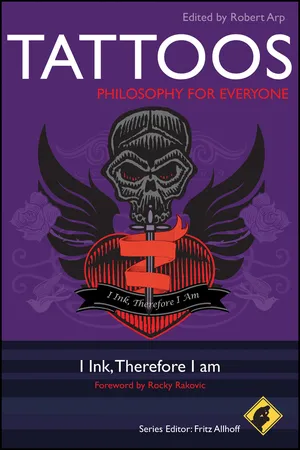
- Contains chapters written by philosophers (most all with tattoos themselves), tattoo artists, and tattoo enthusiasts that touch upon many areas in Western and Eastern philosophy
- Enlightens people to the nature of tattoos and the tattooing arts, leading readers to think deeply about tattoos in new ways
- Offers thoughtful and humorous insights that make philosophical ideas accessible to the non-philosopher
- English
- ePUB (mobile friendly)
- Available on iOS & Android
eBook - ePub
About this book
Covering philosophical issues ranging from tattooed religious symbols to a feminist aesthetics of tattoo, Tattoos and Philosophy offers an enthusiastic analysis of inking that will lead readers to consider the nature of the tattooing arts in a new and profound way.
Information
SHEET VIII
EASTERN AND RELIGIOUS PERSPECTIVES
‘The Buddhist practitioner can learn to embrace the pain of the experience of getting tattooed, the healing process and the rest, first as a kind of meditative practice. The pain itself can become the object of meditation as one simply pays attention to the sensations without trying to push them away.’
( Joseph J. Lynch, p. 240)
CHAPTER 17
IS A TATTOO A SIGN OF IMPIETY?

Dispelling a Confusion
In many ways my wedding was a meeting of two worlds: my family and friends come from European backgrounds, while my wife’s family and friends come from Asian – largely Korean – ones. My side of the family has, for the most part, a Christian worldview, while my wife’s, despite some of its members being Christian, live within a Confucian ethos. Yet, in spite of these differences, nearly all at my wedding shared one thing in common: discomfort with my best man’s heavily tattooed arms. Of course, this ‘one thing in common’ actually springs from sharing two things in common: piety (a form of justice emphasizing respect for one’s superiors) and ignorance in respect to what piety looks like in particular circumstances.
That is, both the Judeo-Christian and Confucian traditions insist that it’s just or pious that both God and one’s parents/ancestors be deeply respected, the reasoning being that, since justice means treating each as they ought to be treated, and since God and one’s parents occupy elevated positions, justice demands they be treated piously. None of this I have a problem with. The trouble, however, is that in both the Bible and the Hsiao King there are statements linking tattoos, or, rather, choosing to get a tattoo, with impiety – the body of the inferior belonging, in a sense, to the superior: be it one’s Heavenly Father (the Bible) or one’s earthly father (the Hsiao King). Because neither the non-contextualized Bible verses condemning tattoos nor Confucian philosophical reasoning in respect to tattoos are properly understood, the result is a Christian Confucian confusion over the ethics of tattooing. My goal in this chapter is to dispel this confusion.
‘You Shall Not Make … Any Marks Upon Yourselves: I Am YHVH’
Jews and Christians alike accept that the Torah, or the books of ‘Moses’ in the Old Testament, is a part of scripture or instances of what theologians call ‘special revelation.’ What this means exactly is far from clear; however, what is agreed is that these books and their content – taken either in minute detail or in a more general sense (depending on who you talk to) – have been sanctioned or approved by God. Jews and Christians often claim to be rationally justified in believing the Torah (and, for Christians, the Bible) primarily, though not exclusively, on the basis of faith. In order for faith to be rationally justified, Jews and Christians maintain two things. First, that the existence of God – in one shade or another, either as the Creator, the Good, Heaven, Truth, Love, or a combination of these and others – can be known by all, such that all who want to know God can know Him. Second, those who want to know God are open to hearing His voice, and so when they read the Torah or Bible they can hear God testifying to them, saying, in effect, ‘these are my words.’ The testimony of God (a person who exists) to the reader (another person who exists) is a form of knowledge by acquaintance – what the French call connaître – and this knowledge is what Jews and Christians mostly mean when they talk about ‘faith.’ Thus, when Jews and Christians read Leviticus 19:28 – ‘You shall not make any cuttings in your flesh on account of the dead or tattoo any marks upon yourselves: I am YHVH’ – Jews and Christians claim to have gained knowledge: specially revealed knowledge, about an ethical command. 1 Consequently, on pain of both ignorance and impiety (i.e., ignoring the commands of a superior), neither Jews nor Christians are safe to ignore this passage about tattooing. However, few things in ancient writings, scripture included, are clear to modern readers and so the context needs to be unpacked.
Prior to the writing of Leviticus, Israel had been chosen by God to be a nation ‘set apart.’ It wasn’t that only Israel could know of God’s existence, nor that only Israelites could be reconciled with God after man’s fall from grace (which will be discussed later); rather, Israel, as a ‘pure’ nation, was to be a sign to all nations of the perfect Holiness, Righteousness, or Justice that is God. Indeed, some non-Israelites were more pious and better than some Israelites: Abraham, the grandfather of Isaac (later named Israel), paid tribute to Melchizadek, the priest-king of a Canaanite city-state, and even Jesus is identified with this non-Israelite priest. Thus, the point of Israel being set apart was for it, as a nation, to reflect perfect doctrinal – and, from this, moral – purity.
Further, because the nations surrounding ancient Israel practiced either self-laceration (as a means to remember the dead, such as in Canaan) or tattooing (as in Egyptian fertility cults) as part of their impure religious teachings, Israel was forbidden to practice these. Indeed, because in nearby Mesopotamia being tattooed was also associated with being owned by a cult (Mesopotamian temple slaves were tattooed), there was a strong sense that Israel, as belonging to YHVH, ought not to be ‘owned’ by a lesser god and thus be associated with these unjust practices (unjust, of course, because to honor a lesser god over the greatest God is not to treat each as it ought to be treated). Israel, as a doctrinally pure nation, was to be the metaphorical bride-wife of YHVH, who is pure Righteousness or Righteousness itself.
Two things follow from this. First, nothing in Leviticus implies that tattooing in and of itself is immoral or unjust. Second, what is equally as clear is that, insofar as impure belief systems make tattooing a part of their practice, Israel is forbidden to engage in such practices: distinctions, it seems, need to be both visible and invisible. It is for this reason that Orthodox Jews, even to this day, see those who choose 2 to get tattoos as immoral or impious and hence usually forbid them, upon death, burial in a Jewish cemetery. For Christians, the case is a bit different. Because Israel was to be a sign of purity to all nations, the spirit, not the letter, of the law in Leviticus is what really matters: in other words, it’s not obvious from the passages in the Old Testament that a person would necessarily be impious for choosing to get a tattoo. Nevertheless, there are still some passages in the New Testament that cause some Christians confusion over tattoos.
‘You Are Not Your Own … Therefore Honor God with Your Body’
The majority of Christians throughout history have erroneously understood the prohibition against tattooing in Leviticus as being true to the letter for all time. Their mistaken understanding of this verse is reiforced by further misunderstanding another verse, this time in 1 Corinthians 6:19–20 of the New Testament, which reads: ‘Do you not know that your body is a temple of the Holy Spirit, who is in you, whom you have received from God? You are not your own; you were bought at a price. Therefore honor God with your body.’ Of course, there is nothing in this passage that explicitly forbids tattoos and thus would link them with impiety. In fact, if a person reads this passage properly – that is, from within its proper context – it is clear that God, via St. Paul, is talking about what happens when a man engages in sexual relations with a temple prostitute of an impure religion. Ink on one’s skin is a red herring; the point, as in the Old Testament, is to preserve sanctity, and the argument for this is as follows.
God created the first man, Adam, and gave him authority over the entire planet. Adam was created in a just state, but, because he was given the faculty of free will, he was able to choose between justice and injustice: treating the greatest thing (God) as the greatest thing, or treating a lesser thing (such as Eve) as the greatest thing (God). Adam chose the latter and hence ‘fell.’ Because anyone who chooses to act unjustly even once can’t enter into the presence of the burning purity that is perfect Justice or Righteousness (God), all who act unjustly even once are consigned, as the most ancient Hebrews, 3 Mesopotamians, 4 Greeks, 5 and even Japanese 6 knew, to the underworld or the land where the spirits of the dead dwell. Yet even if man can’t save himself, insofar as God became man and dwelt among us as the Christ, He can do two things. First, he can represent all people since He has greater authority than even Adam: insofar as Adam, our first father, could pass on the curse of original sin (the disposition to prefer injustice to justice), the Christ, as the ‘Second Adam,’ can take all under His authority and pass on forgiveness of injustice by virtue of his authority. Yet, second, even this wouldn’t be possible if the Christ weren’t perfectly just or righteous; only because He is without injustice is He able to enter the presence of the Father so-to-speak and be in harmony with Him. And, insofar as people speak justly, confessing both that they can’t save themselves (they can’t remove all the stains of their injustice) and that the Christ can, these people, by the graciousness and authority of the Christ, can be accredited as just or righteous and hence be reconciled with the Father, who is perfect Joy. Thus, when 1 Corinthians says ‘You are not your own,’ it refers to those who have freely acknowledged the authority of God over all of what they are, including their bodies. Taking care of one’s body as God has ordained bodies to be taken care of – here in respect to sexual matters (‘The body is not meant for sexual immorality’ 7 ) – is an act of justice, and, because God is one’s superior, it is also an act of piety. Nonetheless, there is nothing at all here that says getting a tattoo is a form of misusing one’s body and hence acting impiously.
‘We Must Not Injure Our Bodies: This Is the Beginning of Filial Piety’
Confucius lived around five hundred years before the birth of the Christ. As a self-confessed ‘lover of the ancients,’ he sought to align his teachings with the most ancient Chinese sages and to make their vague instructions more deliberate (hence, Confucianism is often called ‘the deliberate tradition’). The teachings of these sages can be traced back to the beginning of Chinese civilization, around 2700 BCE, roughly a hundred years after the ziggurat of Eridu in Mesopotamia (a.k.a. the Tower of Babel) was abandoned. At this time, the first Chinese emperor, Huang Di, built a temple to the One Supreme God, known to the Han Chinese as Shang Di (later also called Tian or Heaven 8 ). There never was, nor is to this day, 9 an image made to represent Shang Di since He is beyond all representation. This was the beginning of Chinese religious practice and the subject with which the sages of the ancient world were most concerned. 10 Thus, when Confucius complied the Classic of History, which describes the oldest accounts of the Middle Kingdom, he is careful to note not only that Shang Di is the Supreme Lord on High but also that ‘It is virtue that moves Heaven’ 11 and that ‘His will extends everywhere;’ 12 we are told,
But Shang Di sent down calamities on the Xia Dynasty. The ruler of Xia had increased his opulence. He would not speak kindly to the people, and became utterly immoral and foolish. He was unable for a single day to bring himself to follow the path marked out by Shang Di. 13
Mencius, the second greatest Confucian after the Teacher himself, thus perfectly agrees with the ancients when he writes that ‘It is by the preservation of one’s heart and the nourishment of one’s character that man is able to serve Heaven.’ 14 Shang Di or Heaven – God, we can say – was the source of true morality and justice, and the goal for the ancients, as for the earliest Confucians, was to look to Heaven to discern how to act on earth. Piety, then, was ‘the root of all virtue.’ 15
Of course, Confucians, just as much as Jews and Christians (and many others), saw the scope of created reality not merely as an ontological hierarchy between God and man but also as a hierarchy taking into account differences of age, gender, ability, character, rank, and so on. On the top was Shang Di and below him were those belonging to the created heavens (lower-case ‘h’) – the shen or nature spirits and the zu xian or the spirits of the blessed ancestors 16 – and below these were those belonging to earth. First and foremo...
Table of contents
- Cover
- Series Editor
- Series page
- Title page
- Copyright page
- Dedication page
- I INK, THEREFORE I FOREWORD
- I AM, THEREFORE I INK
- ACKNOWLEDGMENTS
- SHEET I: THE HISTORY AND NATURE OF TATTOOS
- SHEET II: TATTOOS AND ART
- SHEET III: THE TATTOOED WOMAN
- SHEET IV: PERSONAL IDENTITY
- SHEET V: EXPRESSIONS OF FREEDOM
- SHEET VI: EXPERIENCES AND STORIES SURROUNDING TATTOOS
- SHEET VII: ETHICAL CONCERNS
- SHEET VIII: EASTERN AND RELIGIOUS PERSPECTIVES
- NOTES ON CONTRIBUTORS
Trusted by 375,005 students
Access to over 1.5 million titles for a fair monthly price.
Study more efficiently using our study tools.
Frequently asked questions
Yes, you can cancel anytime from the Subscription tab in your account settings on the Perlego website. Your subscription will stay active until the end of your current billing period. Learn how to cancel your subscription
No, books cannot be downloaded as external files, such as PDFs, for use outside of Perlego. However, you can download books within the Perlego app for offline reading on mobile or tablet. Learn how to download books offline
Perlego offers two plans: Essential and Complete
- Essential is ideal for learners and professionals who enjoy exploring a wide range of subjects. Access the Essential Library with 800,000+ trusted titles and best-sellers across business, personal growth, and the humanities. Includes unlimited reading time and Standard Read Aloud voice.
- Complete: Perfect for advanced learners and researchers needing full, unrestricted access. Unlock 1.5M+ books across hundreds of subjects, including academic and specialized titles. The Complete Plan also includes advanced features like Premium Read Aloud and Research Assistant.
We are an online textbook subscription service, where you can get access to an entire online library for less than the price of a single book per month. With over 1.5 million books across 990+ topics, we’ve got you covered! Learn about our mission
Look out for the read-aloud symbol on your next book to see if you can listen to it. The read-aloud tool reads text aloud for you, highlighting the text as it is being read. You can pause it, speed it up and slow it down. Learn more about Read Aloud
Yes! You can use the Perlego app on both iOS and Android devices to read anytime, anywhere — even offline. Perfect for commutes or when you’re on the go.
Please note we cannot support devices running on iOS 13 and Android 7 or earlier. Learn more about using the app
Please note we cannot support devices running on iOS 13 and Android 7 or earlier. Learn more about using the app
Yes, you can access Tattoos - Philosophy for Everyone by Robert Arp in PDF and/or ePUB format, as well as other popular books in Philosophy & Philosophy History & Theory. We have over 1.5 million books available in our catalogue for you to explore.