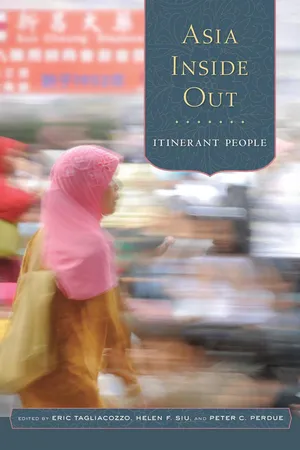
A pioneering study of historical developments that have shaped Asia concludes with this volume tracing the impact of ideas and cultures of people on the move across the continent, whether willingly or not.
In the final volume of Asia Inside Out, a stellar interdisciplinary team of scholars considers the migration of people—and the ideas, practices, and things they brought with them—to show the ways in which itinerant groups have transformed their culture and surroundings. Going beyond time and place, which animated the first two books, this third one looks at human beings on the move.
Human movement from place to place across time reinforces older connections while forging new ones. Erik Harms turns to Vietnam to show that the notion of a homeland as a marked geographic space can remain important even if that space is not fixed in people's lived experience. Angela Leung traces how much of East Asia was brought into a single medical sphere by traveling practitioners. Seema Alavi shows that the British preoccupation with the 1857 Indian Revolt allowed traders to turn the Omani capital into a thriving arms emporium. James Pickett exposes the darker side of mobility in a netherworld of refugees, political prisoners, and hostages circulating from the southern Russian Empire to the Indian subcontinent. Other authors trace the impact of movement on religious art, ethnic foods, and sports spectacles.
By stepping outside familiar categories and standard narratives, this remarkable series challenges us to rethink our conception of Asia in complex and nuanced ways.
eBook - ePub
Asia Inside Out
Itinerant People
- 326 pages
- English
- ePUB (mobile friendly)
- Available on iOS & Android
eBook - ePub
Asia Inside Out
Itinerant People
About this book
Information
1
Mobility’s Spatial Fix
Finding the Vietnamese “Homeland” from the Outside In
ERIK HARMS
The May / June 2002 issue of Heritage, the Vietnam Airlines in-flight magazine, treated travelers to a beautifully illustrated bilingual feature article about the Vietnamese tradition of keeping detailed genealogical records. The article was titled “Gia Phả” in Vietnamese and “Family Records” in English. While the English translation of the main title is quite accurate, other aspects of the two versions convey markedly different tones. For example, the English subtitle, “We Are Family,” flippantly plays on the name of a popular American R&B hit from the 1970s that was enjoying a second life in millennial Vietnam’s karaoke houses—overall, the English-language article amounts to little more than a feel-good story about family heritage. The Vietnamese subtitle, by contrast, is much more serious, sending a moralizing message to readers about the importance of filial piety. “Uống nước nhớ nguồn,” it reads, evoking a folk phrase popular not only in Vietnam but in China as well: “When you drink the water, remember the source” (Vietnam Airlines 2002).1
The article illustrates how the Vietnamese concept of the homeland is commonly described as spatially fixed, despite the empirical fact that Vietnamese people are constantly on the move. As the rest of this chapter will show, a similarly dynamic relationship between fixity and motion is evident within Vietnamese kinship relations, which in turn inform historical movements of Vietnamese throughout Asia, around the world, and in more recent mobility practices as well. In this particular case, the article described the importance of patrilines in the Vietnamese tradition of kinship and explained how interest in preserving genealogies was revitalized alongside economic growth in millennial Vietnam. To show this, it documented the sentimental stories of several elderly men who had gone back to their ancestral villages in search of their families’ genealogical record books. It ended with a poem written by one of those men, which the article’s author, the anthropologist Nguyễn Xuân Kính, described as “rustic, and not written according to poetic conventions”; nevertheless, the author insisted, the poem was “able to awaken among the younger generations a sense of remembering the source.” Part of the poem went like this:
Bùi, Lê, Ngô, Nguyễn vẫn một dòng | Bùi, Lê, Ngô, Nguyễn, the same line |
Vấn tổ tìm tông ghi chép lại | Seek to write ancestral names |
Nhắc cháu con nhớ mãi trong lòng | Help the young keep them in mind |
Cây vững gốc mới mong tồn tại | Trees with stable roots remain |
Người nhớ nguồn người sẽ thành công! | Remember the source and shine.2 |
In order to grasp the way it is possible for fixity and motion to produce each other, it is useful to imagine the context in which a modern and highly mobile Vietnamese person boarding this airplane would have read this magazine article about family genealogies. It appeared in the second year of the new millennium, twenty-seven years after the end of the Vietnam War, sixteen years after the market reforms known as Đổi Mới were introduced in 1986, and eight years after the end of the U.S.-imposed economic embargo (lifted by the Clinton administration in 1994). In 2002 Vietnam was right in the middle of its long process of gaining entry into the World Trade Organization (the process began in 1995 and Vietnam formally entered the WTO in 2007). In other words, when this article appeared, the nominally communist but increasingly market-oriented Socialist Republic of Vietnam was clearly committed to its “open door” policies of global economic integration. But if the country’s leaders (and most Vietnamese people) were increasingly facing outward, the content of the article asked its readers to look inward, admonishing travelers to remember the source of their family identity—and not just any source, but the source; the singular, unique, identifiable source of origins, rooted in the land of one’s father’s ancestors. Such an emphasis on the importance of highly localized origins would not have been surprising to a Vietnamese reader: even today, every Vietnamese citizen carries an identity card that identifies his or her “original homeland” (nguyên quán), which is almost always the same as his or her father’s ancestral home, even if the card holder was born elsewhere and has never even set foot in that place.3 Furthermore, as this chapter will show, the tendency of Vietnamese to emphasize a strong sense of localized identity and place-based origins has long existed in a dynamic relationship with an equally strong emphasis on the importance of mobility and movement. This story about searching for origins in an in-flight magazine encapsulates this dynamic relationship almost perfectly: taking off on an airplane as one moves about the world integrating with the global economy is part of the process through which an idealized sense of origins is preserved.
The article’s central proverb about drinking water and remembering the source clearly emphasizes this assumed sense of singular origins and offers an apt introduction to traditional Vietnamese conceptions of the ancestral patrilocal homeland. The central metaphor of “the source” (nguồn) evokes the traditional image of a family water well in a patrilineal homestead, its shaft bored straight down through the soil of an ancestral homeland, plunging through earth in a plumb line moving from the surface of the present to the source deep in the past. One might imagine the sediments and layers along the well’s shaft as generation markers on the main trunk of a patrilineal family tree. It is those markers of the patriline, of course, that family records seek to document and trace. Ideally, a family’s record book (gia phả) would be safely placed in the ancestral altar, which would itself be located in the most prominent position in the patrilocal home of a male descendant of the patriarch. And that home would be located in the most sacred of places, the ancestral homeland, known in Vietnamese as the quê hương.4
The standard dictionary translation of quê hương is “native land, fatherland” (Viện Ngôn Ngữ Học 1997). Although the word “quê” is not itself inherently gendered, the patrilineal assumptions that attach to the idea of homeland certainly are. The quê hương is not unlike the male-inflected idea of a patria, which Benedict Anderson calls “the wonderful Iberian word that can gently stretch from ‘home-village,’ through ‘home-town’ and ‘home-region,’ on to ‘home-country’ ” (1998, 60). Like this understanding of the patria, the meaning of quê hương includes but also stretches beyond the notion of village origins to encompass more expansive geographical associations of national identity. Perhaps even more distinctly than the term “patria,” the native place of the quê hương is typically associated with the father’s lineage, as typified by the phrase one standard Vietnamese dictionary uses to illustrate the meaning of the word “quê” by way of example: quê cha đất tổ (father’s native place and ancestors’ land) (Viện Ngôn Ngữ Học 1997). In normal Vietnamese discourse, if one wishes to specify a mother’s ancestral place, one must add the qualifier ngoại (outside) to form the composite term quê ngoại, which literally means something equivalent to “native place of the outsiders.”

Heritage magazine article on “Family Records / Gia Phả.” Courtesy of Vietnam Airlines Heritage magazine, May / June 2002.
All of these meanings mingle on the pages of the Heritage article and lend gravitas to its evocative descriptions of Vietnamese families searching to document their ancestors. As the airplane takes off, it is useful to imagine the traveler turning the page of the article. “Through genealogies,” it explains, “people try to search for their native homeland (quê hương bản quán)” (Vietnam Airlines 2002, 15). The article evokes a search for rootedness precisely as the traveler lifts off the ground. Is this flight a part of that search? How can movement itself be bound up in rootedness? As this chapter will show, Vietnamese conceptions of mobility and movement abroad cannot be separated from efforts to reproduce the patria at home.
Movement and Rootedness
This image of highly mobile jet airplane travelers being admonished to remember their fixed patrilocal native places clearly illustrates how movement and fixity should not be understood as opposites, but as two parts bound together within a productive, mutually reinforcing relationship. As Kate Jellema (2007) has pointed out, the Vietnamese notion of leaving the homeland necessarily implies a return; in spoken Vietnamese one never simply says that one is “going” (đi) to one’s ancestral home but always says that one is “returning to the homeland” (về quê). Building from this observation, this chapter further shows that the dynamic relationship between leaving and returning, rootedness and unboundedness, or spatial constraint and expansiveness creates a conception of movement that spatially “fixes” the idealized concept of patrilineal kinship in a society that is decidedly on the move. This way of thinking about movement always returning to a homeland “fixes” the idea of the patriline in the sense of freezing it in place and making it appear spatially fixed and immutable, just like the homeland on one’s identity card. This way of thinking about movement also “fixes” patrilineality, in the sense of offering solutions to its many inherent contradictions, not least of which is the impossibility of maintaining and reproducing a family on a small, bounded piece of land, or otherwise making a living in a resource-scarce world without casting forth into spatially unbounded hinterlands and the outer world of opportunity. Rather than looking at movement and fixity as irreconcilable opposites, careful attention to the actual practices of movement shows that moving and staying put form a dialectic of mutual coproduction. In the Vietnamese sense of the homeland, movement and stability configure each other as parts of the same process. The patrilineal ideal may be understood as mobility’s spatial fix, and mobility, in its own way, fixes the contradictions of patrilineal social organization.5
On the Concept of the Spatial Fix
The way mobile Vietnamese evoke idioms of patrilocal fixity and rootedness in a world of incessant movement can be productively understood as a “spatial fix” for dealing with the challenges of global mobility. By insisting, on the one hand, that identities and roots are formally fixed in space while also recognizing, on the other hand, that human experience also requires movement, the spatial expressions and familiar idioms of Vietnamese kinship provide something of a solution to the problem of accumulating and making productive use of resources in a world inherently limited by scarcity in land, labor opportunities, and other forms of cultural capital, such as social prestige, status, and so on. In making this claim, I borrow from and rethink David Harvey’s (2001) notion of the “spati...
Table of contents
- Cover
- Title Page
- Copyright
- Contents
- Map
- Introduction: Seekers, Sojourners, and Meaningful Worlds in Motion
- 1. Mobility’s Spatial Fix: Finding the Vietnamese “Homeland” from the Outside In
- 2. Mobility Assemblage and the Return of Islam in Southeast China
- 3. Cowry Country: Mobile Space and Imperial Territory
- 4. Persian Rugs in Southeast Asia: Cultural Production and Taste Making in a New Market
- 5. A “South” Imagined and Lived: The Entanglement of Medical Things, Experts, and Identities in Premodern East Asia’s South
- 6. Traveling Manuscripts: Understanding Pilgrimage in Central and Eastern Islamic Lands
- 7. Slaves, Arms, and Political Careering in Nineteenth-Century Oman
- 8. The Darker Side of Mobility: Refugees, Hostages, and Political Prisoners in Persianate Asia
- 9. Deploying Theravada Buddhist Geographies in the Age of Imperialism
- 10. Itinerant Singers: Triangulating the Canton–Hong Kong–Macau Soundscape
- 11. Roast Beef versus Pigs’ Trotters: Knowledge in Transit in the Work of a Chinese Food Evangelist
- 12. The Asian Sportscape: Hubs of Play and Flows of Contention
- Contributors
- Acknowledgments
- Index
Trusted by 375,005 students
Access to over 1.5 million titles for a fair monthly price.
Study more efficiently using our study tools.
Frequently asked questions
Yes, you can cancel anytime from the Subscription tab in your account settings on the Perlego website. Your subscription will stay active until the end of your current billing period. Learn how to cancel your subscription
No, books cannot be downloaded as external files, such as PDFs, for use outside of Perlego. However, you can download books within the Perlego app for offline reading on mobile or tablet. Learn how to download books offline
Perlego offers two plans: Essential and Complete
- Essential is ideal for learners and professionals who enjoy exploring a wide range of subjects. Access the Essential Library with 800,000+ trusted titles and best-sellers across business, personal growth, and the humanities. Includes unlimited reading time and Standard Read Aloud voice.
- Complete: Perfect for advanced learners and researchers needing full, unrestricted access. Unlock 1.5M+ books across hundreds of subjects, including academic and specialized titles. The Complete Plan also includes advanced features like Premium Read Aloud and Research Assistant.
We are an online textbook subscription service, where you can get access to an entire online library for less than the price of a single book per month. With over 1.5 million books across 990+ topics, we’ve got you covered! Learn about our mission
Look out for the read-aloud symbol on your next book to see if you can listen to it. The read-aloud tool reads text aloud for you, highlighting the text as it is being read. You can pause it, speed it up and slow it down. Learn more about Read Aloud
Yes! You can use the Perlego app on both iOS and Android devices to read anytime, anywhere — even offline. Perfect for commutes or when you’re on the go.
Please note we cannot support devices running on iOS 13 and Android 7 or earlier. Learn more about using the app
Please note we cannot support devices running on iOS 13 and Android 7 or earlier. Learn more about using the app
Yes, you can access Asia Inside Out by Eric Tagliacozzo, Helen F. Siu, Peter C. Perdue, Eric Tagliacozzo,Helen F. Siu,Peter C. Perdue in PDF and/or ePUB format, as well as other popular books in History & Asian History. We have over 1.5 million books available in our catalogue for you to explore.