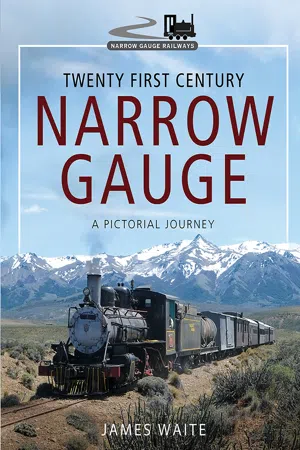
- 208 pages
- English
- ePUB (mobile friendly)
- Available on iOS & Android
eBook - ePub
About this book
James Waite has been a skilled railway photographer for many years. In this book he has brought together photographs of many of the world's steam-worked narrow gauge railways in the twenty-first century, concentrating mostly on views which show the scenery, both natural and man-made, through which they ran. They are accompanied by extended captions, the fruit of extensive research containing much historical information about the railways and their locos. He also offers many fascinating insights into the districts and communities which they serve, along with anecdotes about his adventures while visiting them which are often amusing and always informative.
Tools to learn more effectively

Saving Books

Keyword Search

Annotating Text

Listen to it instead
Information
WALES

On 3 September 2010 0-4-2RT No 3 Wyddfa (SLM 925/1895) has been receiving attention outside Llanberis engine shed on the 800mm gauge Abt-rack Snowdon Mountain Railway. No’s 2-5 are Abt-Brown type 2 machines, the only survivors anywhere. The Abt-Brown system involved mounting the cylinders high up above the ground between the driving axles, useful for keeping out dirt and grit, with the drive being transmitted via a front-mounted rocking beam.
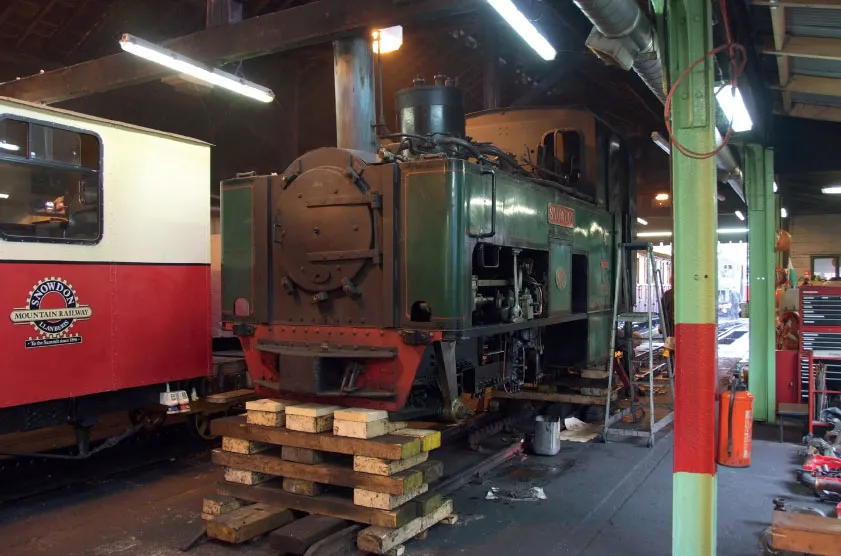
0-4-2RT No 4 Snowdon (SLM 988/1896) is under repair inside Llanberis shed on 3 September 2010. The railway handles most loco overhauls though No 4 carries a Hunslet rebuild plate dated 1963.

On 13 April 2007 No 4 Snowdon crosses Waterfall viaduct. Proposals to build the line had long been thwarted by the mountain’s owner and it didn’t open until 1896. The original carriages were rebuilt in the 1950’s and carried this smart red and cream livery for many years.

A little later, 0-4-2RT No 2 Enid (SLM 924/1895) is about to cross the mountain road as she climbs away from Llanberis. The frequent changes of gradient are obvious here and were the subject of criticism by Roman Abt, the system’s inventor, after a fatal accident on the line’s opening day.

0-4-2RT No 6 Padarn (SLM 2838/1922) approaches Waterfall viaduct on 3 September 2010. She’s an Abt-Brown type 3, the final design, and is the world’s last working example. Three were supplied to the railway in the 1920s.

Very early in the morning of 16 September 2016, three old Penrhyn quarry locos ventured out from its Coed-y-parc workshop, the first time this had happened for at least fifty years. The workshop is part of a complex built almost entirely of slate blocks, much of which is now an industrial estate. The building with its old travelling hoist remained intact and a few years ago was made available to a preservation venture. Here 0-4-0T Marchlyn (Avonside 2067/1933) and 0-4-0ST Winifred (Hunslet 364/1885) are prepared outside the workshop. They were among eleven locos which emigrated to North America in 1965 and 1966 from Penrhyn and from Dinorwic quarry at Llanberis. All have now returned to the UK.

Winifred and 0-4-2ST Tattoo class Stanhope (KS 2395/1917) pass a terrace of quarrymen’s cottages at Coed-y-parc on 16 September 2016. A tramway to convey slate to the coast at Port Penrhyn from the huge quarry, on the north eastern side of Elidir Fawr near Bangor, began operations in about 1798. It was one of the earliest railways in Wales and may have been the first line of approximately 2ft gauge anywhere in the world. In 1879, it was replaced by the new 1ft 10¾ins gauge Penrhyn Quarry Railway which closed in 1963 and the last lines within the quarry soon followed. The Hunslets became almost synonymous with the Welsh slate quarries whereas Stanhope was the only loco of her kind at Penrhyn and is an unlikely survivor. She was withdrawn as long ago as 1947 and stripped of parts over many years; even her frame was cut in two. Alan Keef’s completed her restoration in 1999. She heads a short train of typical Welsh slate wagons. The leading one comes from the Great Western which built fifty in 1899 and another fifty in 1903 for the Blaenau Ffestiniog quarry traffic.
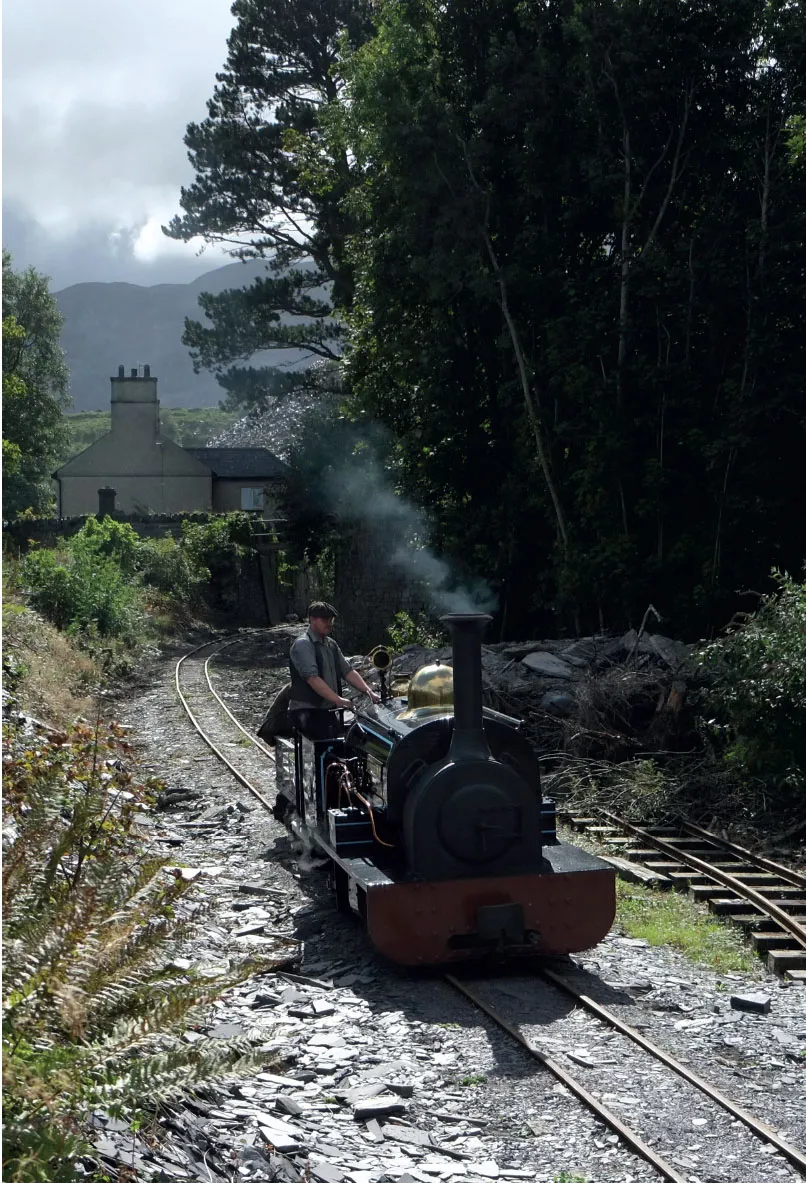
A little later Winifred heads north along the route of the old mainline. This short heritage operation had a rich history and was full of slate railway character, especially when Penrhyn locos were visiting. It promised much for the future but closed suddenly in July 2017 – a great loss. Most of its equipment has now left the site.

Of all the transatlantic émigrés these two Penrhyn locos, 0-4-0ST Nesta (Hunslet 704/1899) and E class 0-4-0T Cegin (Barclay 1991/1931) travelled the furthest, spending many years at the Hacienda La Esperanza near Manatí on the US island of Puerto Rico. It houses a museum of Caribbean slavery and was an appropriate home for them since the cost of developing Penrhyn quarry was met out of the fortune its owning family had made from Jamaican sugar plantations worked by hundreds of slaves in the 1600s and 1700s. Here the locos are in store at La Esperanza on 24 February 2013. The distinctive Penrhyn lining-out on Cegin’s cab is still visible, despite her many years exposed to the sea air. Sadly, the museum couldn’t afford to restore them and in 2016 they became the last of the US locos to return.

Dinorwic quarry, which lay on the opposite side of Elidir Fawr and ate away at the same slate vein, was home to another 1ft 10¾ins gauge system. After haulage to Gilfach Ddu, its wagons were loaded onto transporters on a 4ft gauge line which ran to Penscoins near the coast. They were then offloaded to run down a cable-worked incline to the port. The railway closed in the 1960s like the Penrhyn line and by the end of the decade so had the quarry. A reminder can be found at the Hollycombe Steam Museum in West Sussex. In 1968, its founder bought Jerry M (Hunslet 638/1895), one of two extra-large 0-4-0STs built for the Gilfach Ddu tramway, along with some of the distinctive chaired Dinorwic track which he laid out at his home. Jerry M looks the part on 26 August 2016 and perhaps the Hollycombe woods look a little like those at Gilfach Ddu!

The 600mm gauge Ffestiniog Railway was built in the early 1830s. Its constant gradient allowed gravity working over a distance of more than twelve miles, a brilliant achievement considering the difficult terrain. It wasn’t the first narrow gauge steam railway when locos took over in 1863 but it had an enormous influence around the world and attracted even more attention when its first Double Fairlie arrived in 1869. Here, 0-4-4-0 No 10 Merddin Emrys leaves Porthmadog with a train of superbly restored 4-wheeled carriages on 14 October 2005. She dates from 1879 and was the first loco constructed at the railway’s Boston Lodge shops. In preservation she has become both longer and taller but still has something of the traditional Ffestiniog Fairlie look.

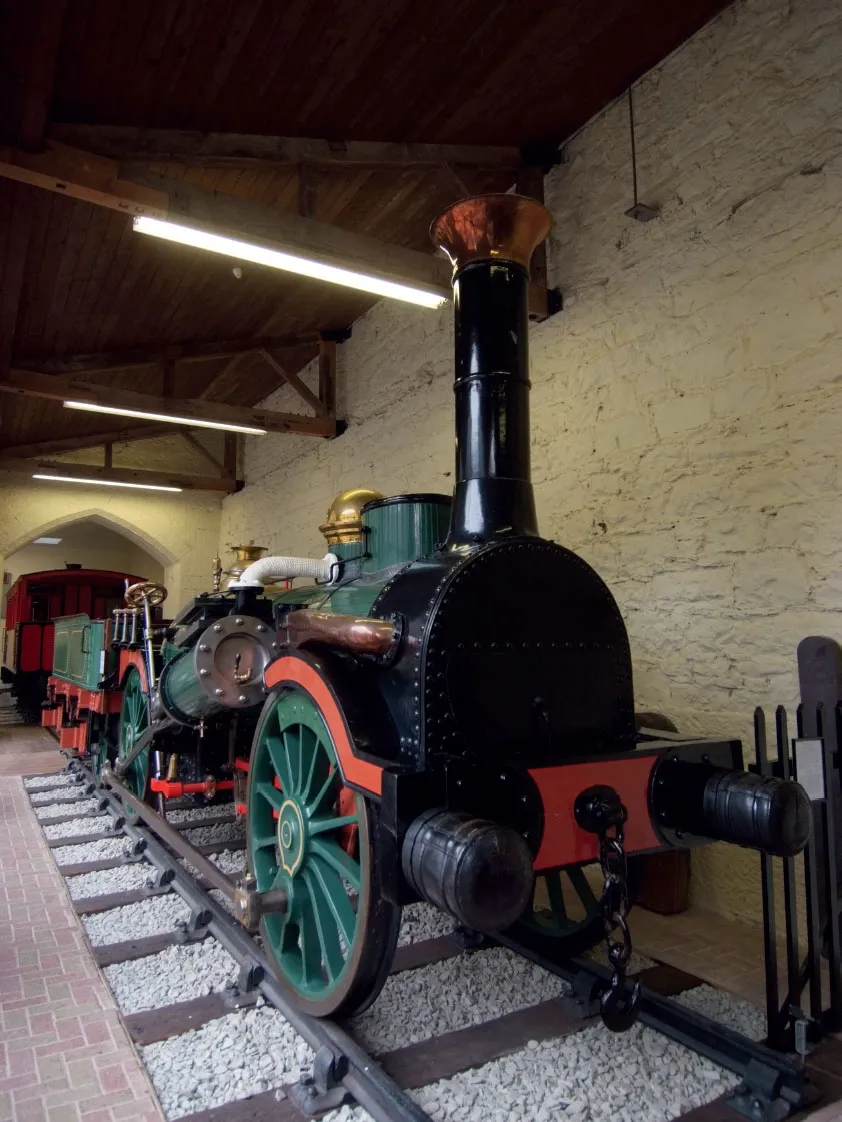
Fire Queen (Horlock, 1848) was one of two Crampton-type 0-4-0s which worked Dinorwic’s 4ft gauge railway to Penscoins between 1848 and the 1880s. After withdrawal, her sister Jenny Lind was scrapped but Fire Queen was just tucked away in her shed at Gilfach Ddu works, reportedly because the quarry owner’s daughter had a soft spot for her. For many years, cleaning the loco was a weekly ritual for the works apprentices. When Dinorwic closed she moved to a new museum at Penrhyn, was given a fresh coat of paint and has been on show ever since, unfortunately in conditions almost as cramped as her previous home. Is she the world’s oldest surviving narrow gauge loco?! Here she is on 3 October 2014; behind her is the owner’s private saloon, built in 1895. Other exhibits here include a Penrhyn Hunslet and two 3ft gauge locos. One is a survivor of at least sixty-nine 0-4-0VBT’s built by de Winton at Caernarfon....
Table of contents
- Cover
- Dedication
- Title
- Copyright
- Contents
- Acknowledgements
- Locomotive Builders
- Foreword
- Canada and the USA
- México
- El Salvador
- Costa Rica
- Colombia
- Brazil
- Uruguay
- Argentina
- Iceland
- Denmark
- Norway
- Sweden
- Finland
- Russia
- Ukraine
- Lithuania
- Estonia
- Latvia
- Ireland
- The Isle of Man
- Wales
- England
- The Netherlands
- Germany
- Poland
- France
- Switzerland
- Austria
- Czech Republic
- Slovakia
- Romania
- Bulgaria
- Spain
- Italy
- Bosnia
- Serbia
- Greece
- Cyprus
- Eritrea
- Kenya
- Mauritius
- South Africa
- Syria
- Jordan
- Pakistan
- India
- Burma
- Sri Lanka
- Thailand
- Cambodia
- Vietnam
- The Philippines
- Malaysia
- China
- Taiwan
- Japan
- Australia
- New Zealand
Frequently asked questions
Yes, you can cancel anytime from the Subscription tab in your account settings on the Perlego website. Your subscription will stay active until the end of your current billing period. Learn how to cancel your subscription
No, books cannot be downloaded as external files, such as PDFs, for use outside of Perlego. However, you can download books within the Perlego app for offline reading on mobile or tablet. Learn how to download books offline
Perlego offers two plans: Essential and Complete
- Essential is ideal for learners and professionals who enjoy exploring a wide range of subjects. Access the Essential Library with 800,000+ trusted titles and best-sellers across business, personal growth, and the humanities. Includes unlimited reading time and Standard Read Aloud voice.
- Complete: Perfect for advanced learners and researchers needing full, unrestricted access. Unlock 1.4M+ books across hundreds of subjects, including academic and specialized titles. The Complete Plan also includes advanced features like Premium Read Aloud and Research Assistant.
We are an online textbook subscription service, where you can get access to an entire online library for less than the price of a single book per month. With over 1 million books across 990+ topics, we’ve got you covered! Learn about our mission
Look out for the read-aloud symbol on your next book to see if you can listen to it. The read-aloud tool reads text aloud for you, highlighting the text as it is being read. You can pause it, speed it up and slow it down. Learn more about Read Aloud
Yes! You can use the Perlego app on both iOS and Android devices to read anytime, anywhere — even offline. Perfect for commutes or when you’re on the go.
Please note we cannot support devices running on iOS 13 and Android 7 or earlier. Learn more about using the app
Please note we cannot support devices running on iOS 13 and Android 7 or earlier. Learn more about using the app
Yes, you can access Twenty First Century Narrow Gauge by James Waite in PDF and/or ePUB format, as well as other popular books in Technology & Engineering & British History. We have over one million books available in our catalogue for you to explore.