This monograph examines the Iranian and Shia legal debates on technologies of assisted reproduction (including embryo donation and surrogacy) and looks at the regulations and implementation of these technologies in Iran. In particular, it addresses: 1) an analysis of the moral reasoning embedded in the Shia theological legal discourse on reproductive technology and how this tradition interprets assisted reproduction with a particular focus on underlying concepts, structure and principles of kinship; 2) the emergence and development of the relevant legislation, regulations and administrative policies and how this might shape the relationship between civil and religious law in Iran, and 3) the ways in which reproductive technology is used and understood with particular focus on underlying values, local narratives and the resulting societal dynamics. The methodological approach for this research is a combination of extensive ethnography and textual analysis of important academic and religious seminary publications in Iran, from Shia jurisprudence (fiqh) and Persian histories to the analysis of laws and verdicts.
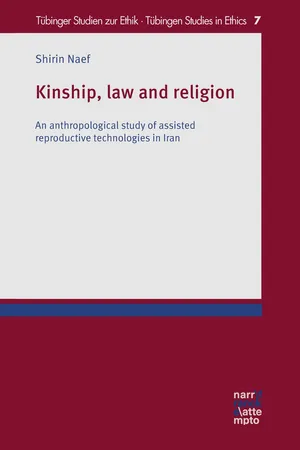
eBook - PDF
Kinship, law and religion
An anthropological study of assisted reproductive technologies in Iran
- 202 pages
- English
- PDF
- Available on iOS & Android
eBook - PDF
Kinship, law and religion
An anthropological study of assisted reproductive technologies in Iran
About this book
Information
Table of contents
- Cover
- Table of content
- Acknowledgments
- Note on transliteration
- 1. Framing the issues
- 2. Ideas about Iranian kinship
- 3. Shia approaches to assisted reproductive technologies
- 4. Embryo donation law and surrogacy regulation: the intersection of religion, law and ethics
- 5. Surrogacy as doing a good deed
- 6. A priceless gift: a short story of surrogacy
- 7. “M as in Mother”: medical perspectives, clinical environments and social dynamics
- 8. Cousin marriage, siblingship and reproductive technologies
- 9. Conclusion
- Appendix 1
- Appendix 2
- Glossary
- Bibliography
Trusted by 375,005 students
Access to over 1.5 million titles for a fair monthly price.
Study more efficiently using our study tools.
Frequently asked questions
Yes, you can cancel anytime from the Subscription tab in your account settings on the Perlego website. Your subscription will stay active until the end of your current billing period. Learn how to cancel your subscription
No, books cannot be downloaded as external files, such as PDFs, for use outside of Perlego. However, you can download books within the Perlego app for offline reading on mobile or tablet. Learn how to download books offline
Perlego offers two plans: Essential and Complete
- Essential is ideal for learners and professionals who enjoy exploring a wide range of subjects. Access the Essential Library with 800,000+ trusted titles and best-sellers across business, personal growth, and the humanities. Includes unlimited reading time and Standard Read Aloud voice.
- Complete: Perfect for advanced learners and researchers needing full, unrestricted access. Unlock 1.5M+ books across hundreds of subjects, including academic and specialized titles. The Complete Plan also includes advanced features like Premium Read Aloud and Research Assistant.
We are an online textbook subscription service, where you can get access to an entire online library for less than the price of a single book per month. With over 1.5 million books across 990+ topics, we’ve got you covered! Learn about our mission
Look out for the read-aloud symbol on your next book to see if you can listen to it. The read-aloud tool reads text aloud for you, highlighting the text as it is being read. You can pause it, speed it up and slow it down. Learn more about Read Aloud
Yes! You can use the Perlego app on both iOS and Android devices to read anytime, anywhere — even offline. Perfect for commutes or when you’re on the go.
Please note we cannot support devices running on iOS 13 and Android 7 or earlier. Learn more about using the app
Please note we cannot support devices running on iOS 13 and Android 7 or earlier. Learn more about using the app
Yes, you can access Kinship, law and religion by Shirin Naef in PDF and/or ePUB format, as well as other popular books in Philosophy & History & Theory of Philosophy. We have over 1.5 million books available in our catalogue for you to explore.