- 128 pages
- English
- ePUB (mobile friendly)
- Available on iOS & Android
eBook - ePub
Honolulu
About this book
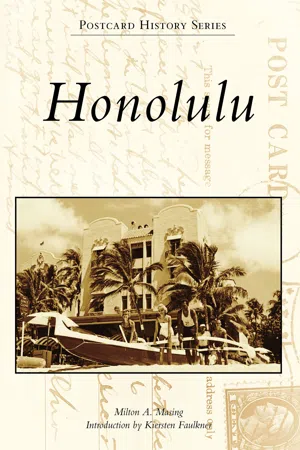
Honolulu's population grew in the first few decades of the 1800s from a few hundred people living in thatched huts to about 3,000 in 1823. Missionaries erected the city's earliest wooden buildings in the 1820s.Starting in the 1840s, stones were used in construction. With so many foreigners moving to Honolulu during the late 1800s, rapid growth occurred, and the remaining thatched huts and old paths were replaced with permanent structures and patterned streets. By the 1900s, control of the city was dominated by the ever-increasing tide of Caucasians. The early 1900s also marked the beginning of a time when millions of postcards were mailed daily throughout Honolulu and the world.
Trusted by 375,005 students
Access to over 1 million titles for a fair monthly price.
Study more efficiently using our study tools.
Information
Topic
HistoireSubtopic
Histoire de l'Amérique du NordOne
PUBLIC BUILDINGS
AND STRUCTURES
AND STRUCTURES

‘IOLANI PALACE. This view from the top of the Ali’iolani Hale shows the front facade of the palace building erected by King David Kalakaua to house Hawaiian royalty. The plans for the building were drawn by architects Thomas J. Baker, C.J. Wall, and Isaac Moore. Construction of the $360,000 building took place from 1879 to 1882, with the cornerstone being laid in a ceremony on December 31, 1879. As a part of the Hawai‘i Capital Historic District, this building is listed in the National Register of Historic Places.

‘IOLANI PALACE, THRONE ROOM. The seats for the king and queen on the second floor of the palace were elevated so that the royals could see out over “their people.” The building served as the royal residence until 1898, when Hawai‘i was annexed as a territory. After statehood was granted in 1959, the building served as the capitol of the state until a new capitol building was completed in 1969. (Published by Edward H. Mitchel, San Francisco, California.)

‘IOLANI PALACE, ANNEXATION DAY. On July 7, 1898, Pres. William McKinley signed an annexation resolution previously passed by the Fifty-Fifth Congress of the United States. This resolution made the Hawaiian Islands a territory of the United States, pleasing the sugar growers on the islands but displeasing native Hawaiians and Queen Liliʻuokalani . After annexation, the queen was banned from the palace, and she lived out the rest of her life in a private residence.

CORONATION PAVILION. The original pavilion, designed by Theodore C. Heuck, was erected at the front steps of ‘Iolani Palace to be used for the coronation of King Kalakaua and Queen Kapiʻolani on February 12, 1883. After termites decimated the wood frame of the pavilion, the structure was moved to the front of the palace grounds and rebuilt with concrete pillars. Later, the pavilion was used by the Royal Hawaiian Band to give concerts for the public.

‘IOLANI BARRACKS. These barracks were constructed in 1870 during the reign of King Kamehameha V to house the Royal Guard, which also included the Royal Hawaiian Band. At a cost of $10,000, this Theodore C. Heuck design was constructed under the supervision of King Kamehameha V.

QUEEN’S HOSPITAL. The Queen’s Hospital was founded in 1859 by King Kamehameha IV to provide medical care to the people of Hawai‘i. He named the hospital for his wife, Queen Emma. Over the years, the facility was expanded several times.

QUEEN’S HOSPITAL. Handwritten notes on the back of this card state that the four-story wing of the Queen’s Hospital pictured here includes “offices on the first floor,” “women’s w.d. on the 2nd floor,” “private rooms on the 3rd floor,” and “operating rooms, labs, and x-rays on the 4th floor.” (Published by Moses Office Equipment Co., Honolulu, Hawai‘i.)

JUDICIARY BUILDING. Construction of this building as a royal residence, known as Ali’iolani Hale, was ordered by King Kamehameha V. He laid the cornerstone for the building in 1872, and the building was finished in 1874. Thomas Rowe, an architect from New York City, drew the plans for the Renaissance Revival building. The building is listed in the National Register of Historic Places. (Photographed and published by Kodak Hawaii.)

KAMEHAMEHA POST OFFICE. This 1871 building was the first post office constructed in Hawai‘i. The principal material for the building, precast concrete reinforced with iron, was scored to resemble stone. The neoclassical design of the building was planned by architect J.G. Osborne of Honolulu.

LUNALILO HOME. This home was established from the trust of King William Charles Lunalilo, the sixth reigning king of Hawai‘i, who died in 1874. It was previously his residence. When first opened, the facility provided care for 53 senior residents. In the 1920s, the building fell into disrepair, and a new building was constructed in the Upper Makiki neighborhood to replace it. The site is now the location of the Roosevelt High School complex. (Published by Hawaii and South Seas Curio Co., Honolulu, Hawai‘i.)

US IMMIGRATION STATION. On July 4, 1905, this group of buildings opened in the Ala Moana district of Honolulu to process immigrants to the islands. By 1934, these buildings were demolished and replaced with a new group of buildings with the same name and purpose. (Published by Wall, Nichols & Co., Honolulu, Hawai‘i.)

KAMEHAMEHA MUSEUM. In 1889, Honolulu businessman Charles Reed Bishop founded the Bishop Museu...
Table of contents
- Cover Page
- Title Page
- Copyright Page
- Dedication
- Table of Contents
- Acknowledgments
- Introduction
- 1. Public Buildings and Structures
- 2. Royal and Legendary People
- 3. Parks
- 4. City Views
- 5. Church Buildings and Religion
- 6. School Buildings
- 7. Clubs and Organizations
- 8. Commercial Buildings and Businesses
- 9. Hotel Buildings
- Index of Designers, Architects, and Architectural Firms
Frequently asked questions
Yes, you can cancel anytime from the Subscription tab in your account settings on the Perlego website. Your subscription will stay active until the end of your current billing period. Learn how to cancel your subscription
No, books cannot be downloaded as external files, such as PDFs, for use outside of Perlego. However, you can download books within the Perlego app for offline reading on mobile or tablet. Learn how to download books offline
Perlego offers two plans: Essential and Complete
- Essential is ideal for learners and professionals who enjoy exploring a wide range of subjects. Access the Essential Library with 800,000+ trusted titles and best-sellers across business, personal growth, and the humanities. Includes unlimited reading time and Standard Read Aloud voice.
- Complete: Perfect for advanced learners and researchers needing full, unrestricted access. Unlock 1.4M+ books across hundreds of subjects, including academic and specialized titles. The Complete Plan also includes advanced features like Premium Read Aloud and Research Assistant.
We are an online textbook subscription service, where you can get access to an entire online library for less than the price of a single book per month. With over 1 million books across 990+ topics, we’ve got you covered! Learn about our mission
Look out for the read-aloud symbol on your next book to see if you can listen to it. The read-aloud tool reads text aloud for you, highlighting the text as it is being read. You can pause it, speed it up and slow it down. Learn more about Read Aloud
Yes! You can use the Perlego app on both iOS and Android devices to read anytime, anywhere — even offline. Perfect for commutes or when you’re on the go.
Please note we cannot support devices running on iOS 13 and Android 7 or earlier. Learn more about using the app
Please note we cannot support devices running on iOS 13 and Android 7 or earlier. Learn more about using the app
Yes, you can access Honolulu by Milton A. Masing in PDF and/or ePUB format, as well as other popular books in Histoire & Histoire de l'Amérique du Nord. We have over one million books available in our catalogue for you to explore.