eBook - ePub
Available until 23 Dec |Learn more
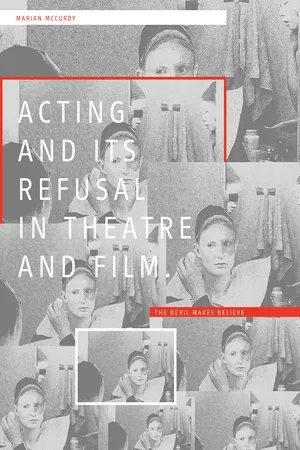
Acting and its Refusal in Theatre and Film
The Devil Makes Believe
- 202 pages
- English
- ePUB (mobile friendly)
- Available on iOS & Android
eBook - ePub
Available until 23 Dec |Learn more
About this book
Acting has traditionally been considered a form of pretending or falsehood, compared with the so-called reality or truth of everyday life. Yet in the postmodern era, a reversal has occurred – real life is revealed as something acted and acting is where people have begun to search for truth.
In Acting and its Refusal in Theatre and Film, Marian McCurdy considers the ethical desire of refusing to act – which results from blurred boundaries of acting and living – and examines how real life and performance are intertwined. Offering a number of in-depth case studies, the book contextualizes refusals of acting on stage and screen and engages in an analysis of fascist theatricality, sexual theatricality and the refusal of theatricality altogether.
In Acting and its Refusal in Theatre and Film, Marian McCurdy considers the ethical desire of refusing to act – which results from blurred boundaries of acting and living – and examines how real life and performance are intertwined. Offering a number of in-depth case studies, the book contextualizes refusals of acting on stage and screen and engages in an analysis of fascist theatricality, sexual theatricality and the refusal of theatricality altogether.
Frequently asked questions
Yes, you can cancel anytime from the Subscription tab in your account settings on the Perlego website. Your subscription will stay active until the end of your current billing period. Learn how to cancel your subscription.
At the moment all of our mobile-responsive ePub books are available to download via the app. Most of our PDFs are also available to download and we're working on making the final remaining ones downloadable now. Learn more here.
Perlego offers two plans: Essential and Complete
- Essential is ideal for learners and professionals who enjoy exploring a wide range of subjects. Access the Essential Library with 800,000+ trusted titles and best-sellers across business, personal growth, and the humanities. Includes unlimited reading time and Standard Read Aloud voice.
- Complete: Perfect for advanced learners and researchers needing full, unrestricted access. Unlock 1.4M+ books across hundreds of subjects, including academic and specialized titles. The Complete Plan also includes advanced features like Premium Read Aloud and Research Assistant.
We are an online textbook subscription service, where you can get access to an entire online library for less than the price of a single book per month. With over 1 million books across 1000+ topics, we’ve got you covered! Learn more here.
Look out for the read-aloud symbol on your next book to see if you can listen to it. The read-aloud tool reads text aloud for you, highlighting the text as it is being read. You can pause it, speed it up and slow it down. Learn more here.
Yes! You can use the Perlego app on both iOS or Android devices to read anytime, anywhere — even offline. Perfect for commutes or when you’re on the go.
Please note we cannot support devices running on iOS 13 and Android 7 or earlier. Learn more about using the app.
Please note we cannot support devices running on iOS 13 and Android 7 or earlier. Learn more about using the app.
Yes, you can access Acting and its Refusal in Theatre and Film by Marian McCurdy in PDF and/or ePUB format, as well as other popular books in Literature & Religious Art. We have over one million books available in our catalogue for you to explore.
Information
Chapter 1
Refusal in Fascist Theatricality
Aestheticization of Political Life
Klaus Mann’s Mephisto
Written in exile, Klaus Mann’s novel Mephisto: Roman einer Karriere/Mephisto: Novel of a Career (1936) explores the comparison between the Nazis and actors in an only thinly disguised autobiographical way. The title Mephisto refers to the key event in the protagonist Hendrik Höfgen’s (Gustaf Gründgens’) life in Berlin during the rise of fascism when he acted the part of the devil Mephisto in a production of Goethe’s Faust. In the chapter titled ‘The Pact with the Devil’, Höfgen acts as the devil onstage in front of an audience that includes the Nazi ‘prime minister’ also referred to as the ‘fat general’. This was Klaus Mann’s pseudonym for Hermann Göring, Hitler’s second in command, Head of the Luftwaffe and Chief of the Prussian State Theatre during this period. Höfgen, in full costume and make-up as Mephisto, is invited during the interval to meet the Nazi prime minister in his box. This is based on the real event during the infamous 1932–33 season of Faust directed by Max Reinhardt where Gründgens met Hermann Göring for the first time in these circumstances.6 The meeting is described by Klaus Mann in the novel as if it were the acting out of the pact scene from Faust:
Was he congratulating him on his magnificent performance? It looked more like the sealing of a pact between the potentate and the actor. In the orchestra people strained their eyes and ears. They devoured the scene in the box above as though it was the most exceptional entertainment, an entrancing pantomime entitled ‘The Actor Bewitches the Prince’.
([1936] 1995: 180)
This Faustian analogy is also hinted at retrospectively at the beginning of the next chapter where ‘[t]he audience had to wait; and they did so with pleasure: the scene in the ministerial box was far more absorbing than Faust’ (K. Mann [1936] 1995: 181).
This theatrical analogy placed onto everyday life suggests that Höfgen (the actor) acts as the devil in life as he did on stage, seducing Göring (the Nazi Prince), who takes up the Faustian position as German hero. However, this analogy cannot escape its context. As the prime minister is in a position of power and influence from which to help Höfgen’s career aspirations, it can also be read conversely that the prime minister takes on the attributes of the devil/Mephisto in making a deal with Höfgen who takes on the attributes of Faust selling his soul (political convictions) to the devil (Nazis) in the pursuit of fame and fortune. This second reading is confirmed in the final words of the chapter where Höfgen thinks to himself: ‘Now I have sold myself … Now I am marked for life …’ (K. Mann [1936] 1995: 180). Just as in the Faust legend where the devil Mephisto tempts Faust, in Klaus Mann’s novel the Nazis can also be seen to deceive and manipulate their public, promising to fulfil its desire to become Godlike (Höfgen’s career ambitions) in order to seduce it into complicity with their regime. Klaus Mann’s use of this analogy in the novel details what followed this meeting in real life. After the end of the performance season of the 1932–33 production, it was a matter of weeks before the Nazi party came to power and it was the next year that Gründgens, in spite of his socialist sympathies, accepted Göring’s offer of the role of Director of the Prussian State Theatre. As Klaus Mann wrote in his autobiography, Gründgens became ‘the Führer of theatrical life in the Third Reich’ ([1942] 1984: 281). However, this ‘pact with the devil’ is as far as the Faustian analogy is explored in his novel.
Gründgens’ Life in the Theatre
Klaus Mann’s fictional comparison of the actor Gründgens with the Nazis as actors in political life may have stemmed from his private experiences with Gründgens. In the novel, the characters Sebastian and Barbara are pseudonyms for Klaus Mann himself and his sister Erika. Klaus and Erika Mann had worked together with Gründgens as actors in the mid-1920s and shared his socialist convictions. The plays that they wrote and performed in were based on their experiences together offstage and in this way their acting became a follow-up to their everyday lives. Written by Klaus Mann and directed by Gründgens, Anja und Esther/Ania and Esther (1925) was inspired by the real-life relationships between Gründgens, Erika Mann, Klaus Mann and Pamela Wedekind (the daughter of playwright Frank Wedekind). During the theatrical run of Ania and Esther it is believed that Gründgens, who as well as directing acted the role of Jakob, had an affair with both Erika and Klaus Mann, who also shared a close (and it was rumoured, sexual) relationship. Gründgens went on to marry Erika. Klaus Mann (who played Kaspar) was at this time engaged to Pamela who was in turn having a relationship with Erika; and this love relationship appears as the central theme in the play between the characters Ania and Esther (played by Erika and Pamela respectively): ‘[T]he offstage entanglements between the foursome which developed during the production of Ania and Esther were as confusing as those enacted in front of the audience’ (Weiss 2008: 50). By acting both in the theatre and in everyday life, Klaus Mann and Gründgens may have considered everything they did to be a kind of play-acting, not quite real.
During this time, and before his success as Mephisto in the 1932 production of Faust, Gründgens had developed a career for himself playing devil-like characters. One of Gründgens’ most popular early successes was starring in the film M (Lang, 1931), playing the charismatic head of the criminal underworld whose gang beats the police in catching and condemning a murderer of young girls. Gründgens’ surge in popularity following the film could be attributed to his role as a fascinating and seductive ‘bad guy’. While Klaus and Erika Mann were active against the growing Nazi threat in Germany, Gründgens continued to seek success as an actor in Berlin. Like their fictional counterparts, Gründgens and Erika Mann divorced in 1929, their respective artistic lives taking different directions. Gründgens proclaimed in a 1932 speech that art should have no connection to reality. Erika and Klaus Mann, however, had an entirely opposite view of the function of art. Unlike Gründgens, they did not separate their artistic aims from their political ones. For this reason they were unable to remain in Germany once the Nazis got into power, going into exile in 1933 (the same year Gründgens met and befriended Hermann Göring) along with many artists, intellectuals, homosexuals, communists and Jews escaping persecution, censorship and in many cases certain torture and death. In Zurich, Erika Mann continued her work with Die Pfeffermühle (The Peppermill), an anti-Nazi cabaret that she had founded in Munich, and in which Klaus also took a part:
I know, that such a cabaret stage is almost meaningless compared to the great world stage. But even so, I also know that every artistic work must have its convictions … We try, in the light manner that we have chosen, to say the difficult things that must be said today.
(E. Mann 1934 in Weiss 2008: 108–109)
Mann’s novel was published immediately in Amsterdam and France in 1936 but banned in Germany. When a Paris daily newspaper advertised it as a roman à clef, Klaus Mann strongly insisted he was not out to write a story about particular persons. It seems that for legal reasons and in order to be published he had to conceal the connection the novel had to Gründgens. Later, in his autobiography Der Wendepunkt/The Turning Point, Klaus Mann is forthcoming about his intention to write about Gründgens but also that Gründgens served as an exemplar of the type of behaviour that was his target:
I visualize my ex-brother-in-law as the traitor par excellence, the macabre embodiment of corruption and cynicism. So intense was the fascination of his shameful glory that I decided to portray Mephisto-Gründgens in a satirical novel. I thought it pertinent, indeed, necessary to expose and analyze the abject type of the treacherous intellectual who prostitutes his talent for the sake of some tawdry fame and transitory wealth. Gustaf was just one among others – in reality as well as in the composition of my narrative.
([1942] 1984: 282)7
After the war Gründgens was arrested and spent nine months in an internment camp before being released and entitled to resume his acting career in Berlin.
Suicide as Final Refusal
The character of Sebastian in Mephisto: Novel of a Career, who Klaus Mann based on himself, describes Höfgen (Gründgens): ‘He’s always lying and he never lies. His falseness is his truth – it sounds complicated, but actually it’s quite simple. He believes everything and he believes nothing. He is an actor’ (K. Mann [1936] 1995: 130). After returning from America after years in exile, Klaus Mann committed suicide on 21 May 1949 a short time after receiving a letter from his publisher dated 5 May advising that his novel would not be published in Germany. Suicide was the choice of his protagonist (also based on himself and called Sebastian) in his earlier novel Treffpunkt im Unendlichen/Meeting Place in Infinity (K. Mann 1932), which like Mephisto: Novel of a Career was set during the rise of the Nazis. Mann’s suicide in Cannes occurred in the same city as his protagonist Sebastian in this novel. Sebastian’s motivation to commit suicide in the novel is in response to his betrayal by a character Gregor Gregori who was based on Gründgens. It seems possible therefore that Mann’s suicide 17 years after writing Meeting Place in Infinity – in the same place as the suicide of his fictional character based on himself and in response to the actions of a character based on Gründgens – had the direct intention of implicating Gründgens.
The rejection of Klaus Mann’s novel for publication is evidence that even decades after the Nazis were defeated it was in the interest of the conservative authorities of the Federal Republic of Germany to uphold the idea of the separation of the political and the cultural life in Nazi Germany. The connection of the political and the aesthetic was disavowed by the German State, which denied that it ever made the ‘pact with the devil’ that Klaus (and his father Thomas Mann) had written about. Yet the connection of the political and the aesthetic was a fundamental desire that the fascists celebrated:
We feel ourselves as more than politicians […] but also as artistic individuals. I am even of the opinion that politics is the highest form of art, because sculptors shape stone … and poets shape words. The statesman, however, shapes the masses so that the masses emerge as a people.
(Goebbels 1933 in Gadberry 1995: 81)
The idea that the political and the aesthetic had a correlation in fascism found its well-known expression in Walter Benjamin’s essay ‘The Work of Art in the Age of Mechanical Reproduction’: ‘The logical result of Fascism is the introduction of aesthetics into political life’ ([1935] 1992: 680). Benjamin, who was in exile in France at the time, saw that the theatrical spectacle of fascism in Germany was used in a destructive way to manipulate the masses: ‘All efforts to render politics aesthetic culminate in one thing: war’ ([1935] 1992: 680). He also made a comparison between the fascist period and the period of the Ancient Greeks:
Mankind, which in Homer’s time was an object of contemplation for the Olympian gods, now is one for itself. Its self-alienation has reached such a degree that it can experience its own destruction as an aesthetic pleasure of the first order. This is the situation of politics which Fascism is rendering aesthetic.
([1935] 1992: 681)
Central to Hitler and the Nazis’ popular success during the rise of fascism was their use of spectacle as ‘Gesamtkunstwerk’ (Total Work of Art). This concept was developed by Wagner in the mid-nineteenth century to describe a combined spectacle of music, theatre, literature and visual arts. Wagner based this form on what he admired in the Ancient Greek dramas, which were central to the functioning of the Ancient Greek polis: powerful, religious spectacles, which asserted and enacted the central beliefs and values of the state. Wagner’s use of ‘Gesamtkunstwerk’ as a revival of the efficacy and spectacle of Ancient Greek theatre inspired writers such as Arthur Moeller van den Bruck to write about the creation of a right-wing German state in Das Dritte Reich/Germany’s Third Empire (1923) in which he propagates nationalist political mass spectacles based on Ancient Greek theatre as acts of revolution. Hitler took up these ideas in his use of highly theatrical and operatic rallies and public spectacles in his creation of the Third Reich. Hitler and Goebbels took theatre and acting out of the State auditorium and into the streets to gain support for and demonstrate fascist ideology, and politicians in this ritualized spectacle of fascism became ‘actors’ in their own propaganda performances.
In an essay from Der Messingkauf, ‘Über die Theatrikalität des Faschismus’/‘On the Theatricality of Fascism’, Bertolt Brecht examined the way the ‘oppressors of our time’ have taken acting out of the theatre and into life:
There is no doubt that the fascists behaved especially theatrically. They have a special sense for that. They themselves speak of stage direction and they have introduced a whole heap of effects directly from the theatre: the spotlights and the musical accompaniment, the choirs and the surprises.
([1939–40] 1967: 560)8
Brecht gives an example of how the Nazis gave political propaganda theatrical expression: the burning of the Reichstag where ‘the communist danger was dramatized and made into an effect’ ([1939–40] 1967: 560). Brecht directed his attention especially to Hitler and the way he developed his public persona like an actor:
An actor told me years ago that Hitler took lessons from the court actor Basil in Munich, not only in diction but also in behaviour. For example, he learnt to walk the onstage strutting of the hero where one presses the knee down and puts the full sole on the floor to make the walk majestic. He also learnt the most impressive way to cross his arms and he also studied the relaxed position.
([1939–40] 1967: 561)
He notes that Hitler learnt acting in life in order to pretend to be someone he was not: ‘It is true that we see an attempt here to deceive the people because they are to accept something which is studied and alien to him as the natural behavior of a great man’ ([1939–40] 1967: 561). It is ironic that Hitler’s acting coach was in fact a ham actor: ‘[A]n actor who when he himself came onstage caused hilarity with the younger crowd through his unnatural behavior’ (Brecht [1939–40] 1967: 561). Brecht explored this phenomenon of Hitler as an actor in his satirical play Der aufhaltsame Aufstieg des Arturo Ui/The Resistible Rise of Arturo Ui (1941) written in exile a year later. The play is a parable on the rise of Hitler and the Nazis set in Chicago with Arturo Ui as ‘head gangster’. In one comic scene an actor is recruited to teach Ui (Hitler)...
Table of contents
- Cover Page
- Title Page
- Copyright
- Contents
- Acknowledgements
- List of Illustrations
- Introduction The Devil Actor
- Chapter 1 Refusal in Fascist Theatricality
- Chapter 2 Refusal in Sexual Theatricality
- Colour Section
- Chapter 3 Refusal of Theatricality
- Conclusion The Devil Spectator
- Notes
- Bibliography
- Index
- Back Cover