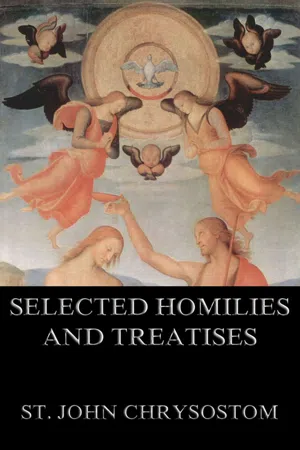
This compilation contains the following writings: Contents: Treatise on the Priesthood.An Exhortation to Theodore After His Fall.Letter to a Young Widow.Homilies on S. Ignatius and S. Babylas.Concerning Lowliness of Mind.Instructions to CatechumensThree Homilies Concerning the Power of Demons.Against Marcionists and Manichaeans.Homily on the Paralytic Let Down Through the Roof.Homily Against Publishing the Errors of the Brethren.On Eutropius, Patrician and Consul.A Treatise to Prove that No One Can Harm the Man Who Does Not Injure HimselfLetters to Olympias.Correspondence of St. Chrysostom with the Bishop of RomeHomilies Concerning the Statues.
- 791 pages
- English
- ePUB (mobile friendly)
- Available on iOS & Android
eBook - ePub
Selected Homilies & Treatises
About this book
Trusted by 375,005 students
Access to over 1.5 million titles for a fair monthly price.
Study more efficiently using our study tools.
Information
I Am not surprised that you call my long letter a short one. For this is just the way with lovers; they do not recognize such a thing as satiety, they will not admit such a thing as satisfaction, but the more they receive from the objects of their love the more they seek. Therefore, even if the letter which you have received had been ten times as large as the former one, it would not have escaped the epithet of “brief;” in fact it would have been called a small letter, and not only would it have been so called, but it would have actually seemed such in your eyes. Hence I also in my turn am never satisfied with the measure of affection for me which you have attained, but am always seeking to make additions to your love-draught, and daily demanding the discharge of your love debt which is always being paid, and yet is always owing (for it is written, “owe no man anything but to love one another” ). I am indeed continually receiving what I ask in great abundance, yet never think that I have received the whole. Do not cease then to pay down this goodly debt, which has a twofold pleasure. For those who pay, and those who receive, derive equal enjoyment, inasmuch as they are both alike enriched by the payment; which in the case of money is an impossibility, for there the one who pays becomes poorer, and only the man who has received is richer. But this is not what commonly happens in the covenant of love. For he who pays it is not less bereft of it, as in the case of money when it is transferred to the receiver; but payment of love makes him who pays richer than before. Knowing these things then, O Sirs, most honoured and devout, cease not continually displaying this excellent disposition towards me. For although you need no exhortation for this purpose from me yet as I greatly long for your love I remind you, even when you need it not, both in order that you may constantly write to me, and also inform me of the state of your health. For even if you do not need any one to remind you on this account, I shall not desist from continually seeking this at your hands; as it is a matter which I have very much at heart. That it is a difficult task owing both to the season of the year, and the difficulty of the journey, and the scarcity of travellers who will do this service for you I am well aware: nevertheless as far as is possible and practicable in the midst of so much difficulty, we exhort you to write constantly, and crave this favour from your love.
Correspondence of St. Chrysostom with the Bishop of Rome
Translated with Introduction and Notes Byrev. W. R. W. Stephens, M.a.prebendary of Chichester Cathedral, and Rector of Woolbeding, Sussex.
Introduction to the Correspondence of St. Chrysostom, and the Church at Constantinople, with Innocent, Bishop of Rome.
Of these four letters the last three were written during the final exile of St. Chrysostom from Constantinople. The first was written a few weeks before his departure. The complication of events which led to that exile cannot be unfolded here. The student will find a full account of them in most historians of this period of the Church, both ancient and modern, and in the Life of St. Chrysostom by the editor of this volume chapters XVI–XIX. It must suffice to say here that Theophilus Patriarch of Alexandria having been summoned by an imperial mandate to Constantinople to be tried on the charge of having cruelly ill-treated certain Egyptian monks, formed a cabal amongst the enemies of St. Chrysostom, and artfully contrived to change his own position from that of the accused into that of the accuser. His devices were in the end only too successful, and in the summer of the year 404 St. Chrysostom was driven from his see, never to return.
The first letter of St. Chrysostom seems to have been written soon after Easter 404 and refers to the events immediately preceding his expulsion.
The second was written, as we learn from the letter itself, after he had entered the third year of his exile, probably near the close of the year 406.
Copies of the first letter were addressed also to Venerius Bishop of Milan, and Chromatius Bishop of Aquileia. It is interesting therefore as indicating the relation between the Eastern and Western branches of the Church at the beginning of the fifth century. On the one hand it illustrates the growing tendency of Christendom to appeal to the authority of the Western Church, especially of the Bishop of Rome, on questions of ecclesiastical discipline. The law-making, law-protecting spirit of the West is invoked to restrain the turbulence and licentiousness of the East. no jealousy is entertained of the Patriarch of the old Rome by the Patriarch of the new. But on the other hand it is to be noted that the Bishop of Rome is in no sense addressed as a supreme arbitrator: aid and sympathy are solicited from him as from an elder brother, and two other prelates of Italy are joint recipients with him of the appeal.
To Chrysostom Innocent writes, as friend to friend and bishop to brother bishop, a letter of Christian consolation and encouragement, not entering into the legal questions of the case, and not pledging himself to decisive action of any kind. In his letter to the Church of Constantinople he denounces the illegality of the late proceedings of Theophilus and his accomplices, in the strongest terms; but insists upon the necessity of convoking an oecumenical council as the only means of allaying the tempest. And it must be allowed that he did his best to accomplish this object. He wrote a letter to Honorius, the Emperor of the Western Empire, who resided at Ravenna, describing the pitiable condition of the Church at Constantinople. The Emperor issued an order for the convention of an italian synod, and the synod, swayed no doubt by Innocent, requested Honorius to write to his brother Arcadius the Eastern Emperor urging the convention of a general council to be held in Thessalonica which would be a convenient meeting-point for the prelates of East and West. Honorius complied, and the letter was despatched under the care of a deputation from the Italian Church, consisting of five bishops, two priests and a deacon. They were the bearers also of letters from Innocent, and the Bishops of Milan and Aquileia, and of a memorial from the Italian synod, recommending that Chrysostom should be reinstated in his see before he was required to take his trial before the Council. The party hostile to Chrysostom however had now such complete sway over the court at Constantinople that the deputation never succeeded in getting an audience with the Emperor, and after suffering many insults and indignities, returned to Italy without having accomplished anything.
The letters of Innocent were probably written in Latin, and afterwards translated into Greek. The Greek version is in several passages clumsy and obscure.
————————————
Letter from St. John Chrysostom to Innocent, Bishop of Rome.
TO MY Lord, The Most Reverend And Divinely Beloved Bishop Innocent, John Sends Greeting IN The Lord.
1. I Suppose that even before receiving our letter your Piety has heard of the iniquity which has been perpetrated here. For the magnitude of our distress has left scarcely a single portion of the world uninformed of this grievous tragedy: for report carrying the tidings of what has happened to the very extremities of the earth, has everywhere caused great mourning and lamentation. But inasmuch as we ought not to mourn, but to restore order, and to see by what means this most grievous storm of the Church may be stayed, we have deemed it necessary to persuade my lords, the most honoured and pious bishops Demetrius, Pansophius, Pappus and Eugenius to leave their own churches, and venture on this great sea voyage, and set out on a long journey from home, and hasten to your Charity, and, after informing you clearly of everything, to take measures for redressing the evils as speedily as possible. And with them we have sent the most honoured and beloved of our Deacons, Paulus and Cyriacus, but we also ourselves, in the form of a letter, will briefly instruct your Charity concerning the things which have come to pass. For Theophilus, who has been entrusted with the presidency of the Church in Alexandria, having been commanded to repair alone to Constantinople, certain men having brought an accusation against him to the most devout Emperor, arrived bringing with him no small multitude of Egyptian Bishops, as if wishing to show from the outset, that he came for war and antagonism; moreover when he set foot in the great and divinely beloved Constantinople he did not enter the Church according to the custom and the law which has prevailed from ancient time, he held no intercourse with us, and admitted us to no share in his conversation, his prayers, or his society: but as soon as he disembarked, having hurried past the vestibule of the Church, he departed and lodged somewhere outside the city, and although we earnestly entreated him, and those who had come with him, to be our guests (for everything had been made ready, and lodgings provided, and whatever was suitable) neither they, nor he consented. We seeing this, were in great perplexity, not being able to discover the cause of this unjust hostility; nevertheless we discharged our part, doing what became us, and continually beseeching him to meet us and to say for what cause he hazarded so great a contest at the outset, and threw the city into such confusion. But as he did not choose to state the reason, and those who accused him were urgent, our most devout Emperor summoned us and commanded us to go outside the walls to the place where Theophilus was sojourning, and hear the argument against him. For they accused him of assault, and slaughter and countless other crimes; but knowing as we did the laws of the fathers, and paying respect and deference to the man, and having also his own letters which prove that lawsuits ought not to be taken beyond the border, but that affairs of the several provinces should be treated within the limits of the province, we would not accept the office of judge, we would not accept the office of judge, but deprecated it with great earnestness. But he, as if striving to aggravate the former insults, having summoned myarchdeacon, by a stretch of arbitrary power, as if the Church were already widowed, and had no bishop, by means of this man seduced all the clergy to his own side; and the Churches became destitute, as the clergy in each were gradually withdrawn, and instructed to hand in petitions against us, and trained to prepare accusations. And having done this he sent and summoned us to trial, although he had not yet cleared himself of the charges brought against him, a proceeding directly contrary to the canons and to all the laws.
2. But we being aware that we were not cited to a trial (for otherwise we would have presented ourselves any number of times) but to the presence of an enemy and an adversary, as was clearly proved by all which occurred both before and after, despatched certain bishops to him, Demetrius of Pesinus, Eulysius of Apamea, Lupicinus of Appiaria, and the presbyters Germanus and Severus, who replied with the moderation which became us, and said, that we did not decline to be judged, but to appear before an open enemy, and manifest adversary. For how could one who had not yet received any bills of indictment against me, and had acted from the outset in the manner described, and severed himself from the Church, from communion, and from prayer, and was training accusers, and seducing the clergy, and desolating the Church, how, I say, could he with justice mount the throne of the judge which was not in any sense befitting him? For it is not suitable that one who belongs to Egypt should act as judge of those who are in Thrace, and this a man who is himself under an accusation, and an enemy and adversary. Nevertheless he, in no way abashed, but hurrying on to the completion of his design, although we had declared our readiness to clear ourselves of the charges in the presence of a hundred yea or a thousand bishops, and to prove ourselves innocent as indeed we are, would not consent: but in our absence, when we were appealing to a synod, and demanding a trial, and not shrinking from a hearing of our cause, but only from open enmity, he both received our accusers and absolved those who had been excommunicated by me, and from them, who had not yet cleared themselves of the offences laid to their charge, he received complaints against me, and had minutes made of the proceedings, all which things are contrary to law, and the order of the canons. But what need is there of a long story? He did not cease doing and contriving everything until, with all possible display of arbitrary power and authority, he ejected us from the city and the church, when the evening was far advanced and all the people were streaming after us. Being drawn by the public informer through the midst of the city, and dragged along by force I was taken down to the sea, and thrust on board ship, and made a night voyage, because I appealed to a synod for a just hearing of my cause. Who could hear these things without tears, even if he had a heart of stone?
But seeing, as I said before, that we ought not merely to lament the evils which have been done, but also to amend them, I beseech your Charity to rouse yourself and have compassion, and do everything so as to put a stop to the mischief at this point. For even after what I have mentioned he did not desist from his deeds of iniquity, but sought to renew the former attack. For when the most devout Emperor had turned out those who shamelessly rushed into the Church, and many of the Bishops present seeing their iniquity had retreated into their own dioceses, flying from the incursion of these men as from a fire devouring all things, we were again invited to the city, and to the Church, from which we had been unjustly expelled, more than thirty bishops introducing us, and our most pious Emperor sending a notary for this purpose, while Theophilus immediately took to flight. For what purpose, and from what cause? When we entered the city we besought our most pious Emperor to convene a synod for prosecuting the offenders in the late transactions. Being conscious therefore of what he had done, and dreading conviction, the imperial letters having been sent in every direction, convoking all men froth all quarters, Theophilus secretly at midnight flung himself into a boat, and so made his escape, taking all his company with him.
3. But even then we did not desist, supported as we were by a clear conscience, from making the same supplication again to the most devout Emperor: and he, acting as became his piety, sent to Theophilus again, summoning him from Egypt, and his associates, in order to give an account of the late proceedings, and informing him that he was not to suppose that the one-sided deeds which he had so unjustly perpetrated in our absence, and in violation of so many canons, would suffice for his defence. He did not however submit to the royal mandate, but remained at home, alleging an insurrection of the people in excuse, and the unseasonable zeal of certain persons who were attached to him, as he pretended: and yet before the arrival of the imperial letters this same people had deluged him with abuse. But we do not make much of these matters now, but have said what we have said as wishing to prove the fact that he was arrested in his mischievous course. Yet even after these things we did not rest, but were urgent in our demand that a tribunal should be formed for the purpose of enquiry and defence: for we said that we were ready to prove that we ourselves were guiltless, but that they had flagrantly transgressed. For there were some Syrians amongst those present with him at that time, who were left behind here; and we accosted them expressing our readiness to plead our cause, and frequently importuned them on this behalf, demanding that the minutes (of the late transactions) should be given up to us, or that the formal bills of indictment, or the nature of the charges, or the accusers themselves, should be made known; and yet we did not obtain any of these things, but were again expelled from the Church. How am I to relate the events which followed, transcending as they do every kind of tragedy? What language will set forth these events? what kind of ear will receive them without shuddering? For when we were urging these things, as I said before, a dense troop of soldiers, on the great Sabbath itself, as the day was hastening towards eventide, having broken into the Churches violently drove out all the clergy who were with us, and surrounded the sanctuary with arms. And women from the oratories who had stripped themselves for baptism just at that time, fled unclothed, from terror at this grievous assault, not being permitted to put on the modest apparel which befits women; indeed many received wounds before they were expelled, and the baptismal pools were filled with blood, and the sacred water reddened by it. Nor did the distress cease even at this point; but the soldiers, some of whom as we understand were unbaptized, having entered the place where the sacred vessels were stored, saw all the things which were inside it, and the most holy blood of Christ, is might happen in the midst of such confusion, was spilt upon the garments of the soldiers aforesaid: and every kind of outrage was committed as in a barbarian siege. And the common people were driven to the wilderness, and all the people tarried outside the city, and the Churches became empty in the midst of this great Festival, and more than forty bishops who associated with us were vainly and causelessly expelled together with the people and clergy. And there were shrieks and lamentations, and torrents of tears were shed...
Table of contents
- John Chrysostom – A Biography
- An Exhortation to Theodore After His Fall.
- Concerning Lowliness of Mind.
- Against Marcionists and Manichaeans.
- Introduction to the Treatise that No One Can Harm the Man Who Does Not Injure Himself.
- A Treatise to Prove that No One Can Harm the Man Who Does Not Injure Himself
- Homilies Concerning the Statues.
Frequently asked questions
Yes, you can cancel anytime from the Subscription tab in your account settings on the Perlego website. Your subscription will stay active until the end of your current billing period. Learn how to cancel your subscription
No, books cannot be downloaded as external files, such as PDFs, for use outside of Perlego. However, you can download books within the Perlego app for offline reading on mobile or tablet. Learn how to download books offline
Perlego offers two plans: Essential and Complete
- Essential is ideal for learners and professionals who enjoy exploring a wide range of subjects. Access the Essential Library with 800,000+ trusted titles and best-sellers across business, personal growth, and the humanities. Includes unlimited reading time and Standard Read Aloud voice.
- Complete: Perfect for advanced learners and researchers needing full, unrestricted access. Unlock 1.5M+ books across hundreds of subjects, including academic and specialized titles. The Complete Plan also includes advanced features like Premium Read Aloud and Research Assistant.
We are an online textbook subscription service, where you can get access to an entire online library for less than the price of a single book per month. With over 1.5 million books across 990+ topics, we’ve got you covered! Learn about our mission
Look out for the read-aloud symbol on your next book to see if you can listen to it. The read-aloud tool reads text aloud for you, highlighting the text as it is being read. You can pause it, speed it up and slow it down. Learn more about Read Aloud
Yes! You can use the Perlego app on both iOS and Android devices to read anytime, anywhere — even offline. Perfect for commutes or when you’re on the go.
Please note we cannot support devices running on iOS 13 and Android 7 or earlier. Learn more about using the app
Please note we cannot support devices running on iOS 13 and Android 7 or earlier. Learn more about using the app
Yes, you can access Selected Homilies & Treatises by St. John Chrysostom, William Richard Wood Stephens in PDF and/or ePUB format, as well as other popular books in Theology & Religion & Biblical Criticism & Interpretation. We have over 1.5 million books available in our catalogue for you to explore.