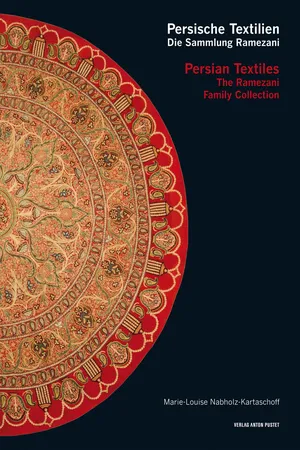
eBook - ePub
Persische Textilien. Die Sammlung Ramezani
Persian Textiles. The Ramezani Family Collection
- 160 pages
- English
- ePUB (mobile friendly)
- Available on iOS & Android
eBook - ePub
Persische Textilien. Die Sammlung Ramezani
Persian Textiles. The Ramezani Family Collection
About this book
From zar-baft to qalamkarPersian textiles from the late 19th to the early 20th century display a multitude of techniques as well as many different kinds of illustrations. Besides, they are used in a number of different ways. As the subtitle indicates, they range from precious brocades (Zar-baft) to printed cloths (Qalamkar), from opulent oriental floral patterns to narrative depictions, from hangings, covers and garments to ones that are used for very special purposes – for example, cloths on which ceremonial meals are served and ones employed as chair and saddle covers, or animal trappings. In this richly illustrated publication, Marie-Louise Nabholz-Kartaschoff presents examples from a highly diversified private collection.
Information

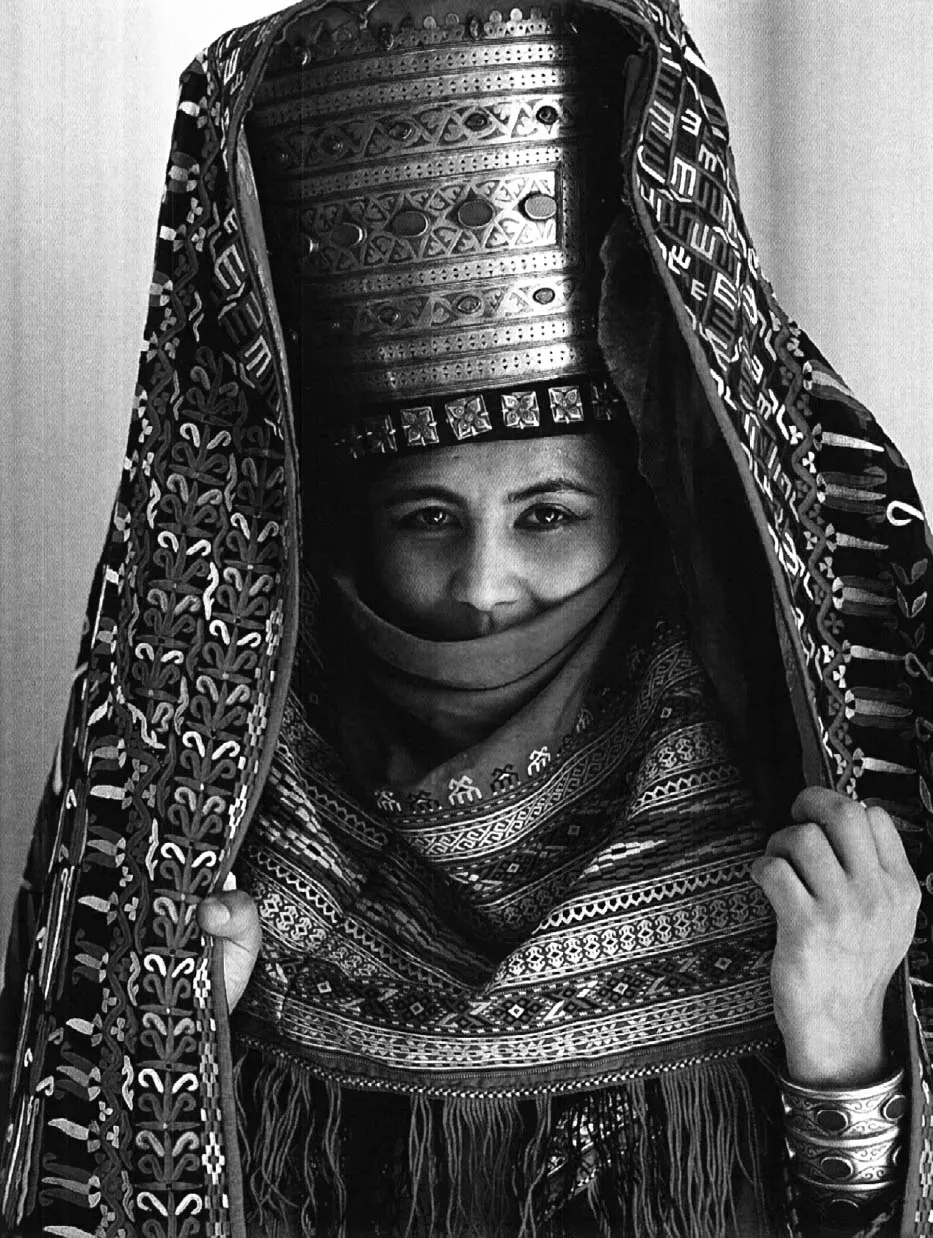
Verheiratete Tekke-Turkmenin mit chyrpy-Umhang [60–63]
Turkmenistan, Ashgabat, 1987
Married Tekke Turkmen woman wearing a chyrpy mantle [60–63], Turkmenistan, Ashgabat, 1987
Bachtiari
Die Bachtiari leben vor allem in der Provinz Tschahār Mahāl und Bachtiyāri zwischen Chuzestan und Isfahan. Nur noch wenige Gruppen sind heute weiterhin Viehzüchternomaden, wie sie im spannenden Dokumentarfilm „Grass“ aus dem Jahr 1925 eindrücklich beschrieben sind: 50 000 Menschen mit 500 000 Tieren, die auf ihrer Wanderung zu den Sommerweiden hohe Berggebiete und den tosenden Karun-Fluss durchqueren mussten. Zu Beginn des 20. Jahrhunderts spielten die Bachtiari eine bedeutende politische Rolle, unterstützten sie doch maßgeblich die konstitutionelle Revolution (1905–11), die zur Einsetzung eines Parlaments führte und mit der eine allmähliche Modernisierung des Landes einsetzte. Unter Reza Shah Pahlavi I. wurde ihr Einfluss jedoch immer stärker von der Zentralregierung beschnitten.
Unverkennbar für die Männertracht der Bachtiari ist die chuqa, eine tunikaartige, vorne offene Jacke ohne Ärmel, die in manchen Fällen mit einem Gürtel zusammengehalten wird [50]. Sie besteht aus zwei horizontal zusammengenähten Bahnen mit feinen dunkelblauen Streifen. Im oberen Teil erscheinen gestufte Pfeilspitzen, die in Wirktechnik – ähnlich wie bei Kelimteppichen – eingefügt sind. Diese Musterung erinnert etwas an höfische Männergewänder (aba), bei denen solche Motive an gleicher Stelle, jedoch in viel kunstvolleren Formen und mit Goldfäden eingewebt sind.
Bakhtiari
The Bakhtiari people mainly live in the Chaharmahal and Bakhtiari Province, which is located between Khuzestan and Isfahan. Only a few groups are still nomadic cattle breeders, like the ones brilliantly depicted in the thrilling documentary “Grass” from 1925. There, 50,000 tribesmen and their 500,000 cattle migrate through high mountain regions in a monthlong trek to their summer grasslands, and they have to cross the roaring Karun river to get there. At the dawn of the 20th century, the Bakhtiari people played an important role in Iranian politics. They strongly supported the Constitutional Revolution (1905-11), which finally established a parliament and gradually led Iran into an era of evolution into modernization. Under the reign of Reza Shah Pahlavi I, however, their influence was increasingly restricted by the central government.
A distinctive feature of the clothing of Bakhtiari men is the chuqa, a sleeveless, tunic-like jacket [50]. It is open in front and sometimes held together with a belt. Two panels of material with thin, dark-blue stripes are sewn together horizontally. The upper one is decorated with stepped arrowheads inserted in tapestry technique; they are reminiscent of men’s court robes (aba) with similar, but more ornate designs that are woven with gold threads.
Quellen/Sources: Digard 2015; Fellinger 2018; Gluck 1977; en.wikipedia.org/wiki/Bakhtiari_people

Bachtiari-Nomaden in traditioneller Kleidung mit chuqa-Jacken und Filzkappen (shaw-kolah).
Provinz Tschahār Mahāl und Bachtiyāri, Bezirk Saman or Shahr-e Kord, 1980er-Jahre
Bakhtiari nomads with traditional chuqa jackets and felt caps (shaw-kolah)
Chaharmahal and Bakhtiari Prov., Saman or Shahr-e Kord county, 1980s

50
Bachtiari Männerjacke chuqa
L. 94 cm, B. 68 cm
Provinz Tschahār Mahāl und Bachtiyāri, etwa 1940
Wolle, Wirktechnik
Inv. Nr. 091
50
Bakhtiari men’s jacket chuqa
L. 94 cm, W. 68 cm
Chaharmahal and Bakhtiari Province, around 1940
Wool, tapestry technique
Inv.no. 091
Belutschen
Der Lebensraum der Belutschen erstreckt sich heute über ein ausgedehntes Gebiet und verschiedene Staaten: Turkmenistan, Afghanistan, Pakistan, Nordwest-Indien und Iran, dort hauptsächlich die südöstliche Provinz Sistan-Baluchistan. Die meisten Belutschen in diesem Gebiet leben heute halbsesshaft oder sesshaft in Dörfern, nur noch wenige nomadisieren noch mit ihren Viehherden in abgelegenen Berggebieten.
Teppichexperten und -sammler denken beim Stichwort „Belutschen“ spontan an Knüpfteppiche, seit den 1970er-Jahren gilt ihr Interesse zunehmend auch Flachgeweben. Weitgehend von der Fachwelt unbeachtet aber blieben bis heute die großartigen Stickereien, mit denen Belutschen-Frauen Kleidungsstücke verzieren.
Dies ist umso erstaunlicher, als diese Handwerkskunst im iranischen Baluchistan trotz aller schwierigen Lebensumstände lebendig geblieben ist und auch im pakistanischen Teil in geringerem Maß noch ausgeübt wird. Doch entstehen heute neue kommerzielle Formen und Materialien sowie Farbkombinationen haben sich in den letzten Jahrzehnten stark verändert.
Im iranischen Gebiet trugen Frauen und Mädchen noch Anfang des 21. Jahrhunder...
Table of contents
- Cover
- Titel
- Widmung
- Inhalt
- Vorwort
- Preface
- Einleitung
- Introduction
- Zar-baft – Golden glänzende Seidenstoffe
- Zar-baft—Shiny Golden Silk Fabrics
- Termeh – Fein gemusterte Gewebe aus Wolle
- Termeh—Finely-Patterned Wool Weaves
- Pateh-duzi – Stickereien aus Kerman
- Pateh-duzi—Embroideries from Kerman
- Rasht-duzi – Patchworkstickereien aus Rasht
- Rasht-duzi—Patchwork Embroideries from Rasht
- Dara’i – Seidene Kettikat-Stoffe
- Dara’i—Silk Warp Ikat Fabrics
- Qalamkar – Gedruckte Ornamente und gemalte Geschichten
- Qalamkar—Printed Ornaments and Painted Stories
- Stammestextilien aus Persien und Zentralasien
- Literaturverzeichnis
- Bildnachweis
- Kurzbiographie Marie-Louise Nabholz-Kartaschoff
- Impressum
Frequently asked questions
Yes, you can cancel anytime from the Subscription tab in your account settings on the Perlego website. Your subscription will stay active until the end of your current billing period. Learn how to cancel your subscription
No, books cannot be downloaded as external files, such as PDFs, for use outside of Perlego. However, you can download books within the Perlego app for offline reading on mobile or tablet. Learn how to download books offline
Perlego offers two plans: Essential and Complete
- Essential is ideal for learners and professionals who enjoy exploring a wide range of subjects. Access the Essential Library with 800,000+ trusted titles and best-sellers across business, personal growth, and the humanities. Includes unlimited reading time and Standard Read Aloud voice.
- Complete: Perfect for advanced learners and researchers needing full, unrestricted access. Unlock 1.4M+ books across hundreds of subjects, including academic and specialized titles. The Complete Plan also includes advanced features like Premium Read Aloud and Research Assistant.
We are an online textbook subscription service, where you can get access to an entire online library for less than the price of a single book per month. With over 1 million books across 990+ topics, we’ve got you covered! Learn about our mission
Look out for the read-aloud symbol on your next book to see if you can listen to it. The read-aloud tool reads text aloud for you, highlighting the text as it is being read. You can pause it, speed it up and slow it down. Learn more about Read Aloud
Yes! You can use the Perlego app on both iOS and Android devices to read anytime, anywhere — even offline. Perfect for commutes or when you’re on the go.
Please note we cannot support devices running on iOS 13 and Android 7 or earlier. Learn more about using the app
Please note we cannot support devices running on iOS 13 and Android 7 or earlier. Learn more about using the app
Yes, you can access Persische Textilien. Die Sammlung Ramezani by Marie-Louise Nabholz-Kartaschoff in PDF and/or ePUB format, as well as other popular books in Kunst & Kunst Allgemein. We have over one million books available in our catalogue for you to explore.