Cut in Half
eBook - ePub

Cut in Half

The Hidden World Inside Everyday Objects

  1. 144 pages
  2. English
  3. ePUB (mobile friendly)
  4. Available on iOS & Android
eBook - ePub

Cut in Half

The Hidden World Inside Everyday Objects

About this book

A science writer and a photographer explore the complicated inner workings of seeming simple everyday objects.

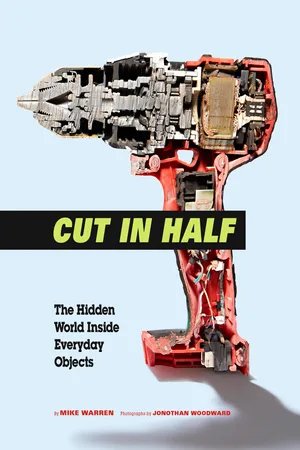
What exactly is inside a laptop, a golf ball, a vacuum cleaner, or a novelty singing fish toy? The insides of these and dozens of other objects are revealed in this photographic exploration of the stuff all around us, exposed and explained. With the help of a high-pressure waterjet cutter able to slice through four inches of steel plate, designer and fabricator Mike Warren (creator of the popular Cut in Half YouTube channel) cuts into everything from boom boxes to boxing gloves, oil filters to seashells, describing and demystifying the inner workings and materials of each. With gorgeously detailed photography, Cut in Half is a fascinating and accessible popular science look at the extraordinary in the everyday.

Praise for Cut in Half

"If you've ever wondered what it looks like inside a hair dryer, or a baseball, or a Magic 8-ball, this book is for you. Mike Warren cuts things in half with a high-pressure waterjet cutter and then has an explanation of what you're looking at inside. . . . One fun feature: the cover of the book itself is "cut in half" along the center." —GeekDad

"A book of mesmerizing photographs of objects that have been perfectly cut in half. . . . Accompanying each photograph are explanations from Warren, who has been doing this for years on his YouTube channel, that walk us through the amazing complexity of the many apparently simple objects." — Fast Company

"Let your device addict explore the fascinating inner workings of common household items with this book from gadget You Tuber Mike Warren." — Real Simple

Frequently asked questions

Yes, you can cancel anytime from the Subscription tab in your account settings on the Perlego website. Your subscription will stay active until the end of your current billing period. Learn how to cancel your subscription.
No, books cannot be downloaded as external files, such as PDFs, for use outside of Perlego. However, you can download books within the Perlego app for offline reading on mobile or tablet. Learn more here.
Perlego offers two plans: Essential and Complete
  • Essential is ideal for learners and professionals who enjoy exploring a wide range of subjects. Access the Essential Library with 800,000+ trusted titles and best-sellers across business, personal growth, and the humanities. Includes unlimited reading time and Standard Read Aloud voice.
  • Complete: Perfect for advanced learners and researchers needing full, unrestricted access. Unlock 1.4M+ books across hundreds of subjects, including academic and specialized titles. The Complete Plan also includes advanced features like Premium Read Aloud and Research Assistant.
Both plans are available with monthly, semester, or annual billing cycles.
We are an online textbook subscription service, where you can get access to an entire online library for less than the price of a single book per month. With over 1 million books across 1000+ topics, we’ve got you covered! Learn more here.
Look out for the read-aloud symbol on your next book to see if you can listen to it. The read-aloud tool reads text aloud for you, highlighting the text as it is being read. You can pause it, speed it up and slow it down. Learn more here.
Yes! You can use the Perlego app on both iOS or Android devices to read anytime, anywhere — even offline. Perfect for commutes or when you’re on the go.
Please note we cannot support devices running on iOS 13 and Android 7 or earlier. Learn more about using the app.
Yes, you can access Cut in Half by Mike Warren in PDF and/or ePUB format. We have over one million books available in our catalogue for you to explore.

Information

eBook ISBN
9781452168746
Subtopic
Photography
ELECTRONICS

Digital Camera

The basic principle of how a camera works has not changed much since its invention. In the simplest terms, they allow light to pass through an opening, focusing it, and preserving an image. The primary differences today come from the electronic mechanics of handling the optical aspects, such as the lenses, and the new way of translating the image to a digital medium rather than imprinting it on film.
This point-and-shoot digital camera shows the lens pathway to the sensor inside that captures the image. The light from an image is focused through the lenses and projected onto a sensor at the back of the camera. This sensor converts the light into pixels, saves the data to the storage card, and displays it on a screen on the back of the camera.
Looking inside, it’s fun to see how compact these devices really are, packing the sensor, digital processor, and display screen in such a tight package.
In this image you can also see some rusting on the interior, which can be a side effect of the waterjet making contact with steel parts, causing oxidation.
image

DSLR Camera

image
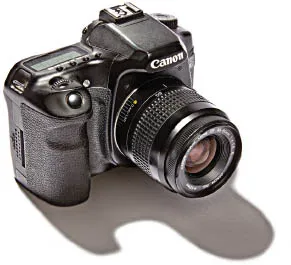
DSLR (digital single-lens reflex) cameras are just an updated version of the first cameras, which used a cover over an exposure plate to capture an image. Instead of an exposure plate, the DSLR uses a large digital sensor to capture the light information of the image, and produces a picture saved to a memory card. The sensor is completely covered by a small mirror that reflects the light from the lens upward, toward a prism that shapes the image into the eyepiece. When the shutter is pressed, the mirror moves out of the way, exposes the sensor to the light from the lens, and captures the picture. All this happens in a split second, but you can hear the action every time the shutter is pressed.
The large lens assembly focuses light into the camera. The lenses can be adjusted to magnify the image and shift the focal point, operated by the zoom and focus rings on the camera lens.
image

LED Light Bulb

image
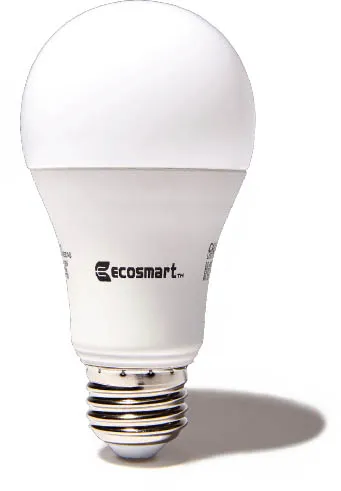
Even the ubiquitous light bulb reveals secrets when we look inside. Unlike traditional incandescent light bulbs that heat a thin magnesium filament inside a vacuum to generate light, this modern bulb uses light emitting diodes (LEDs).
This LED bulb has a ring of lights covered by a plastic dome that diffuses the light to an even glow. The power to the LEDs is controlled by a circuit board and electrical components hidden inside the body of the bulb. Not only are these types of bulbs more energy efficient, but they also outlast incandescent bulbs as there are fewer parts that wear out (for instance, no thin filament as in an incandescent bulb). As an added layer of durability, the empty space inside the bulb body is filled with a resin, which solidifies and protects the components from movement. This, combined with the plastic dome cover, means that this bulb could be dropped without causing any damage. How neat is that?
image

Electric Massager

image
These massagers use an electric motor with an off-center weight on the motor shaft to create an eccentric movement inside the device. This movement translates to a vibrating motion that can be applied to your muscles to relieve tension.
The battery compartment on the top has foam padding to help keep the batteries in place and prevent them from rattling around when vibrating. The top half is separated from the bottom with a silicone gasket, to isolate the vibrations to the lower half from the hand grip up top, insulating your hands from vibration fatigue.
image

Audio Cassette Recorder

image
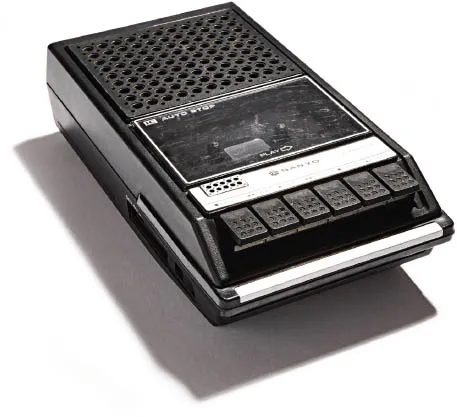
Once upon a time (in the 1960s), cassette tapes were an exciting innovation in portable recorded sound technology. Cassettes consist of a ribbon of tape running between two reels and encoded with magnetized information, allowing audio to be recorded and played back. While vinyl records were made in a factory and could only be played, cassette tapes were sold either containing pre-recorded content or as a recordable blank cassette, allowing audio to be recorded at home, a revolutionary (and contentious) development at the time.
Once a cassette tape is loaded into the machine, a magnetic device called the head is pushed against the tape ribbon. Much like a record stylus reads grooves on a record to create sound, the sensitive cassette head reads the tape for variations of the magnetic pattern, translating the information on tape into sound. A motor t...

Table of contents

  1. Cover
  2. Title
  3. Dedication
  4. Copyright
  5. Contents
  6. Introduction
  7. Household Appliances
  8. Sports Equipment
  9. Electronics
  10. Toys and Games
  11. Other Stuff
  12. About the Author and Photographer
  13. Acknowledgments
  14. Chronicle Ebooks