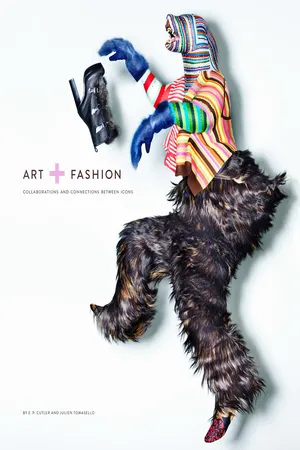
- 224 pages
- English
- ePUB (mobile friendly)
- Available on iOS & Android
eBook - ePub
About this book
A volume of magnificent proportions, Art + Fashion is as exciting and elegant as the creative partnerships it celebrates. Spanning numerous eras, men and women's fashion, and a wide range of art mediums, these 25 collaborative projects reveal the astonishing work that results when luminaries from the art world (such as Pollock, Haring, and Hirst) come together with icons of the fashion world (including Saint Laurent, Westwood, McQueen). From 20th-century legends such as Elsa Schiaparelli and her famous lobster dress painted by Salvador Dalí to 21st-century trailblazers such as Cindy Sherman and her self-portraits in vintage Chanel, these electric and provocative pairings—represented in lavish visuals and thoughtful essays reflecting on the history of each project—brim with the energy and possibility of powerful forces uniting.
Trusted by 375,005 students
Access to over 1.5 million titles for a fair monthly price.
Study more efficiently using our study tools.
Information
Topic
DesignSubtopic
Fashion Design
COLLABORATIONS


JACKSON POLLOCK

CECIL BEATON

The March 1, 1951 vogue featured a four-page spread of photographs by Cecil Beaton. The “Spring Ball Gowns” were modeled by Irene and Sophie in front of Jackson Pollock’s works from 1950: Lavender Mist (Number 1), Number 27, Number 28, and Autumn Rhythm (Number 30), then on display at the Betty Parsons Gallery. The American-made but Paris-inspired gowns were available for order at New York’s top department stores: Henri Bendel, Milgrim, Lord & Taylor, and the Salon Moderne at Saks Fifth Avenue.
Featuring artists in fashion magazines was by no means a new phenomenon. Profiles and artist studio visits have long been segments in fashion publications. Harper’s Bazaar had name-dropped Jackson Pollock (1912–1956) in its April 1944 issue, with a double-page spread dedicated to American painters. However, Brit Cecil Beaton (1904–1980) ventured further, using Jackson Pollock’s work in a fashion spread, not an artist profile. Numerous art critics saw Beaton’s actions as drastically overstepping. This Vogue editorial caused a commotion that continues to this day because Cecil Beaton visually compared the dusky blue of the Bianchini silk dress to the drips of color found in Jackson Pollock’s Lavender Mist, the perky pink of Henri Bendel’s silk paper taffeta day dress and the warm browns in Pollock’s Autumn Rhythm. The bold line in the sand between the disciplines of art and fashion was blurred. From the debate, one would think riots ensued. How dare Beaton compare high art with fashion, a lower art—if an art at all! The models obstructed Pollock’s “genius” work!8 Pollock’s art matters more than Vogue fashions! Vociferous objection!
Yet, for those not mired in the hundreds of pages of dense, often snarky art theory and criticism, the spread illustrates a beautiful cultural confluence. The same societal realities that birthed modernism produced indulgent post–WWII New Looks. What’s more, with this fashion spread, women in search of the perfect frock were educated not just on the new trends but also on high society’s new obsession: Jackson Pollock and his “dazzling and curious” creations. As Vogue wrote, Pollock’s works had been purchased by “the most astute private collectors and museum directors in the country,” among them people affiliated with the Museum of Modern Art in New York, the San Francisco Museum of Modern Art, and Yale University, as well as Pollock’s first agent, Peggy Guggenheim.9
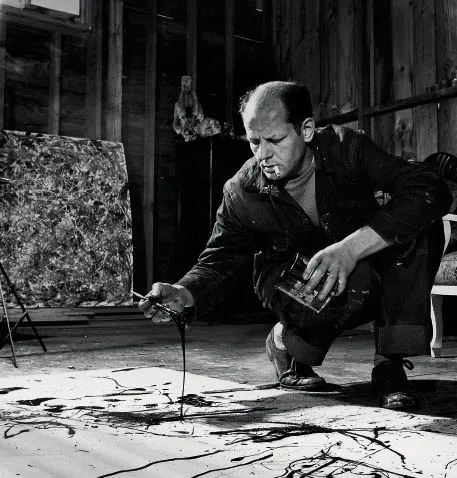
JACKSON POLLOCK
Vogue viewed Jackson Pollock in a positive light when Pollock’s paintings were barely selling—the Betty Parsons Gallery only sold one Pollock, Lavender Mist, during the exhibition—and critics were finding new ways to disparage his work. Venice-based critic Bruno Alfieri had mused a year earlier that Jackson Pollock’s work represented “absolutely nothing” other than perhaps “chaos, absolute lack of harmony; complete lack of structural organization; total absence of technique; once again, chaos.”10
While it seems unlikely that Pollock was contacted for permission regarding the shoot beforehand, he was happy to be in Vogue, writing to his friend that “the issue of Vogue has three pages of my paintings (with models of course). Will send a copy.”11
So, what’s all the fuss about?

THE NEW SOFT LOOK FEATURING A PAINTING BY JACKSON POLLOCK | CECIL BEATON FOR VOGUE, 1951

THE NEW SOFT LOOK FEATURING PAINTINGS BY JACKSON POLLOCK | CECIL BEATON FOR VOGUE, 1951

ALEX PRAGER

BOTTEGA VENETA

Don’t underestimate the power of shoes. In 1974, William Eggleston photographed bedraggled wingtips under a bed. Art critic Hilton Kramer was less than impressed, smirking that if he ever wanted to see that, he’d go home and look at his own. Yet, twenty-five years later, the stark, poignant simplicity of Eggleston’s work inspired then-directionless Alex Prager (b. ...
Table of contents
- Cover
- Title
- Dedication
- Copyright
- Contents
- Acknowledgments
- Introduction
- Quotes
- Collaborations
- Epilogue: Zevs
- Bibliography
- Endnotes
- Art Credits
- Index
- About the Authors
- Chronicle Ebooks
Frequently asked questions
Yes, you can cancel anytime from the Subscription tab in your account settings on the Perlego website. Your subscription will stay active until the end of your current billing period. Learn how to cancel your subscription
No, books cannot be downloaded as external files, such as PDFs, for use outside of Perlego. However, you can download books within the Perlego app for offline reading on mobile or tablet. Learn how to download books offline
Perlego offers two plans: Essential and Complete
- Essential is ideal for learners and professionals who enjoy exploring a wide range of subjects. Access the Essential Library with 800,000+ trusted titles and best-sellers across business, personal growth, and the humanities. Includes unlimited reading time and Standard Read Aloud voice.
- Complete: Perfect for advanced learners and researchers needing full, unrestricted access. Unlock 1.5M+ books across hundreds of subjects, including academic and specialized titles. The Complete Plan also includes advanced features like Premium Read Aloud and Research Assistant.
We are an online textbook subscription service, where you can get access to an entire online library for less than the price of a single book per month. With over 1.5 million books across 990+ topics, we’ve got you covered! Learn about our mission
Look out for the read-aloud symbol on your next book to see if you can listen to it. The read-aloud tool reads text aloud for you, highlighting the text as it is being read. You can pause it, speed it up and slow it down. Learn more about Read Aloud
Yes! You can use the Perlego app on both iOS and Android devices to read anytime, anywhere — even offline. Perfect for commutes or when you’re on the go.
Please note we cannot support devices running on iOS 13 and Android 7 or earlier. Learn more about using the app
Please note we cannot support devices running on iOS 13 and Android 7 or earlier. Learn more about using the app
Yes, you can access Art + Fashion by E.P. Cutler,Julien Tomasello in PDF and/or ePUB format, as well as other popular books in Design & Fashion Design. We have over 1.5 million books available in our catalogue for you to explore.