This book is available to read until 23rd December, 2025
- 416 pages
- English
- ePUB (mobile friendly)
- Available on iOS & Android
eBook - ePub
Available until 23 Dec |Learn more
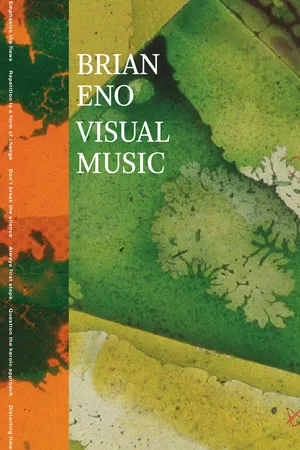
Brian Eno: Visual Music
About this book
This comprehensive monograph celebrates the visual art of renowned musician Brian Eno. Spanning more than 40 years, Brian Eno: Visual Music weaves a dialogue between Eno's museum and gallery installations and his musical endeavors—all illustrated with never-before-published archival materials such as sketchbook pages, installation views, screenshots, and more. Steve Dietz, Brian Dillon, Roy Ascott, and William R. Wright contextualize Eno's contribution to new media art, while Eno himself shares insights into his process. Also included is a download code for a previously unreleased piece of music created by Eno, making this ebook a requisite for fans and collectors.
Frequently asked questions
Yes, you can cancel anytime from the Subscription tab in your account settings on the Perlego website. Your subscription will stay active until the end of your current billing period. Learn how to cancel your subscription.
No, books cannot be downloaded as external files, such as PDFs, for use outside of Perlego. However, you can download books within the Perlego app for offline reading on mobile or tablet. Learn more here.
Perlego offers two plans: Essential and Complete
- Essential is ideal for learners and professionals who enjoy exploring a wide range of subjects. Access the Essential Library with 800,000+ trusted titles and best-sellers across business, personal growth, and the humanities. Includes unlimited reading time and Standard Read Aloud voice.
- Complete: Perfect for advanced learners and researchers needing full, unrestricted access. Unlock 1.4M+ books across hundreds of subjects, including academic and specialized titles. The Complete Plan also includes advanced features like Premium Read Aloud and Research Assistant.
We are an online textbook subscription service, where you can get access to an entire online library for less than the price of a single book per month. With over 1 million books across 1000+ topics, we’ve got you covered! Learn more here.
Look out for the read-aloud symbol on your next book to see if you can listen to it. The read-aloud tool reads text aloud for you, highlighting the text as it is being read. You can pause it, speed it up and slow it down. Learn more here.
Yes! You can use the Perlego app on both iOS or Android devices to read anytime, anywhere — even offline. Perfect for commutes or when you’re on the go.
Please note we cannot support devices running on iOS 13 and Android 7 or earlier. Learn more about using the app.
Please note we cannot support devices running on iOS 13 and Android 7 or earlier. Learn more about using the app.
Yes, you can access Brian Eno: Visual Music by Christopher Scoates in PDF and/or ePUB format, as well as other popular books in Art & Artist Monographs. We have over one million books available in our catalogue for you to explore.
Information
1.1 | THE AESTHETICS OF TIMEPROCESS OVER PRODUCT: THE ART SCHOOL YEARS |
CHRISTOPHER SCOATES |
Color directly influences the soul. Color is the keyboard, the eyes are the hammers, the soul is the piano with many strings. The artist is the hand that plays, touching one key or another purposively, to cause vibrations in the soul.
—Wassily Kandinsky1
In Western thought, music, and in particular its attendant principles of proportion and harmony, have informed an understanding of the world since antiquity. Within the arts, the relationship between music and painting has been understood as one based on the shared concerns of composition, proportional relationships, and harmonic ratios. But it was not until the nineteenth century—with the rise in scientific studies on color, optics, and perception—that the connection between visual and auditory stimuli took on greater currency. In the wake of research by scientists and theorists such as Joseph Plateau, Michel Eugène Chevreul, and Ogden Rood, the dialogue between painting and music began in earnest. In his 1902 essay “Musical Painting and the Fusion of the Arts,” Camille Mauclair posited a correlation between the paintings of Claude Monet and the musical compositions of Claude Debussy, concluding that “chroma, harmony, value, theme, [and] motif” are “employed equally by musicians and painters.”2 In 1912 the British art critic Roger Fry, himself a member of the Bloomsbury group, coined the term visual music to describe the abstract works of the Russian painter Wassily Kandinsky.3 Like many artists of the avant-garde, Kandinsky was interested in synesthesia—a rare neurological condition that produces a cross-sensory perceptual fusion, often between color and sound.4 He explored this synthesis in paintings, stage compositions, and writings such as Concerning the Spiritual in Art (1911) and “On Stage Composition” (1912).5 For Kandinsky, a trained pianist and cellist, the emotional power of music provided inspiration for abstract paintings that used line, shape, color, and form to produce a concordance between musical and visual tones (fig. 1).
Music, as an inherently abstract form, provided a potent metaphor for artists of the avant-garde in their search for an alternative to prevailing modes of representation. Among them were the Czech painter František Kupka; Paul Klee, whose paintings have often been interpreted as graphic transcriptions of musical rhythm; and Francis Picabia, who asserted that the rules of both painting and music should be learned as follows: “If we grasp without difficulty the meaning and the logic of a musical work it is because this work is based on the laws of harmony and composition of which we have either the acquired knowledge or the inherited knowledge . . . The laws of this new convention [painting] have as yet been hardly formulated but they will become gradually more defined, just as musical laws have become more defined, and they will very rapidly become as understandable as were the objective representations of nature.”6 For Piet Mondrian, the improvisational attitude of jazz was particularly significant, and its influence is evident in the dynamic rhythms and pulsating colors of Broadway Boogie Woogie (1942) (fig. 2).

fig. 1
Wassily Kandinsky, Composition 8 (Komposition 8), July 1923, oil on canvas, 55 ⅛ × 79 ⅛ inches. Solomon R. Guggenheim Museum, New York, Solomon R. Guggenheim Founding Collection, by gift 37.262.
Wassily Kandinsky, Composition 8 (Komposition 8), July 1923, oil on canvas, 55 ⅛ × 79 ⅛ inches. Solomon R. Guggenheim Museum, New York, Solomon R. Guggenheim Founding Collection, by gift 37.262.
While these painters invoked music as an important touchstone and created works that gave visual form to its syncopations and staccato rhythms, they remained rooted in the static, two-dimensional plane of easel painting. It wasn’t until the latter half of the twentieth century that artists began to engage more directly with “real life” in their challenge to the conventions of art making. Turning to their bodies, the landscape, and everyday life to extend the parameters of aesthetic experimentation, they radicalized the relationship between the artist, the art object, and the audience. In this burgeoning effort to rethink artistic practice during the late 1950s and early 1960s, happenings and performance art came to the fore among a host of emerging forms that also included Fluxus, an international collective of artists noted for its work across the disciplines of visual arts, experimental film, literature, performance, and music. Fluxus mounted a critique of individual authority by proclaiming, “anyth...
Table of contents
- Cover
- Title
- Copyright
- Dedication
- Contents
- Downloadable Music: Cam (Canada, Amsterdam, Milan), 1983–1984
- Foreword: Extending Aesthetics
- Acknowledgments
- 1.1 The Aesthetics of Time: Process Over Product: The Art School Years
- 1.2 The Aesthetics of Time: Mistakes and Random Errors: Chance, Systems, and Process
- 1.3 The Aesthetics of Time: Color Change: Experiencing Light as A Physical Presence
- 2 Gone to Earth
- 3 Perfume, Defense, and David Bowie’s Wedding
- 4 Learning From Eno
- 1.4 The Aesthetics of Time: 77 Million Paintings: Evolving and Living in Time
- 5 A Conversation Between Will Wright and Brian Eno
- List of Plates
- Image Credits
- Contributor Biographies
- Index
- About the Author