eBook - ePub
Available until 23 Dec |Learn more
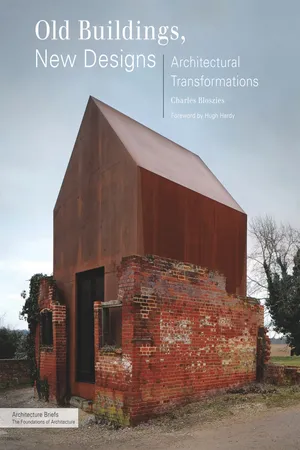
Old Buildings, New Designs
Architectural Transformations
This book is available to read until 23rd December, 2025
- 144 pages
- English
- ePUB (mobile friendly)
- Available on iOS & Android
eBook - ePub
Available until 23 Dec |Learn more
About this book
Increasingly, architects are hired to design new work for existing structures. Whether for reasons of preservation, sustainability, or cost-effectiveness, the movement to reuse buildings presents a variety of design challenges and opportunities. Old Buildings, New Designs is an Architecture Brief devoted to working within a given architectural fabric from the technical issues that arise from aging construction to the controversy generated by the various project stakeholders to the unique aesthetic possibilities created through the juxtaposition of old and new.
Frequently asked questions
Yes, you can cancel anytime from the Subscription tab in your account settings on the Perlego website. Your subscription will stay active until the end of your current billing period. Learn how to cancel your subscription.
At the moment all of our mobile-responsive ePub books are available to download via the app. Most of our PDFs are also available to download and we're working on making the final remaining ones downloadable now. Learn more here.
Perlego offers two plans: Essential and Complete
- Essential is ideal for learners and professionals who enjoy exploring a wide range of subjects. Access the Essential Library with 800,000+ trusted titles and best-sellers across business, personal growth, and the humanities. Includes unlimited reading time and Standard Read Aloud voice.
- Complete: Perfect for advanced learners and researchers needing full, unrestricted access. Unlock 1.4M+ books across hundreds of subjects, including academic and specialized titles. The Complete Plan also includes advanced features like Premium Read Aloud and Research Assistant.
We are an online textbook subscription service, where you can get access to an entire online library for less than the price of a single book per month. With over 1 million books across 1000+ topics, we’ve got you covered! Learn more here.
Look out for the read-aloud symbol on your next book to see if you can listen to it. The read-aloud tool reads text aloud for you, highlighting the text as it is being read. You can pause it, speed it up and slow it down. Learn more here.
Yes! You can use the Perlego app on both iOS or Android devices to read anytime, anywhere — even offline. Perfect for commutes or when you’re on the go.
Please note we cannot support devices running on iOS 13 and Android 7 or earlier. Learn more about using the app.
Please note we cannot support devices running on iOS 13 and Android 7 or earlier. Learn more about using the app.
Yes, you can access Old Buildings, New Designs by Charles Bloszies in PDF and/or ePUB format, as well as other popular books in Architecture & Architecture Design. We have over one million books available in our catalogue for you to explore.
Information

For Courtney
The Architecture Briefs series takes on a variety of single topics of interest to architecture students and young professionals. Field-specific and technical information are presented in a user-friendly manner along with basic principles of design and construction. The series familiarizes readers with the concepts and technical terms necessary to successfully translate ideas into built form.
Also in this series:
Architects Draw
Sue Ferguson Gussow, 978-1-56898-740-8
Architectural Lighting: Designing with Light and Space
Hervé Descottes, Cecilia E. Ramos, 978-1-56898-938-9
Architectural Photography the Digital Way
Gerry Kopelow, 978-1-56898-697-5
Building Envelopes: An Integrated Approach
Jenny Lovell, 978-1-56898-818-4
Digital Fabrications: Architectural and Material Techniques
Lisa Iwamoto, 978-1-56898-790-3
Ethics for Architects: 50 Dilemmas of Professional Practice
Thomas Fisher, 978-1-56898-946-4
Model Making
Megan Werner, 978-1-56898-870-2
Philosophy for Architects
Branko Mitrovic, 978-1-56898-994-5
Image Credits
All images courtesy of the author unless otherwise noted on image page or as listed: Cover: Philip Vile; 22: Gilly Walker (Creative Commons licensed on Flickr; http://www.pixellated.typepad.com/); 27 (bottom): Ian A. Holton (Creative Commons licensed on Flickr; http://www.flickr.com/people/poeloq/); 59: Brother Randy Greve (Creative Commons licensed on Flickr; http://www.holycrossmonastery.com/); 100 (right): Flickr user _ppo
Published by
Princeton Architectural Press
37 East Seventh Street
New York, New York 10003
Visit our website at www.papress.com.
© 2012 Princeton Architectural Press
All rights reserved
15 14 13 12 4 3 2 1 First edition
No part of this book may be used or reproduced in any manner without written permission from the publisher, except in the context of reviews.
Every reasonable attempt has been made to identify owners of copyright. Errors or omissions will be corrected in subsequent editions.
Editor: Megan Carey
Designer: Jan Haux
Special thanks to: Bree Anne Apperley, Sara Bader, Nicola Bednarek Brower, Janet Behning, Fannie Bushin, Carina Cha, Tom Cho, Penny (Yuen Pik) Chu, Russell Fernandez, Linda Lee, Jennifer Lippert, John Myers, Katharine Myers, Margaret Rogalski, Dan Simon, Andrew Stepanian, Paul Wagner, Joseph Weston, and Deb Wood of Princeton Architectural Press —Kevin C. Lippert, publisher
Library of Congress Cataloging-in-Publication Data
Bloszies, Charles.
Old buildings, new designs : architectural transformations / Charles Bloszies. — 1st ed.
p. cm. — (Architecture briefs series)
Includes bibliographical references.
ISBN 978-1-61689-035-3 (alk. paper)
ISBN 978-1-61689-201-2 (digital)
1. Architecture—Aesthetics. 2. Buildings—Repair and reconstruction. 3. Buildings—Additions. I. Title. II. Title: Architectural transformations.
NA2500.B575 2012
720.28’6—dc22
2011015979

Table of Contents
Foreword, Hugh Hardy, FAIA
Preface
Chapter 1
Old Buildings
Appeal of Old Buildings
Familiar Idioms
The Urge to Preserve
Buildings Have Finite Useful Lives
Not Everything Old Is Good
Interventions
Chapter 2
Sustainable Urban Environments
Critical Components for Urban Sustainability
Reuse and Repurposing of Old Buildings
Public Policy
Will Smart Growth Take Place?
Sustainable Design Implications
Aesthetic Implications
Chapter 3
Design Propositions
The Question of Context
Lessons from History
Design Integrity
Contrast
Critical Viewpoints
Exemplary Work
Chapter 4
Project Execution
Stakeholders
Expectations
Design Difficulties
Building in the Already-Built Environment
Successful Execution
Chapter 5
Case Studies
Case Study Selections
Small Interventions
Dovecote Studio, Haworth Tompkins
Hutong Bubble 32, MAD Architects
Bar Guru Bar, KLab Architects
Ozuluama Penthouse, Architects Collective, at. 103
Il Forte di Fortezza, Markus Scherer and Walter Dietl
Major Additions
Knocktopher Friary, ODOS Architects
Walden Studios, Jensen & Macy Architects
Contemporary Jewish Museum, Studio Daniel Libeskind
Morgan Library, Renzo Piano Building Workshop
Moderna Museet Malmö, Tham & Videgård Arkitekter
CaixaForum Madrid, Herzog & de Meuron
1 Kearny Street, Office of Charles Bloszies
Hearst Tower, Foster + Partners
Repurposed Buildings
Village Street Live-Work, Santos Prescott & Associates
Selexyz Dominicanen Bookshop, Merkx + Girod Architects
California College of the Arts, Leddy Maytum Stacy Architects, KMD Architects, Jensen & Macy Architects, David Meckel
None of the Above
185 Post Street, Brand + Allen Architects
Hôtel Fouquet’s Barrière, Édouard François
Recycled Batteries, Office of Charles Bloszies
Afterword
Notes
Acknowledgments

Hugh Hardy, FAIA
This is an important book for anyone concerned about the future of architecture. Our media culture presents buildings from the perspective that their importance comes from being new, with a preference for works that are unlike anything seen before. Instead, Charles Bloszies has put together an incisive and broad investigation of nineteen projects from all over the world that show thoughtful ways in which new buildings draw their importance from their relation to old. His is a generous survey of an extensive and diverse range of design possibilities. More than a handsome publication of designs, however, this book is also a considered exploration of a subject vital to the profession, one that should encourage great discussion.
Bloszies’s text investigates why old buildings appeal so strongly to the public and the resulting challenge this represents to contemporary design. Conflicts between public policy concerning landmarks law and sustainable design are also factors he explores with clarity. No professional jargon mars his prose, and his goal “to explore successful design approaches for visible interaction between new and old” is admirably realized.
Architecture only exists once it is built. Future architecture must be spoken of with drawings, images, or digital information. Buildings, however, can occupy the present and also speak to us about the past. Although apparently static, their uses change, and their activities ensure they never remain new. Some even become so redolent with historical content they are made into museums and deliberately kept the same through detailed preservation. As an aesthetic ruse, some are even added onto in imitation of the original. This book assumes a more vigorous premise, using change as the vehicle to introduce new ideas, new ways of building. Furthermore, Bloszies cites how this can be accomplished without bowdlerizing the original, careful to respect the values of those who built it.
By not being doctrinaire, a wide selection of examples instructs how to appreciate each project on its own merits. So much of contemporary architecture is created and judged as a standalone consumer product, but pursuit of these pages proves there is no single way to responsibly shape new in relation to old. Although it becomes obvious that the best old work incites the best new, no two projects offer the same aesthetic proposition, nor should they, claims the author. Instead, he argues for an exploration of ideas that celebrates continuity.
Bloszies provides valuable commentary on why the public’s response to historic preservation has been so intense and why it has caused modernism’s once tentative embrace of the public imagination to all but disappear. Today that revolutionary aesthetic often lies buried under a tidal wave of moldings, small-paned windows, sloping shingle roofs, and “vintage details” that provide only an ill-proportioned simulation of decorative skill. Instead, this book puts forward a bracing approach to how new can meet old, always assuming a degree of contrast. It cites examples in three categories: extreme, restrained, and referential. Each results from a consistent and carefully realized design premise chosen for its clari...
Table of contents
- Foreword