![]()
JEFFERSON’S MIND FOR THE UNIVERSITY
While Jefferson’s role in the architectural design of the University is better known, he was no less concerned with what would happen in University classrooms after faculty and students arrived in Charlottesville. Jefferson’s educational vision depended on the careful preparation of the curriculum and choice of professors. Even the purchase of books for the University and their arrangement on the library shelves did not escape his careful planning. Unstinting in his efforts in spite of his age, the first rector devoted himself to fulfilling his own broad educational vision. Innovation would define the curriculum at Mr. Jefferson’s University, excellence the faculty, breadth the library.
While other American colleges in the early nineteenth century required students to follow a prescribed course of study, drawing on his own, insatiable appetite for virtually every possible subject of inquiry, Jefferson’s new university would permit students to pursue an elective course of classes suited to their own interests. This novelty certainly appealed to prospective students, but it also encouraged professors to pursue advanced study in their respective fields and thus to establish the University as a preeminent place of learning. Inspired by the finest faculty, engaged students would promote the development and diffusion of human knowledge. As they formed strong attachments with each other and across the generations, students and teachers would live the Enlightenment.
The disciplines of law and politics (“moral philosophy”), the two positions that Jefferson insisted not be filled by foreign-born professors, posed a special problem. Having lived through what he saw as the political and legal heresies of the 1790s—what he termed the “reign of witches”—and fearing what the Missouri Crisis of 1820 portended for the future of a deeply divided union, Jefferson was more cautious about potentially dangerous innovation in legal and political fields. After all, “The University’s” law students, disproportionately drawn from the Commonwealth and its southern neighbors, were supposed to play a prominent role in protecting republicanism in their states against perceived encroachments by the federal government. This made designing their education all the more critical. Jefferson and his fellow board member James Madison generated a list of appropriate books for the study of law and moral philosophy that made their political preferences clear. Unlike other areas of study, the search for professors of law and moral philosophy would focus on finding the ablest advocate of Democratic-Republican orthodoxy, not simply on recruiting the “best and the brightest.” In these fields, any member of the faculty must be a true Whig/Republican; a New England Federalist (or even a “Richmond lawyer”—the state capital was a suspected cesspool of Federalists) would not do. Further complicating his efforts to fill the law professorship, Jefferson insisted that the incumbent dedicate himself entirely to the University, forgoing any legal practice on the side, as was common for professional faculty at other schools. This was essential if the University was to provide the type of academic community that Jefferson had cherished in his own education. (This requirement also posed a problem in the search for the professor of medicine.) Finally, after multiple failed offers, the University hired John T. Lomax, a noted lawyer from Fredericksburg, and George Tucker, a Democrat congressman from Virginia.
Even in the study of medicine, where a skeptical Jefferson thought quackery and superstition still reigned, he sought to institute the best possible practical curriculum on a solid scientific foundation. Jefferson was justifiably suspicious of the education doctors received in the early nineteenth century, Robert S. Gibson explains, and of the “fanciful theories” that masqueraded as medical knowledge. Building upon studies in chemistry and biology, and grounded in empiricism, a more systematic form of medical education was necessary. The Anatomical Theatre, designed by Jefferson and completed in 1827, would be an important part of that education (as would the necessary practical experience that young graduates would gain working with sick patients after they left Charlottesville). In many respects, Gibson explains, Jefferson’s innovative plans for his medical school presaged the fundamental reforms to medical education that overtook the profession only seventy-five years after the University opened.
Jefferson’s Anatomical Theatre supported a practical medical education. (University of Virginia prints and photographs file, accession no. RG-30/1/10.011, Prints 07390, Albert and Shirley Small Special Collections Library, University of Virginia)
Of necessity, such a forward-looking curriculum required the best faculty. This would prove to be one of Jefferson’s greatest challenges. Thomas Cooper, the first faculty member he hired, faced vocal and damning opposition because of his unorthodox religious views. To protect state funding for the University, Jefferson capitulated to the criticism and dismissed Cooper with a handsome financial settlement, although he never taught a single class. As buildings were completed and the opening of the University began to come into sight, Jefferson sought first to fill his faculty in the United States, turning to New England where higher education was much better established. But few educated northerners wanted to risk the travails of what seemed to be a backwater, southern village. In the face of strong criticism, but undeterred, Jefferson sent Francis Gilmer to England in 1824 on a confidential mission to find faculty for the school’s imminent opening. When six of the eight new faculty seats were filled with foreigners, northern critics quipped that Jefferson might as well have decided that the buildings “should not be built with American bricks and have sent to Europe for them.”1
The buildings, faculty, and curriculum were not the end of the matter in creating the Academical Village. With his manic interest in books, Jefferson’s careful design of the University library—down to elaborating a schema for cataloging books and rules for students’ access to and borrowing of them—would occupy an extraordinary amount of time.
Books took center stage in Jefferson’s Enlightenment philosophy and would have a similar role in his Enlightenment university. If each generation had an obligation to make progress in human affairs and science, the retention of past knowledge, as a foundation and baseline, was essential. By transmitting knowledge across generations, books enabled Enlightenment and progress. More than that, Juretta Jordan Heckscher explains, books were for Jefferson “at all times his chosen companions,” to use his granddaughter Ellen’s words, and “tools of sociability and community.” Projecting on his envisioned students his own studious, bibliophile character, he saw the library as the very center of the University. The opportunity to draw up a comprehensive list of books to be acquired for the University was undoubtedly a gratifying task, the capstone of his great educational enterprise.
Yet drawing up a list of necessary and hoped-for acquisitions was not the end of the bibliophile’s heroic efforts. He also wanted to advise (and control) the cataloging, shelf placement, and regulations for access to the collection. Only after an appeal from the University’s first librarian, notes Endrina Tay, did Jefferson permit a limited relaxation of the rule that required students to have faculty permission to borrow a book, although he relented only while insisting that the librarian must be able to locate every book at any time, a misplaced book being “lost” to the University.
Jefferson was fond of invoking the maxim that “the earth belongs … to the living”; control from the grave was ill advised and, without the complicity of the living generation, a logical impossibility. Alas, the same held true for university rectors. It was not long after Jefferson’s death before some of his careful plans for curriculum and operations at the University of Virginia were amended or ignored—with all due respect, of course, for his ongoing, undying influence.
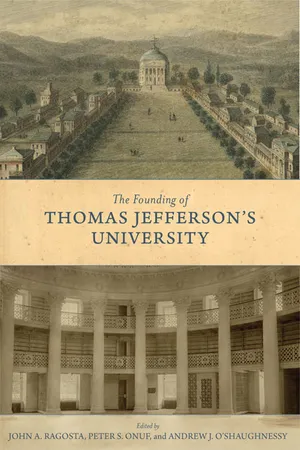
The Rotunda library was the heart of Jefferson’s Enlightenment university. (Interior of Library, University of Virginia, ca. 1898, LC-DIG-ds-06610, Library of Congress, Prints and Photographs Division)
Despite Jefferson’s great care in selecting the best (appropriate) professor and recommending the best texts for the study of law, students generally preferred the more easily digested Blackstone (in spite of what Jefferson saw as the author’s monarchical tendencies) to the much more difficult, if not indigestible, Coke (the purer font of republican jurisprudence)—students in the nineteenth century were not so very different from their counterparts in the twenty-first. By the 1830s, James P. Ambuske and Randall Flaherty have discovered, even the faculty found it more convenient to start with Blackstone as they laid a foundation for studying the common law, Jefferson’s misgivings notwithstanding.
Demanding a separation of church and state, Jefferson did not plan for a chapel at the state university; University of Virginia’s chapel was dedicated in 1890. (Image courtesy of Sue Kell, University of Virginia)
The devolution from Jefferson’s design was even more evident in the area of religion, as Cameron Addis shows. Jefferson sought to limit the influence of religion at his University for two reasons. First, he feared the corrupt influence of privileged elites, the backward-looking “kings, nobles, and priests” who had always been dedicated to shoring up their own power at the expense of free thought and innovation. While other American colleges were still subject to clerical influence if not control, students at the University of Virginia would be free to search for new knowledge and truth. Second, Jefferson was deeply conscious that the University would be state-created and state-controlled and that a clear separation between “church” and University was therefore imperative. Jefferson became the target of scathing criticism because of the University’s irreligiosity and supposed hostility to Christian orthodoxy. Speaking to Jefferson’s influence, one Presbyterian minister quipped that “[w]hen Satan promised all the kingdoms of the world to Christ he laid his thumb on Charlottesville and whispered, ‘Exce...