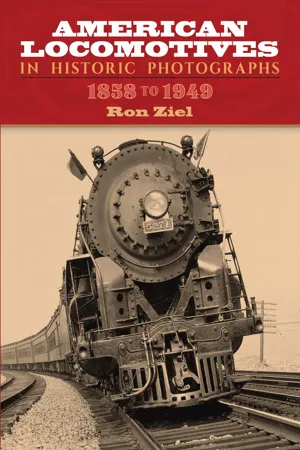
This rare collection of 126 "builder portraits" of American locomotives offers an exciting cavalcade of images that chronicle the momentous rise of steam locomotive power in America. Builder portraits are especially prized by railway historians because they are the exacting official photographs of new models taken before repairs, alterations, and weathering altered their original appearance. The builder portraits reprinted here were selected from the William A. Rogers collection, a priceless archive of images documenting the history of American steam locomotion from the pre–Civil War era to the mid-20th century.
While the accent in this book is on the oldest and rarest photographs in the Rogers collection, many modern portraits are included as well to demonstrate how highly developed the American steam locomotive had become before the advent of dieselization. Among the engines depicted are the España, a diminutive model built for the Spanish government in 1858; engine no. 216 of the Pennsylvania Railroad, a "fearsome apparition of Gothic character" built in 1861; the Chimbote Emilia, an inspection engine built for railroad company officials in 1868 that is considered a masterpiece of the engine builder's art; and a Union Pacific 1940s' "Big Boy," the largest and heaviest type of steam locomotive ever built.
Clearly, builder portraits are the most revealing record possible of the evolution of the American steam locomotive. This rich selection offers railroading historians and enthusiasts a peerless record of a great age in railway history. Railroading expert Ron Zeil's introduction and captions provide readers with a brief railroading background, a commentary on the art of the builder portrait and key details on each locomotive depicted.
- 140 pages
- English
- ePUB (mobile friendly)
- Available on iOS & Android
eBook - ePub
About this book
Trusted by 375,005 students
Access to over 1.5 million titles for a fair monthly price.
Study more efficiently using our study tools.
Information
Publisher
Dover PublicationseBook ISBN
9780486136196
Year
2013
1
“España”
One of the earliest builder photographs is also of a primeval export locomotive: a diminutive narrow-gauge 0–4–0 tank engine that was built for the government of Spain in 1858. The tapered balloon stack is a good indication of its age, for this style was pretty well outdated by 1860. A most basic locomotive, España was equipped with an early injector just forward of the cab, as well as a crosshead-mounted water pump, and the steam dome was placed above the firebox, inside the cab, with safety valve and whistle protruding through the roof.

2
Pennsylvania Railroad No. 1
By 1860, the 4–6–0 ten-wheeler locomotive, larger and more powerful than the 4–4–0, or “American Standard,” type, was being built, initially as a heavy (for that time) freight engine. With no. 1 of the Pennsylvania Railroad, Mathias W. Baldwins factory had already been well established, this being his 1,009th locomotive, which was turned out in September 1861, just a few months after the outbreak of the Civil War. Railroads often do not number their engines consecutively, so the P.R. R., which was chartered in 1846, had had at least one previous no. 1. A cast plate, usually of brass, was affixed to each side of a locomotive, giving the name of the builder, the serial number, the date of construction and, usually, the location of the foundry. Some early Baldwins, such as this one, had two plates, ornately displayed between the driving wheels: the front one said “M. W Baldwin & Co. 1009”; the rear one, “Philadelphia 1861.” The Baldwin Locomotive Works, as it was later known, went on to erect nearly 75,000 locomotives—including some very impressive diesels—before all production ceased in the 1950s.

3
Pennsylvania Railroad No. 216
Pennsylvania Railroad 0–6–0 no. 216 emerged from the erecting hall at Baldwin in August 1861 as a fearsome apparition of Gothic character, with its bulky components, massive smokestack, high-mounted canted cylinders and awkwardly positioned wheels. The box of a water cistern slung over the boiler and the massive dome scrunched up against the pin-striped cab did nothing to detract from the ungainly visage of this early switch engine. Certainly at this stage of development, the steam locomotive was still experiencing aesthetic growing pains. Within a decade, however, it would mature into an embodiment of elegance and refinement that in taste and proportion would rival the clipper ship and Federal architecture. Such details on no. 216 as the one-piece molded fender over the wheels, the wrought-iron bell cradle and the paint trim could only hint at the princely splendor of the typical steam locomotive later in the nineteenth century.

4
Eastern Pennsylvania Railroad No. 7
Baldwin’s 1, 114th locomotive was a utilitarian 4–6–0 built for the Eastern Pennsylvania Railroad in June 1862. Instead of mounting a cast plate itemizing the builder’s information, that data was cast directly into the bottom of the valve chest above the cylinder. Locomotives of this period mounted enormous headlights on a platform directly in front of the smokestack, which housed a large reflector to magnify the weak oil flame that provided the illumination. Often, the railroad itself supplied the headlight—sometimes exquisitely decorated, including pastoral scenery or a portrait of the person for whom the machine was named—so many of the factory photos show engines devoid of the lamps. Barely three decades after the power of steam locomotives first proved practical as a successor to that of animals, engines such as no. 7 shown here had already attained a technological sophistication that was recognizable even in its gigantic descendants in the twentieth century.

5
Union Pacific Railroad No. 90
A year and a month prior to the Golden Spike ceremony at Promontory Point, Utah Territory, on May 10, 1869, Baldwin completed a brutish 4–6–0, no. 90, for the Union Pacific. It would be a month before the ten-wheeler arrived on its owners property in Omaha, Nebraska, and went to work hauling freight—much of it construction materials for the U.P.—to help complete the epic labor of the first transcontinental line. Typical of the 4–4–0s and 4–6–0s of its era, no. 90 had a wide space between the rear sets of driving wheels, to allow room for the firebox to be mounted between the axles. The biggest improvement in locomotive design occurred in the 1890s when trailing wheels enabled the firebox to be carried above the frame. This enabled fireboxes to be increased enormously in size (in both width and length) and ultimately resulted in the high-horsepower steam-generating boilers of the 1900s.

6
Broadway Railroad No. 4
Street railways, utilizing horses to power small passenger cars, began to appear in American cities even prior to the War Between the States. Most of them retained equine energy until they were electrified, beginning in the 1890s, heralding the advent of the trolley or tram lines. The inherent economics and improved performance of steam on the railways soon became obvious to the horsecar line operators, but running steam locomotives down city streets presented problems. Hissing steam, oscillating, clanking machinery and belching smoke frightened horses and children, disturbed peaceful neighborhoods and blackened washlines. The solution was to hide the steam engine, to make it appear little different from the familiar cars it was replacing. The resulting steam cars, while never widely accepted in the United States, were nevertheless to become a common sight in cities around the world, the last operating in Indonesia in the 1970s. Powered by diminutive wash boilers, the steam tram lines either used “dummy” locomotives decked out to resemble horsecars to pull a passenger car, or, in the larger versions, had a passenger compartment that shared the car with a partitioned-off boiler. Broadway Railroad no. 4 was of the former type. Built by Baldwin in 1868, it ran in the city of Brooklyn, New York, from the Roosevelt and Grand Street ferries on the East River, out to East New York. With a car body completely enclosing the locomotive—even the wheels were covered—the engine was indistinguishable from a small horsecar.

7
Chimbote Railway “Emilia”
One of the most fascinating and affable of all the little inspection engines built for the use of company offic...
Table of contents
- DOVER BOOKS ON TRANSPORTATION
- Title Page
- Dedication
- Picture Credits
- Copyright Page
- Table of Contents
- INTRODUCTION
- 1 - “España”
- 2 - Pennsylvania Railroad No. 1
- 3 - Pennsylvania Railroad No. 216
- 4 - Eastern Pennsylvania Railroad No. 7
- 5 - Union Pacific Railroad No. 90
- 6 - Broadway Railroad No. 4
- 7 - Chimbote Railway “Emilia”
- 8 - Chicago & North-Western Railway “Alexander Mitchell”
- 9 - Southern Pacific Railway No. 1008
- 10 - Glendon Iron Co. “Alert”
- 11 - Ferro-Carril de Salaverry á Trujillo No. 9
- 12 - Grand Trunk Railway No. 283
- 13 - Central Railroad of New Jersey No. 125
- 14 - Central Railroad
- 15 - Boston and Maine Railroad No. 47
- 16 - Ashland Iron Co. “Edward Patterson”
- 17 - Hilliard & Bailey’s Lumber Railroad “Florida”
- 18 - Brooklyn, Bath & Coney Island Railroad “George”
- 19 - Camden, Gloucester & Mt. Ephraim Railroad No. 2
- 20 - New York Elevated Railroad No. 24
- 21 - Long Island Rail Road No. 71
- 22 - Atchison, Topeka & Santa Fe Railway No. 91
- 23 - Cincinnati Inclined Plane Railway No. 1
- 24 - Boston, New York & Philadelphia Railroad No. 65
- 25 - Cia. E. de F. Barão de Araruama No. 3
- 26 - Saint Louis & San Francisco Railroad No. 2
- 27 - Ferrocarril Interoceánico No. 20
- 28 - T. L. Hackney Locomotive
- 29 - Gilpin Tramway No. 181
- 30 - Fort Bragg Railroad Co. No. 2
- 31 - New York, New Haven & Hartford Railroad No. 149
- 32 - Sinnemahoning Valley Railroad No. 2
- 33 - Usal Railroad No. 1
- 34 - Manitou & Pikes Peak Railway No. 6
- 35 - Sinnemahoning Valley Railroad No. 3
- 36 - South Side Rapid Transit No. 1
- 37 - Greenfield & Northern Railroad No. 4
- 38 - Lehigh Valley Railroad No. 708
- 39 - Chicago, Milwaukee & St. Paul Railway No. 125
- 40 - Pittsburgh, Cincinnati, Chicago & St. Louis Railroad No. 2
- 41 - Erie Railroad No. 512
- 42 - Seaboard Air Line Railway No. 606
- 43 - Union Pacific Railroad No. 9
- 44 - W. I. Company No. 16
- 45 - Southern Pacific Railway No. 3048
- 46 - Great Northern Railway No. 1800
- 47 - Ferrocarril de Guantánamo
- 48 - Dai Nippon Seito Kwaisha, Ltd., No. 1
- 49 - South Manchurian Railway No.1
- 50 - Lehigh & Hudson River Railway No. 64
- 51 - Atchison, Topeka & Santa Fe Railway No. 1301
- 52 - California Western Railway & Navigation Company No. 7
- 53 - Lehigh Valley Railroad No. 1597
- 54 - Lehigh & New England Railroad No. 32
- 55 - Nashville, Chattanooga & St. Louis Railroad No. 290
- 56 - Pennsylvania Railroad No. 5400
- 57 - Louisiana State Penitentiary “Jack”
- 58 - Croft Lumber Company No. 4
- 59 - Nevada-California-Oregon Railway No. 14
- 60 - Erie Railroad No. 2603
- 61 - Union Pacific, Railroad No. 187
- 62 - Great Northern Railway No. 1755
- 63 - Pennsylvania Railroad No. 9710
- 64 - Illinois Central Railroad No. 1701
- 65 - New York Central Railroad No. 3983
- 66 - Virginian Railway No. 700
- 67 - Southern Railway No. 4537
- 68 - Imperial Russian Railways Ye Class No. 541
- 69 - Central Railroad of New Jersey No. 825
- 70 - Chaparra Railroad Company No. 33
- 71 - Kin-Han Railway No. 351
- 72 - Elgin, Joliet & Eastern Railway No. 333
- 73 - Texas-Mexican Railway No. 1
- 74 - Missouri, Kansas & Texas Railroad No. 399
- 75 - Nickel Plate Road No. 627
- 76 - Imperial Forestry Railway of Japan
- 77 - Lake Independence Lumber Company No. 4
- 78 - Grand Trunk Western Railway No. 8222
- 79 - Long Island Rail Road No. 268
- 80 - Maryland and Pennsylvania Railroad No. 43
- 81 - Insular Lumber Company No. 7
- 82 - Lima Locomotive Works No. 1
- 83 - Texas & Pacific Railway No. 600
- 84 - Ferrocarril del Pacífico No. 63
- 85 - Manila Railway No. 144
- 86 - Atchison, Topeka & Santa Fe Railway No. 3450
- 87 - Baldwin Locomotive Works No. 60000
- 88 - Boston and Maine Railroad No. 4000
- 89 - Erie Railroad No. 3389
- 90 - New York Central Railroad No. 5271
- 91 - Boston & Albany Railroad No. 610
- 92 - Nickel Plate Road No. 177
- 93 - Royal State Railways of Siam
- 94 - Southern Pacific Lines No. 4114
- 95 - Alton and Southern Railroad No. 14
- 96 - Durham and Southern Railroad No. 200
- 97 - Pennsylvania Railroad No. 6775
- 98 - Chicago Great Western Railroad No. 854
- 99 - Chesapeake & Ohio Railway No. 3004
- 100 - Duluth, Missabe & Iron Range Railroad No. 223
- 101 - Lehigh Valley Railroad No. 5101
- 102 - Pittsburgh and West Virginia Railroad No. 1101
- 103 - Ferrocarriles Nacionales de México No. 3000
- 104 - Union Railroad No. 303
- 105 - Boston and Maine Railroad No. 3715
- 106 - Kansas City Southern Railroad No. 900
- 107 - Denver & Rio Grande Western Railroad No. 3702
- 108 - New York, New Haven & Hartford Railroad No. 1408
- 109 - New York Central Railroad No. 5453
- 110 - Atchison, Topeka & Santa Fe Railway No. 5004
- 111 - Frisco Lines No. 1065
- 112 - Southern Pacific Lines No. 3800
- 113 - Pennsylvania Railroad No. 6100
- 114 - New York Central Railroad No. 3037
- 115 - Union Pacific Railroad No. 3976
- 116 - Union Pacific Railroad No. 4002
- 117 - Boston and Maine Railroad No. 4117
- 118 - Southern Pacific Lines No. 4436
- 119 - Chesapeake & Ohio Railway No. 1605
- 120 - Chesapeake & Ohio Railway No. 246
- 121 - Western Maryland Railway No. 6
- 122 - Société Nationale des Chemins de Fer Français 141.R No. 446
- 123 - Polish State Railways Ty246 No. 91
- 124 - Chesapeake & Ohio Railway No. 610
- 125 - Louisville & Nashville Railroad No. 1970
- 126 - Nickel Plate Road No. 779
- GENERAL INDEX
- INDEX OF LOCOMOTIVE WHEEL ARRANGEMENTS
- DOVER PHOTOGRAPHY COLLECTIONS