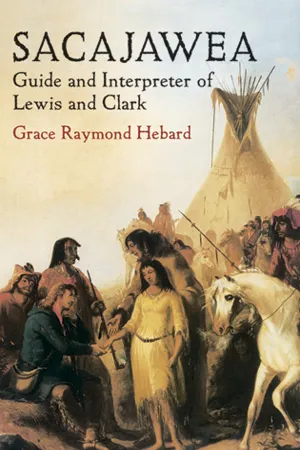
This remarkable study rescues from undeserved obscurity the name and reputation of Sacajawea — a true Native American heroine. The volume also unravels the tangled threads of her family life and traces the career of her son Baptiste, the "papoose" of the Lewis and Clark expedition. 21 illustrations, including a map. Bibliography. Index. 6 Appendices.
- 352 pages
- English
- ePUB (mobile friendly)
- Available on iOS & Android
eBook - ePub
About this book
Trusted by 375,005 students
Access to over 1.5 million titles for a fair monthly price.
Study more efficiently using our study tools.
Information
With the Lewis and Clark Expedition
Journeyed westward, westward,
Left the fleetest deer behind him,
Left the antelope and bison,
Passed the mountains of the prairie,
Passed the land of Crows and Foxes,
Passed the dwellings of the Blackfeet,
Came unto the Rocky mountains,
To the kingdom of the west-wind. – Hiawatha
Left the fleetest deer behind him,
Left the antelope and bison,
Passed the mountains of the prairie,
Passed the land of Crows and Foxes,
Passed the dwellings of the Blackfeet,
Came unto the Rocky mountains,
To the kingdom of the west-wind. – Hiawatha
CHAPTER I
With the Lewis and Clark Expedition
The treaty by which France ceded the Louisiana territory to the United States was signed April 30, 1803, and ratified by congress on October 26 of the same year. It was not until December 20, however, that the formal transfer of the territory, embracing approximately 1,020,571 square miles, actually occurred. The cost of this enormous empire was $15,000,000, or about two and one-half cents an acre.
The American most interested in this transaction, and in many ways most responsible for it, was Thomas Jefferson. As early as 1786 we find him lending his support in Paris to John Ledyard, the “Connecticut Yankee” who dreamed of crossing Asia, sailing to the northwest coast, and making his way overland to the American settlements in the Mississippi valley. Six years later, more than a decade before the confirmation of the Louisiana purchase, Jefferson, then secretary of state, began to discuss the advisability of sending an exploring party to navigate the Missouri river to its source. His object was to open commercial relations with the Indians ; secure for our government some of the riches of the region which were being monopolized by traders from Canada; discover, if possible, a waterway to the Pacific; and open a route that would enable us to share in the trade of the orient.
At that time, however, no one had the slightest conception of the vastness of the territory lying beyond the Missouri, although in 1792 Robert Gray, a ship captain from Boston, had sailed around the cape to the Pacific in the ship “Columbia,” and cast anchor in the harbor at the mouth of the river to which he gave the name of his vessel. From this time on many English and Yankee ships sailed along the northwest coast gathering furs, and the region about Vancouver island thus became definitely known. But the territory between the Missouri and the Pacific was as yet unexplored except as a few adventurous trappers had ascended the Missouri river a thousand miles or so and set their steel beaver traps along its tributaries. In 1793 Jefferson engaged the services of André Michaux, a French botanist, to explore the territory between the Missouri and the Pacific, instructing him specifically to “seek for and pursue that route which shall form the shortest and most convenient communication between the higher parts of the Missouri and the Pacific ocean.” 13 Michaux set out upon the expedition, but before he reached the Mississippi was recalled by his own government.
Three months, moreover, before the treaty transferring the Louisiana territory to the United States was actually signed, Jefferson sent a confidential letter to congress asking for an appropriation of twenty-five hundred dollars to be used to equip an expedition to explore the country drained by the Missouri river. It is interesting to note that an appropriation for even so small an amount to explore a region that now has taxable wealth of more than seven billion dollars was difficult to secure.
In preparing for the expedition that was finally authorized, Jefferson selected the leaders with extraordinary care. As already stated, the chief command was given to his former private secretary from Virginia, Captain Meriwether Lewis, and he in turn selected Captain William Clark, likewise a native of Virginia but at that time a resident of Kentucky, to be his companion. Preparatory to its final organization, the expedition went into winter quarters at the mouth of the Wood river about twenty miles above St. Louis. Besides the two leaders, the party at this time included twenty-seven men, among whom was Clark’s colored body servant, named York, who proved a rare curiosity to the natives. Three other men were added to this number before the expedition started on its westward journey. These included the hunter, Drewyer, or Drouillard as it is correctly spelled; a head-boatman, Crusatte; and a water-man named Labiche. Fifteen soldiers, commanded by Warfington, escorted the expedition as a guard. Twenty of the thirty men comprising the body of the expedition completed the entire journey. Of these none was married.
As already stated, the instructions which President Jefferson issued to the commanders of the expedition were minute and complete. They were expected to make careful observations of the country through which they passed and to keep complete records of these observations. They were also to serve as naturalists, botanists, geologists, paleontologists, astronomers, engineers, meteorologists, minerologists, ornithologists, and ethnologists. Especially were they charged to be diplomatic and conciliatory in their dealings with the Indians, for in this capacity they were the official representatives for the United States government. As already explained, because of these instructions the journals kept by Lewis and Clark and the other members of the company became veritable storehouses of valuable information regarding nearly every aspect of the country through which the expedition passed, and of the various Indian tribes of the northwest.
The expedition left its winter quarters at the mouth of Wood river on May 14, 1804. In ascending the Missouri, the party employed three boats, the largest of which was fifty-five feet long, drew three feet of water, and was propelled by one large, square-shaped sail and twenty-two oars. The other two boats were of six and seven oars respectively. Two horses were taken along to assist whenever possible in dragging the boats upstream, and to carry to the boats the game killed by the hunters. The largest boat had a swivel gun, or a small cannon swinging on a pivot, which often did efficient service if in no other way than by its terrifying noise.14
Because of the tortuous streams, unknown channels, countless snags, sandbars, and swift currents, the progress of the company was slow and the expedition ordinarily counted itself fortunate to make as much as fifteen miles a day. One hundred sixty-five days were required to reach the Mandan villages, sixteen hundred miles from St. Louis. On the return journey the same distance was covered in thirty-seven days.

CAPTAIN MERIWETHER LEWIS AND CAPTAIN WILLIAM CLARK
There were, of course, no charts or maps for the explorers to follow; the territory was unnamed, uncharted, unexplored. Naturally for an expedition of this magnitude, a vast and varied amount of supplies was necessary. These included food, clothing, camp equipment, firearms and ammunition, and large quantities of articles to be used in bartering with the Indians. It was expected, naturally, that much of the necessary food would be supplied by hunting and fishing from day to day. Powder was carried in small cannisters made of lead. These cannisters not only served as containers for the powder but also were melted up for bullets. Each cannister furnished sufficient bullets to correspond to its original content of powder, so that in this way there was no lost weight.
The supplies were packed in bales, each of which contained a portion of all the articles taken. Thus in case of accident or the loss of a single bale, the entire supply of any one commodity would not be destroyed. Articles to be used as presents to the Indians comprised fourteen additional bales. These consisted of bright-colored beads, tinsel and red cloth, lace coats, brass kettles, fish hooks, looking glasses, small bells, thimbles, handkerchiefs of various colors, flags, medals, knives, tomahawks, articles of dress, and anything else that might please the fancy of bartering Indians. Among the beads, those of a blue color were most popular because they were known as the “chief’s beads,” and commanded a higher value than those of other colors. Lewis and Clark also took with them three sizes of medals representing varying degrees of honor which were to be given to the chiefs of the tribes with whom they came in contact.
The first stages of the journey which lasted several months were for the most part uneventful. The weather was generally mild and wild game plentiful. Not infrequently the explorers, making headway against the muddy current of the Missouri, met the crude boats of trappers loaded to the gunwale with hides and pelts, floating down the river to St. Louis – the forerunners of the vast fur-trade soon to be in operation up and down the Missouri river.
On August 3, 1804, Lewis and Clark held their first formal council with the Indians. At this council Lewis told the chiefs about the new government to which they must in the future give their allegiance, and assured them of that government’s protection. The chiefs expressed their pleasure at this change of government and sent their greetings to their “Great Father,” the president. The place where this council was held was called Council bluffs. The site of this council was on the west bank of the river, in what is now Nebraska, about twenty miles north of the site of the present city of Council bluffs in Iowa.
On October 26 the explorers reached the Mandan villages, near the site of the present city of Bismarck, North Dakota. This site was about five days’ journey further up the river from the original Mandan villages discovered by the Vérenderyes in 1738. The expedition members spent the winter of 1805 in these villages, housing themselves in huts and stockades which they constructed under the supervision of Sergeant Patrick Gass, the head-carpenter. The winter was occupied in making boats, mending clothes, jerking meat, and studying the language, habits, and customs of the Indians.
While the expedition was in winter quarters at the Mandan villages, Lewis and Clark secured the services of an interpreter named Toussaint Charbonneau, a French-Canadian trapper who had spent his life in the northwest. Charbonneau’s career will be described more at length in a later chapter; it is sufficient to note here that his training and experience were such as to fit him to be of great value to the expedition.
Charbonneau brought with him his three Indian wives, one of whom was Sacajawea, the chief figure of this volume.15 His arrival at the headquarters of the expedition is recorded in nearly all of the journals. Clark, in his entry of November 4, 1804, wrote as follows :
A Mr. Chaubonie [Charbonneau], interpreter from the Gross Ventre nation, came to see us and informed that he came down with several Indians from a hunting expedition up the river to hear what we had told the Indians in council. This man wished to hire as an interpreter.
Similarly Ordway, on November 4, wrote:
A Frenchman’s squaw came to our camp who belongs to the Snake nation. She came with our interpreter’s wife and brought with them four buffalo robes and gave them to our officers.
An entry of the same date in the Biddle edition reads:
We received a visit of two squaws, prisoners from the Rocky mountains, purchased by Charboneau.
Gass, in speaking of Charbonneau’s wives in his entry of December 25, writes as follows:
At half past two another gun was fired, as a notice to assemble at the dance, which was continued in a jovial manner till eight at night; and without the presence of any females except three squaws, wives to our interpreter, who took no other part than the amusement of looking on.16 None of the natives came to the garrison this day; the commanding officers having requested they should not, which was strictly attended to. During the remainder of the month we lived in peace and tranquility in the garrison, and were daily visited by the natives.
Sacajawea, as stated by Ordway, was a member of the Snake, or Shoshone tribe of Indians.17 For this reason it was felt that she would be a most essential addition to the company, because it was known that the route of the expedition lay through the territory occupied by this tribe. As a child she had been captured by the Minnetarees, Hidatsas, or Gros Ventres of the upper Missouri. These Hidatsa Indians lived in the vicinity of the junction of the Knife and Missouri rivers in North Dakota. From these Indians Charbonneau either purchased her or won her by gambling, and later married her, probably, as we shall see, at the insistance of Lewis or Clark.
While the expedition was still in winter quarters, Sacajawea gave birth to a boy. The event is recorded by four of the diarists of the expedition. Lewis, on February 11, 1805, wrote as foll...
Table of contents
- DOVER BOOKS ON NATIVE AMERICANS
- Title Page
- Copyright Page
- Dedication
- Table of Contents
- Foreword to the 1957 Edition
- Preface
- An Appreciation
- Introduction
- CHAPTER I - With the Lewis and Clark Expedition
- CHAPTER II - Charbonneau, the Interpreter
- CHAPTER III - Toussaint and Baptiste
- CHAPTER IV - Sacajawea among the Comanches and on the Shoshone Reservation
- CHAPTER V - Sacajawea at Fort Bridger and the Reservation
- CHAPTER VI - Sacajawea’s Death and Burial
- APPENDIX A - Expenditures for Toussaint and Baptiste Charbonneau
- APPENDIX B - Testimony of Indian agents, missionaries, and teachers among the Shoshones
- APPENDIX C - Shoshone Indian Testimony
- APPENDIX D - Sacajawea among the Comanches
- APPENDIX E - Sacajawea’s Names
- APPENDIX F - Sacajawea’s Memorials
- Bibliography
- Index
- A CATALOG OF SELECTED DOVER BOOKS IN ALL FIELDS OF INTEREST
Frequently asked questions
Yes, you can cancel anytime from the Subscription tab in your account settings on the Perlego website. Your subscription will stay active until the end of your current billing period. Learn how to cancel your subscription
No, books cannot be downloaded as external files, such as PDFs, for use outside of Perlego. However, you can download books within the Perlego app for offline reading on mobile or tablet. Learn how to download books offline
Perlego offers two plans: Essential and Complete
- Essential is ideal for learners and professionals who enjoy exploring a wide range of subjects. Access the Essential Library with 800,000+ trusted titles and best-sellers across business, personal growth, and the humanities. Includes unlimited reading time and Standard Read Aloud voice.
- Complete: Perfect for advanced learners and researchers needing full, unrestricted access. Unlock 1.5M+ books across hundreds of subjects, including academic and specialized titles. The Complete Plan also includes advanced features like Premium Read Aloud and Research Assistant.
We are an online textbook subscription service, where you can get access to an entire online library for less than the price of a single book per month. With over 1.5 million books across 990+ topics, we’ve got you covered! Learn about our mission
Look out for the read-aloud symbol on your next book to see if you can listen to it. The read-aloud tool reads text aloud for you, highlighting the text as it is being read. You can pause it, speed it up and slow it down. Learn more about Read Aloud
Yes! You can use the Perlego app on both iOS and Android devices to read anytime, anywhere — even offline. Perfect for commutes or when you’re on the go.
Please note we cannot support devices running on iOS 13 and Android 7 or earlier. Learn more about using the app
Please note we cannot support devices running on iOS 13 and Android 7 or earlier. Learn more about using the app
Yes, you can access Sacajawea by Grace Raymond Hebard in PDF and/or ePUB format, as well as other popular books in History & North American History. We have over 1.5 million books available in our catalogue for you to explore.