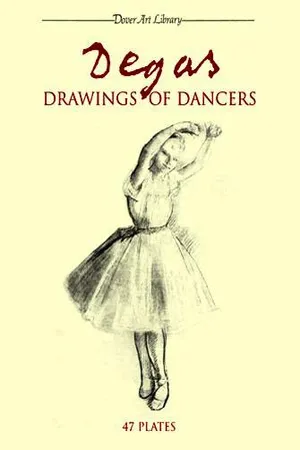
Among the best known and most immediately recognizable images in art history are the superb studies and portraits of ballet dancers by Edgar Degas (1834–1917). One of the most popular of nineteenth-century artists, Degas was fascinated by movement, especially that of dancers. His highly trained eye enabled him to capture the dancer's grace and power as well as subtleties and nuances of pose and execution, making his pictures as true in fact as they are in spirit.
This original compilation includes 41 full-page and six half-page black-and-white Degas drawings of dancers. Some are finished works, others are sketches or studies for future works. Singly, in pairs, and in groups, the dancers appear on stage, in the classroom, and at rehearsals — pirouetting, executing grand battements and portes de bras, practicing at the barre, and adjusting their costumes in moments of repose.
Art enthusiasts and balletomanes who prize Degas's pictures of dancers will delight in the sublime beauty and mastery of expression of these images. This inexpensive edition allows lovers of art and the dance to savor these enchanting, beautifully reproduced drawings.
- 48 pages
- English
- ePUB (mobile friendly)
- Available on iOS & Android
eBook - ePub
Degas Drawings of Dancers
About this book
Information
Topic
ArtSubtopic
Artist MonographsPUBLISHER’S NOTE
Edgar [-Hilaire-Germain] Degas, the first of five children, was born in 1834 to the wealthy de Gas family. His father managed the Paris branch of the family bank, which had been founded in Naples by Edgar’s grandfather after he fled there during the French Revolution. Edgar’s mother, who died in 1847, was a French Creole native of New Orleans. As a schoolboy, Edgar studied classical languages but earned top grades in drawing only, and filled his notebooks with sketches of imagined heads and figures. He earned his bachelor’s degree in 1853; instead of entering the family business, he traveled extensively, especially in Italy. There he painted portraits of some Naples relatives, studied works of the old masters, and drew and painted in pencil, ink, watercolors, and oils. After a year of studies with a former pupil of J. Ingres, whom Degas emulated in discipline, fine draftsmanship, and dedication to his art, in 1855 he enrolled at the Ecole des Beaux-Arts.
During the early 1860s he drew in pencil chiefly, but later began using charcoal, chalk, pastel, and essence (a thin, quick-drying medium—refined turpentine with oil paints dried to eliminate the oil and stickiness). In the mid-1860s his work was influenced strongly by the different perspective and points of view found in Japanese prints (this can be seen especially in his drawings of ballet dancers) and by early photography. Among his subjects were café-concert singers, jockeys, dancers, laundresses, and brothels. He began filling notebooks (37 are extant) with sketches and writings, and drew prolifically in that format until the mid-1880s.
In 1870, during the Franco-Prussian War, he joined an artillery unit to defend Paris during the Prussian siege. From then on he suffered from vision problems. In later years he couldn’t bear bright sunlight and had to work indoors; ultimately he believed he was going blind. He visited New Orleans in 1872-73. His brothers René and Achille, both married to women from that city, worked in a family cotton business there. Again he painted portraits (he never took portrait commissions, but painted many relatives and friends) and did other drawings and paintings. His most famous work done in the United State...
Table of contents
- DOVER BOOKS ON FINE ART
- Title Page
- Copyright Page
- Table of Contents
- PUBLISHER’S NOTE
Trusted by 375,005 students
Access to over 1.5 million titles for a fair monthly price.
Study more efficiently using our study tools.
Frequently asked questions
Yes, you can cancel anytime from the Subscription tab in your account settings on the Perlego website. Your subscription will stay active until the end of your current billing period. Learn how to cancel your subscription
No, books cannot be downloaded as external files, such as PDFs, for use outside of Perlego. However, you can download books within the Perlego app for offline reading on mobile or tablet. Learn how to download books offline
We are an online textbook subscription service, where you can get access to an entire online library for less than the price of a single book per month. With over 1.5 million books across 990+ topics, we’ve got you covered! Learn about our mission
Look out for the read-aloud symbol on your next book to see if you can listen to it. The read-aloud tool reads text aloud for you, highlighting the text as it is being read. You can pause it, speed it up and slow it down. Learn more about Read Aloud
Yes! You can use the Perlego app on both iOS and Android devices to read anytime, anywhere — even offline. Perfect for commutes or when you’re on the go.
Please note we cannot support devices running on iOS 13 and Android 7 or earlier. Learn more about using the app
Please note we cannot support devices running on iOS 13 and Android 7 or earlier. Learn more about using the app
Yes, you can access Degas Drawings of Dancers by Edgar Degas in PDF and/or ePUB format, as well as other popular books in Art & Artist Monographs. We have over 1.5 million books available in our catalogue for you to explore.