![]()
Part Three
Analysis
During this second half of the semester we shall select certain chapters in analysis which are important from our standpoint and we shall discuss them as we did arithmetic and algebra. The most important thing for us to discuss will be the elementary transcendental functions, i. e. logarithmic and exponential functions and trigonometric functions, since they play an important part in school instruction. Let us begin with the first.
I. Logarithmic and Exponential Functions
Let me recall briefly the familiar curriculum of the school, and the continuation of it to the point at which the so called algebraic analysis begins.
1. Systematic Account of Algebraic Analysis
One starts with powers of the form a = bc, where the exponent c is a positive integer, and extends the notion step by step for negative integral values of c, then for fractional values of c, and finally, if circumstances warrant it, to irrational values of c. In this process the concept of root appears as that of a particular power. Without going into the details of involution, I will only recall the rule for multiplication
which reduces the multiplication of two numbers to the addition of exponents. The possibility of this reduction, which, as you know, is fundamental for logarithmic calculation, lies in the fact that the fundamental laws for multiplication and addition are so largely identical, that both operations, namely, are commutative as well associative.
The operation inverse to that of raising to a power yields the logarithm. The quantity c is called the logarithm of a to the base b:
At this point a number of essential difficulties appear which are usually passed over without any attempt at explanation. For this reason I shalltry to be especially clear at this point. For the sake of convenience we shall write x and y instead of a and c, inasmuch as we wish to study the mutual dependence of these two numbers. Our fundamental equations then become
Let us first of all notice that
b is always assumed to be positive. If
b were negative,
x would be alternately positive and negative for integral values of
y, and would even include imaginary values for fractional values of
y, so that the totality of number pairs (
x,
y) would not give a continuous curve. But even with
b > 0 one cannot get along without making stipulations that appear to be quite arbitrary. For if
y is rational, say
y =
m/
n, where
m and
n are integers prime to each other,
x =
bm/n is, as you know, defined to be
and it has accordingly
n values, of which, for even values of
n, we should have two to deal with even if we confined ourselves to real numbers. It is customary to stipulate that
x shall always be the positive root, the so-called
principal root.
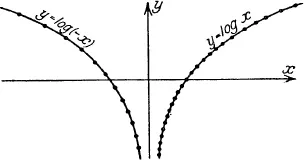
If you will permit me to use, somewhat prematurely, the familiar graph of the logarithm y = log x (Fig. 54), you will see that neither the above stipulation nor its suitableness is by any means self-evident. If y traverses the dense set of rational values, the corresponding points whose abscissas are the positive principal values x = by constitute a dense set on our curve. If, now, when the denominator n of y is even, we should mark the points which correspond to negative values of x, we have a set of points which would be, one might say, only half so dense, but nevertheless dense on the curve which is the reflection in the y axis of our curve [y = log (– x)]. If we now admit all real, including irrational, values of y, it is certainly not immediately clear why the principal values which we have been marking on the right now constitute a continuous curve and whether or not the set of negative values which we have marked on the left is similarly raised to a continuum. We shall see later that this can be made clear only with the profounder resources of function theory, an aid which is not at the command of the elementary student. For this reason, one does not attempt in the schools to give a complete exposition. One adopts rather an authoritative convention, which is quite convincing to the pupils, namely that one must take b > 0 and must select the positive principal values of x, that everything else is prohibited. Then the theorem follows, of course, that the logarithm is a single-valued function defined only for a positive argument.
Once the theory is carried to this point, the logarithmic tables are put into the hands of the pupil and he must learn to use them in practical calculation. There may still be some schools–in my school days this was the rule–where little or nothing is said as to how these tables are made. That was despicable utilitarianism which is scornful of every higher principle of instruction, and which we must surely and severly condemn. Today, however, the calculation of logarithms is probably discussed in the majority of cases, and in many schools indeed the theory of natural logarithms and the development into series is taught for this purpose.
As for the first of these, the base of the system of natural logarithms is, as you know, the number
This definition of e is usually, in imitation of the French models, placed at the very beginning in the great text books of analysis, and entirely unmotivated, whereby the really valuable element is missed, the one which mediates the understanding, namely, an explanation why precisely this remarkable limit is used as base and why the resulting logarithms are called natural. Likewise the development into series is often introduced with equal abruptness. There is a formal assumption of the development
the coefficients a0, a1, . . . , are calculated by means of the known properties of logarithms, and perhaps the convergence is shown for |x| < 1. B...