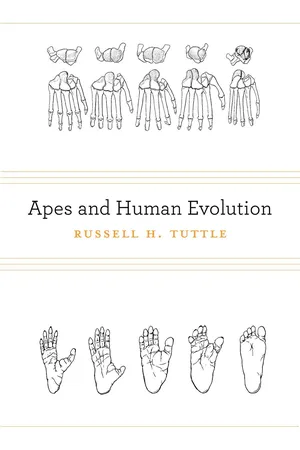
In this masterwork, Russell H. Tuttle synthesizes a vast research literature in primate evolution and behavior to explain how apes and humans evolved in relation to one another, and why humans became a bipedal, tool-making, culture-inventing species distinct from other hominoids. Along the way, he refutes the influential theory that men are essentially killer apes—sophisticated but instinctively aggressive and destructive beings.
Situating humans in a broad context, Tuttle musters convincing evidence from morphology and recent fossil discoveries to reveal what early primates ate, where they slept, how they learned to walk upright, how brain and hand anatomy evolved simultaneously, and what else happened evolutionarily to cause humans to diverge from their closest relatives. Despite our genomic similarities with bonobos, chimpanzees, and gorillas, humans are unique among primates in occupying a symbolic niche of values and beliefs based on symbolically mediated cognitive processes. Although apes exhibit behaviors that strongly suggest they can think, salient elements of human culture—speech, mating proscriptions, kinship structures, and moral codes—are symbolic systems that are not manifest in ape niches.
This encyclopedic volume is both a milestone in primatological research and a critique of what is known and yet to be discovered about human and ape potential.
- English
- ePUB (mobile friendly)
- Available on iOS & Android
eBook - ePub
Apes and Human Evolution
About this book
Information
Table of contents
- Cover
- Half Title
- Title Page
- Copyright
- Dedication
- Contents
- Preface
- 1. Mongrel Models and Seductive Scenarios of Human Evolution
- Part I: Terminology, Morphology, Genes, and Lots of Fossils
- Part II: Positional and Subsistence Behaviors
- Part III: Hands, Tools, Brains, and Cognition
- Part IV: Sociality and Communication
- Part V: What Makes Us Human?
- Color Illustrations
- Notes
- References
- Illustration Credits
- Index
Trusted by 375,005 students
Access to over 1.5 million titles for a fair monthly price.
Study more efficiently using our study tools.
Frequently asked questions
Yes, you can cancel anytime from the Subscription tab in your account settings on the Perlego website. Your subscription will stay active until the end of your current billing period. Learn how to cancel your subscription
No, books cannot be downloaded as external files, such as PDFs, for use outside of Perlego. However, you can download books within the Perlego app for offline reading on mobile or tablet. Learn how to download books offline
Perlego offers two plans: Essential and Complete
- Essential is ideal for learners and professionals who enjoy exploring a wide range of subjects. Access the Essential Library with 800,000+ trusted titles and best-sellers across business, personal growth, and the humanities. Includes unlimited reading time and Standard Read Aloud voice.
- Complete: Perfect for advanced learners and researchers needing full, unrestricted access. Unlock 1.5M+ books across hundreds of subjects, including academic and specialized titles. The Complete Plan also includes advanced features like Premium Read Aloud and Research Assistant.
We are an online textbook subscription service, where you can get access to an entire online library for less than the price of a single book per month. With over 1.5 million books across 990+ topics, we’ve got you covered! Learn about our mission
Look out for the read-aloud symbol on your next book to see if you can listen to it. The read-aloud tool reads text aloud for you, highlighting the text as it is being read. You can pause it, speed it up and slow it down. Learn more about Read Aloud
Yes! You can use the Perlego app on both iOS and Android devices to read anytime, anywhere — even offline. Perfect for commutes or when you’re on the go.
Please note we cannot support devices running on iOS 13 and Android 7 or earlier. Learn more about using the app
Please note we cannot support devices running on iOS 13 and Android 7 or earlier. Learn more about using the app
Yes, you can access Apes and Human Evolution by Russell H. Tuttle in PDF and/or ePUB format, as well as other popular books in Biological Sciences & Evolution. We have over 1.5 million books available in our catalogue for you to explore.