"A civil but honest dialogue…As illuminating as it is fascinating."
—Ayaan Hirsi Ali
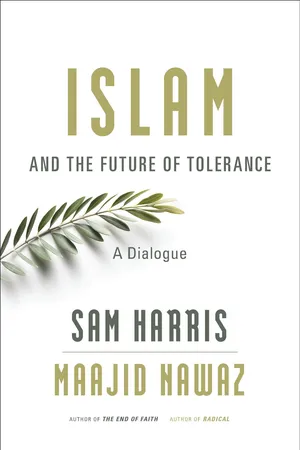
Is Islam a religion of peace or war? Is it amenable to reform? Why do so many Muslims seem to be drawn to extremism? And what do words like jihadism and fundamentalism really mean? In a world riven by misunderstanding and violence, Sam Harris—a famous atheist—and Maajid Nawaz—a former radical—demonstrate how two people with very different religious views can find common ground and invite you to join in an urgently needed conversation.
"How refreshing to read an honest yet affectionate exchange between the Islamist-turned-liberal-Muslim Maajid Nawaz and the neuroscientist who advocates mindful atheism, Sam Harris…Their back-and-forth clarifies multiple confusions that plague the public conversation about Islam."
—Irshad Manji, New York Times Book Review
"It is sadly uncommon, in any era, to find dialogue based on facts and reason—but even more rarely are Muslim and non-Muslim intellectuals able to maintain critical distance on broad questions about Islam. Which makes Islam and the Future of Tolerance something of a unicorn…Most conversations about religion are marked by the inability of either side to listen, but here, at last, is a proper debate."
—New Statesman
- English
- ePUB (mobile friendly)
- Available on iOS & Android
eBook - ePub
About this book
Trusted by 375,005 students
Access to over 1.5 million titles for a fair monthly price.
Study more efficiently using our study tools.
Information
Publisher
Harvard University PressYear
2015Print ISBN
9780674241480
9780674088702
eBook ISBN
9780674737068
Topic
Theology & ReligionSubtopic
Global Politics
Harris Maajid, thank you for taking the time to have this conversation. I think the work that you’re doing is extremely important. I’m not sure how much we agree about Islam or about the prospects for reforming the faith—and it will be useful to uncover any areas where we diverge—but I want you to know that my primary goal is to support you.
Nawaz That’s very kind of you. I appreciate that. As you know, we are working in a very delicate area, walking a tightrope and attempting to bring with us a lot of people who, in many instances, do not want to move forward. It is very important that we have this conversation in as responsible a way as possible.
Harris Agreed. I’d like to begin by recalling the first time we met, because it was a moment when you seemed to be walking this tightrope. It was, in fact, a rather inauspicious first meeting.
In October 2010, I attended the Intelligence Squared debate in which you were pitted against my friends Ayaan Hirsi Ali and Douglas Murray. We met afterward at a dinner for the organizers, participants, and other guests. People were offering short remarks about the debate and otherwise continuing the discussion, and at one point Ayaan said, “I’d like to know whether Sam Harris has anything to say.” Although I was well into a vodka tonic at that moment, I remember what I said more or less verbatim. I addressed my remarks directly to you. We hadn’t been introduced, and I don’t think you had any idea who I was. I said, essentially, this:
Maajid, I have a question for you. It seems to me that you have a nearly impossible task and yet much depends on your being able to accomplish it. You want to convince the world—especially the Muslim world—that Islam is a religion of peace that has been hijacked by extremists. But the problem is that Islam isn’t a religion of peace, and the so-called “extremists” are seeking to implement what is arguably the most honest reading of the faith’s actual doctrine. So your maneuvers on the stage tonight—the claims you made about interpretations of scripture and the historical context in which certain passages in the Qur’an must be understood—appear disingenuous.Everyone in this room recognizes that you have the hardest job in the world, and everyone is grateful that you’re doing it. Someone has to try to reform Islam from within, and it’s obviously not going to be an apostate like Ayaan, or infidels like Douglas and me. But the path of reform appears to be one of pretense. You seem obliged to pretend that the doctrine is something other than it is—for instance, you must pretend that jihad is just an inner spiritual struggle, whereas it’s primarily a doctrine of holy war. I’d like to know whether this is, in fact, the situation as you see it. Is the path forward a matter of pretending certain things are true long enough and hard enough so as to make them true?
I should reiterate that I was attempting to have this conversation with you in a semipublic context. We weren’t being recorded, as far as I know, but there were still around seventy-five people in the room listening to us. I’m wondering if you remember my saying these things and whether you recall your response at the time.
Nawaz Yes, I do remember that. I’m glad you reminded me of it. I hadn’t made the connection with you. I’m also grateful you mentioned that although we were not on air, many others were present. To my mind, it was just as important inside that room as outside it for people to take what I was saying at face value. In fact, my desire to impact Muslim-minority societies with my message is just as strong as my desire to impact Muslim-majority societies. Part of what I seek to do is build a mainstream coalition of people who are singing from the same page. That doesn’t require that they all become Muslim or non-Muslim. On the contrary, what can unite us is a set of religion-neutral values. By focusing on the universality of human, democratic, and secular (in the British and American sense of this word) values, we can arrive at some common ground. It follows that all audiences need to hear this message. Even inside that room, therefore, the stakes were high. To lose that audience would be to realize my fear: the polarization of this debate between those who insist that Islam is a religion of war and proceed to engage in war for it, and those who insist that Islam is a religion of war and proceed to engage in war against it. That would be an intractable situation.
Now, moving to the specifics of your question, I responded in the way I did because I felt you were implying that I was engaging in pretense by arguing that Islam is a religion of peace. If I remember correctly, you said, “It’s understandable in the public context, but here in this room can’t you just be honest with us?”
Harris Yes, that’s exactly what I said.
Nawaz Yes. “Can’t you just be honest with us in here?” implied that I hadn’t been honest out there. My honest view is that Islam is not a religion of war or of peace—it’s a religion. Its sacred scripture, like those of other religions, contains passages that many people would consider extremely problematic. Likewise, all scriptures contain passages that are innocuous. Religion doesn’t inherently speak for itself; no scripture, no book, no piece of writing has its own voice. I subscribe to this view whether I’m interpreting Shakespeare or interpreting religious scripture.
So I wasn’t being dishonest in saying that Islam is a religion of peace. I’ve subsequently had an opportunity to clarify at the Richmond Forum, where Ayaan and I discussed this again. Scripture exists; human beings interpret it. At Intelligence Squared, being under the unnatural constraints of a debate motion, I asserted that Islam is a religion of peace simply because the vast majority of Muslims today do not subscribe to its being a religion of war. If it holds that Islam is only what its adherents interpret it to be, then it is currently a religion of peace.1
Part of our challenge is to galvanize and organize this silent majority against jihadism so that it can start challenging the narrative of violence that has been popularized by the organized minority currently dominating the discourse. This is what I was really trying to argue in the Intelligence Squared debate, but the motion forced me to take a side: war or peace. I chose peace.
Harris I understand. My interest in recalling that moment is not to hold you accountable to your original answer to me—and it may be that your thinking has evolved to some degree. But our conversation broke down quite starkly at that point. I don’t remember how we resolved it.
Nawaz (laughing) I don’t remember that we did resolve it.
Harris Well, let’s proceed in a spirit of greater optimism than may seem warranted by our first meeting, because we have a lot to talk about. However, before we dive into the issues, I think we should start with your background, which is fascinating. Perhaps you can tell our readers why you’re in a position to know so much about the problems we’re about to discuss.
The Roots of Extremism
Nawaz A comprehensive version of my story is available in my autobiography, Radical, but I’ll summarize it here. I was born and raised in Essex, in the United Kingdom, and grew up in what I refer to as the bad old days of racism in my country. A case that changed the course of race relations in the UK, the murder of Stephen Lawrence, led to a government inquiry that produced the Macpherson report.2 That report coined the phrase “institutional racism” and judged that it existed in the police forces of the UK. It was a serious indictment.
I came of age at a time immediately preceding that shift in the collective consciousness. I experienced institutional racism on multiple occasions and became incredibly disillusioned with mainstream society as a result. I was falsely arrested on a number of occasions. Such discrimination played out in our young lives while we witnessed the Bosnian genocide unfolding in continental Europe.
Naturally, my generation became disgruntled, disillusioned, and disconnected from society. Into that grave identity crisis came the Islamist ideological group that I eventually joined. The group, Hizb ut-Tahrir, is of the revolutionary variety, remains active across the world, and is still legal in the West. Founded in 1953 in Jerusalem during an earlier Muslim identity crisis after the creation of Israel, Hizb ut-Tahrir was the first Islamist group to popularize the idea of creating a theocratic “caliphate,” or an “Islamic state.” Rather than terrorism, its members use recruiting and winning over Muslim public opinion, with the eventual aim of inciting military coups in Muslim-majority countries such as Egypt, Turkey, and Pakistan in order to come to power.
I joined this organization as a deeply aggrieved, perhaps traumatized, sixteen-year-old victim of severely violent racist attacks. However, my grievances were frozen for a long time by the ideological dogma that I came to adopt. I choose my words here deliberately. Grievances are not in themselves sufficient to radicalize somebody. They are half the truth. My meaning is best summarized this way: when we in the West failed to intervene in the Bosnian genocide, some Muslims became radicalized; when we did intervene in Afghanistan and Iraq, more Muslims became radicalized; when we failed to intervene in Syria, many more Muslims became radicalized. The grievance narrative that pins the blame on foreign policy is only half the story. It is insufficient as an explanation for radicalization.
Harris This topic of foreign intervention and Muslim grievance is very tricky—and I trust we’ll come back to it. But it seems to me that two things made the West’s intervention in Bosnia unique—and uniquely inoffensive from a Muslim point of view. We didn’t have to invade a Muslim country to do it, and the operation entailed bombing non-Muslims. As we’ve seen from recent conflicts, if either of those variables changes, a large percentage of Muslims will view the operation as a sacrilege—no matter how evil or secular the target of Western power happens to be. Saddam Hussein was the perfect example: he was a universally hated secular tyrant. But the moment a coalition of non-Muslim states attacked him, much of the Muslim world was outraged that “Muslim lands” were being invaded by infidels. Of course, there were many perfectly sane reasons to be against the war in Iraq, but that wasn’t among them. One of the problems with religion is that it creates in-group loyalty and out-group hostility, even when members of one’s own group are behaving like psychopaths. I would add that when we did eventually intervene in Bosnia, for purely humanitarian reasons, we didn’t get much credit for it.
Nawaz Absolutely. I mention it only because where grievances are relevant is in priming young, vulnerable individuals who are experiencing a profound identity crisis to receive ideological dogma through charismatic recruiters. Once that dogma has been received, it frames one’s worldview, the lens through which others are perceived, the vehicle by which others are recruited; it becomes the language we speak. It is very important to understand that, because grievances will always exist. They’ve existed from the beginning of time, and they will exist until the end of time. Other communities face them as well, but this particular ideological phenomenon has arisen only in certain contexts. For example, people often blame poverty or a lack of education for radicalization, whereas experts have long known that a disproportionate number of terrorists come from highly educated backgrounds.3 So at sixteen I adopted an ideological worldview that froze my sense of grievance and turned it instead into dogma. I then began recruiting heavily for Hizb ut-Tahrir; I bear my fair share of responsibility for promoting the notion of a theocratic caliphate.
Harris Were you seeking to popularize these ideas in the UK or globally?
Nawaz Globally. The group spread from Jerusalem to Jordan, from Jordan to Syria and Iraq, and eventually to Egypt. It then spread from the Middle East to the West, and from the West it spread to Turkey via German Muslims, to North Africa via French Muslims, and to South Asia via British Muslims of Indian, Pakistani, and Bangladeshi origin. Becoming an international recruiter, I exported revolutionary Islamism from Britain to Pakistan, Denmark, and, finally, Egypt.
In 1999, midway through my law and Arabic degree at the University of London’s School of Oriental and African Studies (SOAS), I took a year off and went to Pakistan on the instructions of Hizb ut-Tahrir to help cofound the Pakistani branch. Pakistan had just tested its atomic bomb a year earlier, and the global leader of our group aspired to a nuclear caliphate.
Anywhere we laid the foundations of this organization, we very specifically targeted army officers so that we could incite military coups. In 2000, after my return from Pakistan, I was personally involved in conversations with Pakistani cadets who had come to study at Britain’s Sandhurst Royal Military Academy. Since then, Pakistan has witnessed aborted coup plots by my former organization, some of which have been reported in the press.4
By then, I had resumed study for my degree in London, but I was traveling to Copenhagen every weekend to found the Danish-Pakistani branch of my group. In 2001, my studies took me to Egypt for my Arabic-language year. I arrived one day before the 9/11 attacks. Not fully comprehending the significance of those attacks, I continued recruiting across Egypt for my cause. In April 2002, my Alexandria residence was raided by Egyptian state security officers. I was blindfolded, had my hands tied behind my back, and was taken to state security headquarters in Cairo, where I witnessed other prisoners being tortured by electrocution. I was twenty-four years old.
After I was sentenced to five years as a political prisoner in Egypt’s Mazra Tora prison complex, Amnesty International took the brave step of adopting me as a prisoner of conscience. Although Amnesty disagreed with what we believed in, its view was that we had committed no specific crime in Egypt—which was true—and my group was legal in Britain, where I had joined it. It was in Egypt, in prison with the entire spectrum of Islamists—from the assassins of Egypt’s former president Anwar Sadat to the now incarcerated global leader of Egypt’s Muslim Brotherhood, Muhammad Badei—that I began to truly explore the ideology I had come to adopt and the cause I had embraced with such fervor at sixteen.
It was a combination of my lengthy revisionist conversations with other prisoners and Amnesty’s outreach that started me on the long journey toward a liberal, human rights–based secular perspective. In 2006, I was released from prison and returned to London. In 2008, while completing my master’s degree in political theory at the London School of Economi...
Table of contents
- Cover
- Title Page
- Copyright
- Begin Reading
- Further Reading
- Acknowledgments
- Index
Frequently asked questions
Yes, you can cancel anytime from the Subscription tab in your account settings on the Perlego website. Your subscription will stay active until the end of your current billing period. Learn how to cancel your subscription
No, books cannot be downloaded as external files, such as PDFs, for use outside of Perlego. However, you can download books within the Perlego app for offline reading on mobile or tablet. Learn how to download books offline
Perlego offers two plans: Essential and Complete
- Essential is ideal for learners and professionals who enjoy exploring a wide range of subjects. Access the Essential Library with 800,000+ trusted titles and best-sellers across business, personal growth, and the humanities. Includes unlimited reading time and Standard Read Aloud voice.
- Complete: Perfect for advanced learners and researchers needing full, unrestricted access. Unlock 1.5M+ books across hundreds of subjects, including academic and specialized titles. The Complete Plan also includes advanced features like Premium Read Aloud and Research Assistant.
We are an online textbook subscription service, where you can get access to an entire online library for less than the price of a single book per month. With over 1.5 million books across 990+ topics, we’ve got you covered! Learn about our mission
Look out for the read-aloud symbol on your next book to see if you can listen to it. The read-aloud tool reads text aloud for you, highlighting the text as it is being read. You can pause it, speed it up and slow it down. Learn more about Read Aloud
Yes! You can use the Perlego app on both iOS and Android devices to read anytime, anywhere — even offline. Perfect for commutes or when you’re on the go.
Please note we cannot support devices running on iOS 13 and Android 7 or earlier. Learn more about using the app
Please note we cannot support devices running on iOS 13 and Android 7 or earlier. Learn more about using the app
Yes, you can access Islam and the Future of Tolerance by Sam Harris,Maajid Nawaz in PDF and/or ePUB format, as well as other popular books in Theology & Religion & Global Politics. We have over 1.5 million books available in our catalogue for you to explore.