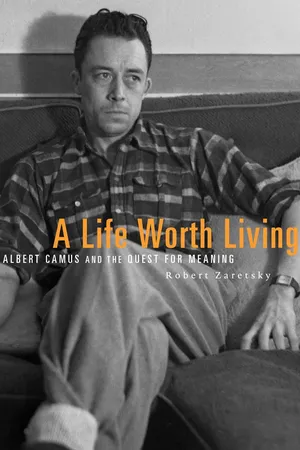
In his Nobel Prize acceptance speech, Albert Camus declared that a writer's duty is twofold: "the refusal to lie about what one knows and the resistance against oppression." These twin obsessions help explain something of Camus' remarkable character, which is the overarching subject of this sympathetic and lively book. Through an exploration of themes that preoccupied Camus--absurdity, silence, revolt, fidelity, and moderation--Robert Zaretsky portrays a moralist who refused to be fooled by the nobler names we assign to our actions, and who pushed himself, and those about him, to challenge the status quo.
Though we do not face the same dangers that threatened Europe when Camus wrote The Myth of Sisyphus and The Stranger, we confront other alarms. Herein lies Camus' abiding significance. Reading his work, we become more thoughtful observers of our own lives. For Camus, rebellion is an eternal human condition, a timeless struggle against injustice that makes life worth living. But rebellion is also bounded by self-imposed constraints--it is a noble if impossible ideal. Such a contradiction suggests that if there is no reason for hope, there is also no occasion for despair--a sentiment perhaps better suited for the ancient tragedians than modern political theorists but one whose wisdom abides. Yet we must not venerate suffering, Camus cautions: the world's beauty demands our attention no less than life's train of injustices. That recognition permits him to declare: "It was the middle of winter, I finally realized that, within me, summer was inextinguishable."
- English
- ePUB (mobile friendly)
- Available on iOS & Android
eBook - ePub
About this book
Trusted by 375,005 students
Access to over 1.5 million titles for a fair monthly price.
Study more efficiently using our study tools.
Information
Topic
LiteraturSubtopic
Literarische Biographien1
ABSURDITY
“There is just one truly important philosophical question: suicide. To decide whether life is worth living is to answer the fundamental question of philosophy. Everything else … is child’s play; we must first of all answer the question.”1
Among the most celebrated challenges of the twentieth century, the opening lines to Albert Camus’ The Myth of Sisyphus left André Malraux, the dashing novelist and intellectual, unsatisfied. As an editor at Gallimard, France’s most prestigious publishing house, Malraux, who had been deeply impressed by Albert Camus’ other manuscript, The Stranger, found the new work labored and meandering. “The beginning stumbles around a bit,” he counseled the author: “Since you have made clear that the essay will adopt the perspective of suicide, it’s unnecessary to repeat it so often.”2
Malraux was wrong: the essay adopts the perspective not of suicide, but of our absurd condition. If, one day, we discover ourselves in “a universe suddenly divested of illusions and light”; if we nevertheless insist on meaning, but instead hear only “the unreasonable silence of the world”; and if we fully absorb the consequences of this silence, Camus affirms, suicide suddenly imposes itself as the sole response.3 Malraux’s stricture notwithstanding, this is why the essay’s celebrated opening line still demands our attention. If the question abides, it is because it is more than a matter of historical or biographical interest. Our pursuit of meaning, and the consequences should we come up empty-handed, are matters of eternal immediacy.
When we confront the question, however, we discover that traditional philosophy fails to guide us. Philosophers have no purchase on this subject, Camus writes, which is “simultaneously so modest and so charged with emotion.”4 Perhaps for this reason, many professional philosophers have insisted, and some continue to insist, that it is a false problem, glistening dully like a stream made brackish by the confusion of formal categories or the abuse of language. Yet there are other philosophers who now criticize their guild’s failure to grasp the stubborn presence of the absurd in our lives. As Robert Solomon insists, the absurd “poisons our everydayness and gives our every experience a tinge of futility.… We find ourselves desperately trying to move more quickly, to nowhere; or we try to ‘entertain ourselves.’ ”5 In terms less dramatic, but equally emphatic, Thomas Nagel compares absurdity with what he calls “the view from nowhere.” This view tears us from our everyday subjective experiences and forces us to assume an external viewpoint—a perspective that rattles the conceits and assumptions we hold about our lives. This view forces upon us truths that are both prosaic and paralyzing—that we need never have lived or that the world will continue without the faintest of shudders when we die. In seeing ourselves from the outside, Nagel notes, “we find it difficult to take our lives seriously.” At such moments, we confront absurdity—a “genuine problem which we cannot ignore.”6
Hence Camus’ decision to leave behind philosophy’s traditional vocabulary and techniques. Rather than a chain of arguments, The Myth of Sisyphus is instead a salvo of impressions, some intimate, others literary, all of them urgent and lucid. The Myth is an essay, similar to those written by one of Camus’ models, Michel de Montaigne. In its pages, Camus pursues the perennial prey of philosophy—the questions of who we are, where and whether we can find meaning, and what we can truly know about ourselves and the world—less with the intention of capturing them than continuing the chase. Camus no more worried that there remained “something provisional” to his work than Montaigne did that his self-portrait kept changing.7 In fact, Camus achieves with the Myth what the philosopher Maurice Merleau-Ponty claimed for Montaigne’s Essays: it places “a consciousness astonished at itself at the core of human existence.”8
For Camus, however, this astonishment results from our confrontation with a world that refuses to surrender meaning. It occurs when our need for meaning shatters against the indifference, immovable and absolute, of the world. As a result, absurdity is not an autonomous state; it does not exist in the world, but is instead exhaled from the abyss that divides us from a mute world. “This world in itself is not reasonable, that is all that can be said. But what is absurd is the confrontation of this irrational and wild longing for clarity whose call echoes in the human heart. The absurd depends as much on man as on the world. For the moment it is all that links them together.”9
Absurd reasoning, Camus warns, surges with an urgency alien to traditional philosophy: no one, he insists, has ever died for the ontological argument. Even the great explorers of the absurd, thinkers who have bent their minds to reach firm conclusions, have with few exceptions swerved at the last moment from this journey. Kierkegaard, Camus declares, blinked first in his confrontation with the lidless gaze of the absurd. The Danish thinker’s “leap of faith,” far from being a heroic act of lucidity and logic, amounts to philosophical suicide. Rather than leaping into a world where absurdity rules, Kierkegaard retreats to God, to whom he gives “the attributes of the absurd: unjust, incoherent, and incomprehensible.”10 Even an absurd god, Kierkegaard confesses, is preferable to an unfathomable void.
As with an earlier Christian thinker, Blaise Pascal, who was famously frightened by “the silence of these infinite spaces,” Kierkegaard was terrified by the prospect of a life lived in the absurd. But Camus insists that, for the absurd man, “Seeking what is true is not seeking what is desirable.”11 But we must not cease in our exploration, Camus affirms, if only to hear more sharply the silence of the world. In effect, silence sounds out when human beings enter the equation. If “silences must make themselves heard,” it is because those who can hear inevitably demand it.12 And if the silence persists, where are we to find meaning? What must we do if meaning is not to be found? Can we live our lives without the reassurance, once provided by religion, of transcendental justifications for the world and its denizens?
The question, Camus concludes, is “to find out if it is possible to live without appeal.”13

As a literary and philosophical quarry, the absurd first appears in Camus’ journal in May 1936, the same month he defended his dissertation on the subject of neo-Platonism at the University of Algiers. “Philosophical work: Absurdity,” he assigned himself as part of his study and writing plan.14 Two years later, in June 1938, the absurd again appears on his to-do list, then a third time at the end of the same year. Though he is mostly at the stage of research and reflection, Camus had already decided to approach the subject more or less simultaneously through three different genres: as a novelist, playwright, and essayist. He had begun work on his play Caligula in 1938, though it was first performed only in 1945. As for The Stranger, Camus completed a draft just days before the Germans smashed through the Ardennes in May 1940. And it was at that same moment, when France still appeared, if not eternal, at least solid and secure, that Camus yoked himself to what he described to his former teacher Jean Grenier as his “essay on the Absurd.”15
During this same period, Camus discovered another young and still unknown French writer who was grappling with the absurd. In 1938, the veteran journalist Pascal Pia, who had founded an independent newspaper, Alger républicain, had hired Camus. Given the paper’s straitened financial situation, Camus quickly found he was juggling many tasks, including that of book reviewer. Two thin books by Jean-Paul Sartre soon came to his attention: The Wall and Nausea. In these remarkable works, Sartre described a world awash in pure contingency. Caught in the undertow of events for which there is no ultimate or external justification, Sartre observed, we are overcome with a sense of nausea. What other response can we feel when we discover that events, once imbued with meaning, are in fact arbitrary; that our acts, once invested with intention, are only mechanical; and that the world, once our home, is simply alien.
Still, though the stories were compelling, Camus concluded that they offered little more than a kind of existential solipsism. To be sure, the “intense and dramatic universe” informing the stories in The Wall was striking, but what were we to make of characters incapable of doing anything meaningful with their freedom? Similarly, in Nausea, Camus marveled at Sartre’s depiction of the world’s oppressive density, but insisted it was wrong to conclude “life is tragic because it is miserable.” Instead, our tragic sense of life lies in the world’s “overwhelming and beautiful” nature—without beauty, without love, and without risk “life would be almost too easy.” From the heights of his youth, Camus affirmed: “To observe that life is absurd cannot be an end, but only a beginning.… What interests me is not this discovery [of life’s absurd character], but the consequences and rules of action we must draw from it.”16
Though young, Camus was a veteran of the absurd. When still an infant, he lost his father in the purposeless mayhem of the Battle of the Marne; as an athletic teenager, he coughed blood one day and discovered he had tuberculosis; as a reporter of Alger républicain, he discovered, behind the universal values of liberty and equality of the French Republic, the grim reality for the Arabs and Berbers living under the colonial administration; as the paper’s editor, he inveighed against the absurdity of a world war that, as a committed pacifist, he unrealistically insisted could have been avoided; and as a pacifist exempted from the draft because of his tuberculosis, Camus nevertheless tried to enlist: “This war has not stopped being absurd, but one cannot retire from the game because the game may cost your life.”17
He was, in a word, already fastened on the lessons to be drawn from an absurd world. He shared this conviction not just with his readers but also with his fiancée, Francine Faure. (The couple was waiting for the finalization of the divorce between Camus and Simone Hié, a glamorous and seductive woman whose drug addiction defeated Camus’ efforts to cure.) Camus told Francine that most everyone thinks the war is absurd, but this amounts to little if anything at all since they then go on living the lives they had always lived. But what interested him were the ethical consequences of this insight: “What I want to draw is a humanistic way of thinking, one that is clear-sighted and modest—a certain kind of personal conduct in which life would confront life as it is and not with daydreams.”18
Eventually, it was Camus’ insistence on consequences that forced the closing of Alger républicain in 1940. Already hated by the local authorities because of his relentless attacks on their treatment of the Arab and Berber populations, Camus doubled down once France declared war in September 1939. Though without illusions about Hitler’s Germany, a “bestial state where human dignity counted for nothing,” Camus also refused to nourish illusions about the purity or lucidity of France’s leaders.19 He was convinced that the powerless—workers, peasants, small merchants, and clerks—would pay the price of this march to war just as his own father had in 1914. (He had not yet understood that the powerless, in France and the rest of the world, would nevertheless pay if the Nazis were not opposed by military means.) The censors, intent on maintaining public morale, suppressed growing chunks of the paper’s front page; Camus, equally intent on outwitting the censors, would reprint passages from literary classics, such as Voltaire’s entry on “war” from his Philosophical Dictionary, to fill the gaps. Even this, though, did not survive the officials’ scissors.
In November, Camus confided to his journal: “Understand this: we can despair of the meaning of life in general, but not of the particular forms that it takes; we can despair of existence, for we have no power over it, but not of history, where the individual can do everything. It is individuals who are killing us today. Why should not individuals manage to give the world peace? We must simply begin witho...
Table of contents
- Cover
- Half Title
- Title Page
- Copyright
- Contents
- Prologue
- 1. Absurdity
- 2. Silence
- 3. Measure
- 4. Fidelity
- 5. Revolt
- Epilogue
- Notes
- Acknowledgments
- Index
Frequently asked questions
Yes, you can cancel anytime from the Subscription tab in your account settings on the Perlego website. Your subscription will stay active until the end of your current billing period. Learn how to cancel your subscription
No, books cannot be downloaded as external files, such as PDFs, for use outside of Perlego. However, you can download books within the Perlego app for offline reading on mobile or tablet. Learn how to download books offline
Perlego offers two plans: Essential and Complete
- Essential is ideal for learners and professionals who enjoy exploring a wide range of subjects. Access the Essential Library with 800,000+ trusted titles and best-sellers across business, personal growth, and the humanities. Includes unlimited reading time and Standard Read Aloud voice.
- Complete: Perfect for advanced learners and researchers needing full, unrestricted access. Unlock 1.5M+ books across hundreds of subjects, including academic and specialized titles. The Complete Plan also includes advanced features like Premium Read Aloud and Research Assistant.
We are an online textbook subscription service, where you can get access to an entire online library for less than the price of a single book per month. With over 1.5 million books across 990+ topics, we’ve got you covered! Learn about our mission
Look out for the read-aloud symbol on your next book to see if you can listen to it. The read-aloud tool reads text aloud for you, highlighting the text as it is being read. You can pause it, speed it up and slow it down. Learn more about Read Aloud
Yes! You can use the Perlego app on both iOS and Android devices to read anytime, anywhere — even offline. Perfect for commutes or when you’re on the go.
Please note we cannot support devices running on iOS 13 and Android 7 or earlier. Learn more about using the app
Please note we cannot support devices running on iOS 13 and Android 7 or earlier. Learn more about using the app
Yes, you can access A Life Worth Living by Robert Zaretsky in PDF and/or ePUB format, as well as other popular books in Literatur & Literarische Biographien. We have over 1.5 million books available in our catalogue for you to explore.