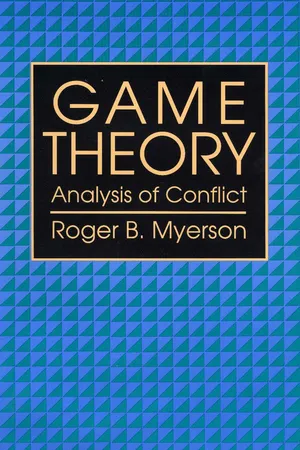
Eminently suited to classroom use as well as individual study, Roger Myerson's introductory text provides a clear and thorough examination of the models, solution concepts, results, and methodological principles of noncooperative and cooperative game theory. Myerson introduces, clarifies, and synthesizes the extraordinary advances made in the subject over the past fifteen years, presents an overview of decision theory, and comprehensively reviews the development of the fundamental models: games in extensive form and strategic form, and Bayesian games with incomplete information.
Game Theory will be useful for students at the graduate level in economics, political science, operations research, and applied mathematics. Everyone who uses game theory in research will find this book essential.
- 584 pages
- English
- ePUB (mobile friendly)
- Available on iOS & Android
eBook - ePub
About this book
Information
Publisher
Harvard University PressYear
2013Print ISBN
9780674341166
9780674341159
eBook ISBN
9780674728622
1
Decision-Theoretic Foundations
1.1 Game Theory, Rationality, and Intelligence
Game theory can be defined as the study of mathematical models of conflict and cooperation between intelligent rational decision-makers. Game theory provides general mathematical techniques for analyzing situations in which two or more individuals make decisions that will influence one another’s welfare. As such, game theory offers insights of fundamental importance for scholars in all branches of the social sciences, as well as for practical decision-makers. The situations that game theorists study are not merely recreational activities, as the term “game” might unfortunately suggest. “Conflict analysis” or “interactive decision theory” might be more descriptively accurate names for the subject, but the name “game theory” seems to be here to stay.
Modern game theory may be said to begin with the work of Zermelo (1913), Borel (1921), von Neumann (1928), and the great seminal book of von Neumann and Morgenstern (1944). Much of the early work on game theory was done during World War II at Princeton, in the same intellectual community where many leaders of theoretical physics were also working (see Morgenstern, 1976). Viewed from a broader perspective of intellectual history, this propinquity does not seem coincidental. Much of the appeal and promise of game theory is derived from its position in the mathematical foundations of the social sciences. In this century, great advances in the most fundamental and theoretical branches of the physical sciences have created a nuclear dilemma that threatens the survival of our civilization. People seem to have learned more about how to design physical systems for exploiting radioactive materials than about how to create social systems for moderating human behavior in conflict. Thus, it may be natural to hope that advances in the most fundamental and theoretical branches of the social sciences might be able to provide the understanding that we need to match our great advances in the physical sciences. This hope is one of the motivations that has led many mathematicians and social scientists to work in game theory during the past 50 years. Real proof of the power of game theory has come in recent years from a prolific development of important applications, especially in economics.
Game theorists try to understand conflict and cooperation by studying quantitative models and hypothetical examples. These examples may be unrealistically simple in many respects, but this simplicity may make the fundamental issues of conflict and cooperation easier to see in these examples than in the vastly more complicated situations of real life. Of course, this is the method of analysis in any field of inquiry: to pose one’s questions in the context of a simplified model in which many of the less important details of reality are ignored. Thus, even if one is never involved in a situation in which people’s positions are as clearly defined as those studied by game theorists, one can still come to understand real competitive situations better by studying these hypothetical examples.
In the language of game theory, a game refers to any social situation involving two or more individuals. The individuals involved in a game may be called the players. As stated in the definition above, there are two basic assumptions that game theorists generally make about players: they are rational and they are intelligent. Each of these adjectives is used here in a technical sense that requires some explanation.
A decision-maker is rational if he makes decisions consistently in pursuit of his own objectives. In game theory, building on the fundamental results of decision theory, we assume that each player’s objective is to maximize the expected value of his own payoff, which is measured in some utility scale. The idea that a rational decision-maker should make decisions that will maximize his expected utility payoff goes back at least to Bernoulli (1738), but the modern justification of this idea is due to von Neumann and Morgenstern (1947). Using remarkably weak assumptions about how a rational decision-maker should behave, they showed that for any rational decision...
Table of contents
- Cover
- Title Page
- Copyright Page
- Dedication
- Contents
- Preface
- Chapter 1. Decision-Theoretic Foundations
- Chapter 2. Basic Models
- Chapter 3. Equilibria of Strategic-Form Games
- Chapter 4. Sequential Equilibria of Extensive-Form Games
- Chapter 5. Refinements of Equilibrium in Strategic Form
- Chapter 6. Games with Communication
- Chapter 7. Repeated Games
- Chapter 8. Bargaining and Cooperation in Two-Person Games
- Chapter 9. Coalitions in Cooperative Games
- Chapter 10. Cooperation under Uncertainty
- Bibliography
- Index
Trusted by 375,005 students
Access to over 1.5 million titles for a fair monthly price.
Study more efficiently using our study tools.
Frequently asked questions
Yes, you can cancel anytime from the Subscription tab in your account settings on the Perlego website. Your subscription will stay active until the end of your current billing period. Learn how to cancel your subscription
No, books cannot be downloaded as external files, such as PDFs, for use outside of Perlego. However, you can download books within the Perlego app for offline reading on mobile or tablet. Learn how to download books offline
Perlego offers two plans: Essential and Complete
- Essential is ideal for learners and professionals who enjoy exploring a wide range of subjects. Access the Essential Library with 800,000+ trusted titles and best-sellers across business, personal growth, and the humanities. Includes unlimited reading time and Standard Read Aloud voice.
- Complete: Perfect for advanced learners and researchers needing full, unrestricted access. Unlock 1.5M+ books across hundreds of subjects, including academic and specialized titles. The Complete Plan also includes advanced features like Premium Read Aloud and Research Assistant.
We are an online textbook subscription service, where you can get access to an entire online library for less than the price of a single book per month. With over 1.5 million books across 990+ topics, we’ve got you covered! Learn about our mission
Look out for the read-aloud symbol on your next book to see if you can listen to it. The read-aloud tool reads text aloud for you, highlighting the text as it is being read. You can pause it, speed it up and slow it down. Learn more about Read Aloud
Yes! You can use the Perlego app on both iOS and Android devices to read anytime, anywhere — even offline. Perfect for commutes or when you’re on the go.
Please note we cannot support devices running on iOS 13 and Android 7 or earlier. Learn more about using the app
Please note we cannot support devices running on iOS 13 and Android 7 or earlier. Learn more about using the app
Yes, you can access Game Theory by Roger B. Myerson,Roger B. Myerson in PDF and/or ePUB format, as well as other popular books in Economics & Economic Theory. We have over 1.5 million books available in our catalogue for you to explore.