The field of chemical engineering is undergoing a global "renaissance," with new processes, equipment, and sources changing literally every day. It is a dynamic, important area of study and the basis for some of the most lucrative and integral fields of science. Introduction to Chemical Engineering offers a comprehensive overview of the concept, principles and applications of chemical engineering. It explains the distinct chemical engineering knowledge which gave rise to a general-purpose technology and broadest engineering field.
The book serves as a conduit between college education and the real-world chemical engineering practice. It answers many questions students and young engineers often ask which include: How is what I studied in the classroom being applied in the industrial setting? What steps do I need to take to become a professional chemical engineer? What are the career diversities in chemical engineering and the engineering knowledge required? How is chemical engineering design done in real-world? What are the chemical engineering computer tools and their applications? What are the prospects, present and future challenges of chemical engineering? And so on.
It also provides the information new chemical engineering hires would need to excel and cross the critical novice engineer stage of their career. It is expected that this book will enhance students understanding and performance in the field and the development of the profession worldwide. Whether a new-hire engineer or a veteran in the field, this is a must—have volume for any chemical engineer's library.
Trusted by 375,005 students
Access to over 1.5 million titles for a fair monthly price.
Chemical engineering is a branch of engineering concerned with the conceptual, front-end and detailed design, construction, and operation of technologies and plants that perform chemical reactions to solve practical problems or make useful products or provide chemical and environmental solutions for many societal needs. It deals mainly with industrial or commercial processing to produce value-added products from raw materials. The processing of organic (crude oils, natural gas, lumber), inorganic (air, ores, salts) and biological (starches, fats, cellulose) materials into a wide range of useful commodity products, such as plastics, fuels, pharmaceuticals, chemical additives, fibers, fertilizers and foods, is carried out in a controlled process within a framework of environmental sustainability and concern for worker and public safety. Emphasis is on the concept, design, construction and economic operation of equipment that effect the chemical changes and on related research and development.
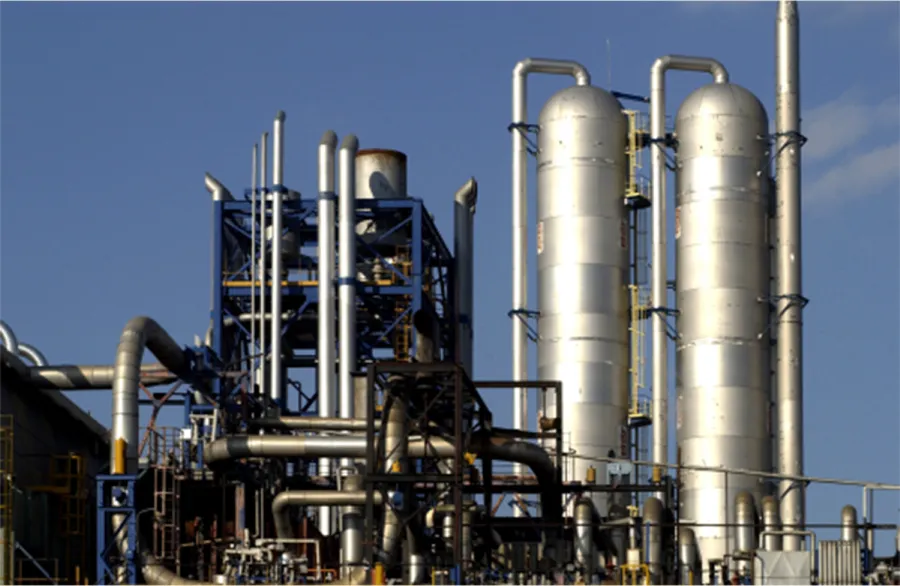
Figure 1.1.1 Crude Oil Refinery
(Image sourced at http://www.filtsep.com/view/16678/energy-materials-processing-filtration-and-the-fuels-of-the-future/, 2014).
Chemical engineering differs from other types of engineering in the application of knowledge of chemistry and biochemistry, in addition to other chemical engineering principles. The discipline generally involves researching, planning, development, evaluation and operation of chemical, biochemical or physical plants and processes; pollution control systems, changes in composition, heat content; analysis of chemical reactions that take place in mixtures; determination of methodologies for the systematic design, control and analysis of processes, evaluating economics, safety and state of aggregation of materials. It also involves analysis of forces that act on matter that leads to the formation of new or conventional chemical materials and products.
Slin’ko (2003) [1] elaborates that chemical engineering, as a rule, deals with nonequilibrium chemical engineering systems. Consequently, the analysis and description of such systems present substantial difficulties, which become fundamental as the number of structural elements is increased and the system regresses from equilibrium. The technical aspects of chemical engineering, hence, revolve around managing the behavior of materials and chemical reactions in a closely controlled system—this means predicting and manipulating chemical or biochemical process parameters such as compositions, temperatures, flow rates, and pressures of solids, liquids and gases.
Table 1.1.1 Systems of Interest to Chemical Engineering.
Products
Products of interest to chemical engineering include various types of commodity or specialty polymers; pharmaceuticals; a broad array of inorganic, ceramic, or composite materials; chemicals and materials for personal care products (e.g., cellular phones, optic fiber communication networks), medical products, or automobiles; diagnostic devices; drug delivery systems; and others.
Processes for making products
Processes of interest to chemical engineering include a large variety of industrial manufacturing systems used for the production of chemicals and materials (e.g., chemical plants, petrochemical plants, multipurpose pharmaceutical plants, microelectronics fabrication facilities, food processing plants, biomass to fuel conversion plants); ecological subsystems such as the atmosphere; the human body in its entirety and its parts; and energy devices such as batteries and fuel cells.
Applications of interest
Applications of interest to chemical engineering include monitoring and control of air pollution; extraction of fossil energy; life-cycle analysis, design, and production of “green” or sustainable products; diagnostic devices; drug targeting and delivery systems; combustion systems; solar energy; and many others.
Therefore, another way to explain chemical engineering is to state that it is a discipline that deals with the engineering aspects of chemical and biological systems of interest. The special focus within the discipline on process engineering cultivates a systems perspective that makes chemical engineers extremely versatile and capable of handling a wide spectrum of technical problems. Systems of interest most often include products, processes for making them, and applications for using them. Beyond designing, manufacturing, and using products, chemical engineering also includes finding new ways to measure, effectively analyze, and possibly redesign complex systems involving chemical and biological processes.
1.1.2 Chemical Engineers
A comprehensive description of the chemical engineer may be to say that he or she is the engineer that designs both products and processes, plans and constructs process hardware, manages operations of processes and researches the solutions to environmental problems. Hence, chemical engineers can be directly involved in research and development and responsible for the design, construction and operation of hardware and processes in varied areas such as energy, biomedicine, electronics, food engineering/technology, materials, biotechnology, the environment and so on. Details of these areas of expertise are treated in Chapter 3.
Figure 1.1.2 Chemical Engineers maintain and run plants.
Following completion of process and equipment design, chemical engineers, in addition, remain on hand at a production facility to solve problems that occur as the processes continue. When changes occur that upset a running system, chemical engineers analyze samples from the system, looking at parameters such as flow rates, temperatures and pressures to determine where the problem exists. They also work on expanding projects, evaluating new or alternative equipment, and improving existing equipment and processes. Meeting safety, health, and environmental regulations is also a large part of a chemical engineer’s work life.
By way of example, the work of the process/chemical engineer can involve any of the following:
Designing a process to produce or refine a given chemical or biochemical product through all the stages from feedstock to output of the finished product.
Designing or sizing the various pieces of equipment or process units which make up this process.
Once a production process is operational, process/chemical engineers can be responsible for managing the production process, improving the efficiency and safety of the process; ensuring products meet the...
Table of contents
Cover
Title Page
Copyright
Preface
Foreword
Acknowledgements
Chapter 1: Introduction
Chapter 2: Chemical Engineering Basic Education and Training
Chapter 3: Chemical Engineers’ Areas of Expertise
Chapter 4: Career Diversities in Chemical Engineering
Chapter 5: Design and Chemical Engineering Practice
Chapter 6: Chemical Process Safety Engineering and Management
Chapter 7: Sustainability in Chemical Engineering Design
Chapter 8: Chemical Engineering Computer Software Tools and Applications
Chapter 9: Graduate Programs in Chemical Engineering
References
Index
End User License Agreement
Frequently asked questions
Yes, you can cancel anytime from the Subscription tab in your account settings on the Perlego website. Your subscription will stay active until the end of your current billing period. Learn how to cancel your subscription
No, books cannot be downloaded as external files, such as PDFs, for use outside of Perlego. However, you can download books within the Perlego app for offline reading on mobile or tablet. Learn how to download books offline
Perlego offers two plans: Essential and Complete
Essential is ideal for learners and professionals who enjoy exploring a wide range of subjects. Access the Essential Library with 800,000+ trusted titles and best-sellers across business, personal growth, and the humanities. Includes unlimited reading time and Standard Read Aloud voice.
Complete: Perfect for advanced learners and researchers needing full, unrestricted access. Unlock 1.5M+ books across hundreds of subjects, including academic and specialized titles. The Complete Plan also includes advanced features like Premium Read Aloud and Research Assistant.
Both plans are available with monthly, semester, or annual billing cycles.
We are an online textbook subscription service, where you can get access to an entire online library for less than the price of a single book per month. With over 1.5 million books across 990+ topics, we’ve got you covered! Learn about our mission
Look out for the read-aloud symbol on your next book to see if you can listen to it. The read-aloud tool reads text aloud for you, highlighting the text as it is being read. You can pause it, speed it up and slow it down. Learn more about Read Aloud
Yes! You can use the Perlego app on both iOS and Android devices to read anytime, anywhere — even offline. Perfect for commutes or when you’re on the go. Please note we cannot support devices running on iOS 13 and Android 7 or earlier. Learn more about using the app
Yes, you can access Introduction to Chemical Engineering by Uche P. Nnaji in PDF and/or ePUB format, as well as other popular books in Tecnología e ingeniería & Ingeniería química y bioquímica. We have over 1.5 million books available in our catalogue for you to explore.