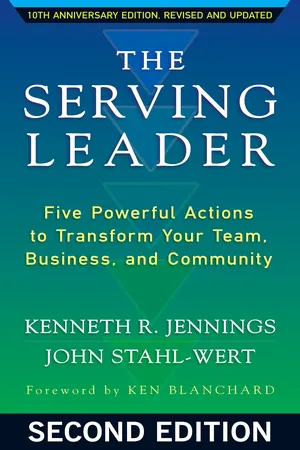
The Serving Leader
Five Powerful Actions to Transform Your Team, Business, and Community, 10th Anniversary Edition, Revised and Expanded It's people who make organizations great, so how can leaders best help their people achieve that greatness? As Ken Jennings and John Stahl-Wert show in this new edition of their bestseller, you can't just demand greatness—you have to inspire it. The most effective leaders don't just stand in front of their people, they stand behind them too. As one of the characters in the book notes, "You qualify to be first by putting other people first." This concept sounds paradoxical, but it leads to extraordinary outcomes—and The Serving Leader shows precisely how and why.WhileJennings and Stahl-Wert use a compelling fictional story to outline the basics of Serving Leadership, all the characters in it are based on real people, the organizations depicted are based on real organizations—and the results they achieved are what really happened. This edition features a new foreword by Ken Blanchard, a new introduction, and a new chapter checking back in with Mike, the main character, to see what he has learned in the twelve years since he embraced Serving LeadershipOn one levelthis is the most practical guide available to implementing Serving Leadership; on a deeper level, it is a book about the personal journey of growth that real leadership requires. Great organizations are great because they're filled with people who freely choose to do their very best. It's a maddeningly simple concept yet stunningly hard to execute. Jennings and Stahl-Wert show leaders how to earn that kind of commitment.
eBook - ePub
The Serving Leader
Five Powerful Actions to Transform Your Team, Business, and Community
- 192 pages
- English
- ePUB (mobile friendly)
- Available on iOS & Android
eBook - ePub
The Serving Leader
Five Powerful Actions to Transform Your Team, Business, and Community
About this book
Trusted by 375,005 students
Access to over 1.5 million titles for a fair monthly price.
Study more efficiently using our study tools.
Information

Mike Wilson’s Journal
The Fast Track Diverted
Why am I sitting on this train? If I had taken a flight, I’d already be there. Instead, I’ve got four more hours to sit here and fume about what I’ve gotten myself into.
I feel like I’m eight years old again. Dad says, “Why don’t you ride down on the train, Son! It’ll give you a chance to think.” And so I just do it. Like I’ve got time to sit for hours, thinking. Like I actually enjoy trains.
The thing about trains is this: trains only show you what you’re passing, not where you’re headed. Whatever you can see out the window is already old news. Been there. Regularly, the track bends enough that you can catch a glimpse of the journey ahead, but as soon as the train straightens its aim for the goal, you’re left sitting in the back just watching stuff go past. An hour into this trip and I’m way past bored.
Scratch that last sentence. I’m not bored. And, truthfully, being stuck on this train is not what I’m really troubled about. What upsets me is the fact that I don’t know what’s waiting for me at the end of this track. And I’m afraid to find out. I’m deeply worried about Dad. I don’t know how I’m going to pass so much time sitting here just with myself.
And more truth: I used to like trains. A lot. It’s one of the memories I do have with Dad. One of the too-few memories. And that’s what this is really about. Sitting here reminds me of so much that I’ve lost. So much!
There you have it, boss: a journal entry. I’d say I’m well on my way!
All right, Mike, enough time on the therapist’s couch. Here’s a thought: scratch it all out. I doubt Charlie wants to read the sorry ramblings of a lost son.
Please let my dad be okay!
Okay, new start. Official sounding.
Journal entry: “Background and Orientation.”
Two months ago, Charlie gave me the assignment of building a new leadership development practice for our firm, working from our Boston headquarters. An MBA, ten years of management consulting assignments, experience with nearly fifty clients around the world—I had done it all with this in mind, the chance to take the lead. Thirty-eight years old. Heading the development of our firm’s newest and most promising practice area. My life was right on track!
Our firm routinely gets involved with helping clients attack tough strategic problems, strengthen their operations, and improve profitability. Up until now, however, we have never directly focused our client services on building critical leadership capacity in organizations. As a firm, we have the access and reputation required to build a practice in the area, but I knew we did not have a good handle on the current best practices in leadership effectiveness. It became my mission to pull together a point of view on “leadership that really works,” as Charlie put the challenge to us.
So I buried myself and my crew—the colleagues who joined me—in the research available about leadership, including traits, models, value propositions. PowerPoint presentations were zigzagging back and forth between our offices like crazed bats. We interviewed some of the best CEOs in the country, scanned mountains of journal articles, met with professors and writers who studied leadership, and amassed our data. We felt like we were launching a major Himalayan expedition. It felt good!
In all our research, some threads emerged. And a few especially puzzling findings spurred us to go deeper.
A Boulder, Colorado–based “freelance professor” and rock climber, Jim Collins, along with his team, had found some unusually curious data. He observed that dramatic improvements in company performance were coming from leaders whose traits and practices broke the traditional leadership mold. This research described leaders who were personally humble (in some cases, almost shy) and totally devoted to the service of others but who were also fiercely and unwaveringly resolved to do whatever it took to improve organizational performance. Something was jarring about great results coming from a self-effacing style, but the data was compelling.
It occurs to me just now that it was this Collins research that got me thinking again about my own dad as a leader. All right, score a point for this long train trip. Back in business school, I took a fair measure of ribbing about my famous father. He was featured in one of the school’s management case studies about leadership, ethics, and decision making in business. Honestly, I didn’t put much effort into that assignment. Dad was well known, admired by many, so loved. And he gave me, his son, so little of himself. It was a sore point. Still is.
I didn’t fare very well on that particular assignment, and my classmates rode me big time. Not that I really cared; I figured back then that some of them were better suited to social work than business, anyway.
But reading Collins had caused me to reconsider all of this. What I’ve always heard about my dad’s way of working sounds suspiciously like the profile of the effective leader Collins described. The thought had even crossed my mind that if I was going to launch a new leadership practice, then my old man might be helpful. Just a week ago I was thinking about Dad and wishing I could get past my hurt enough to reach out to him and run some of these ideas past him.
I should be more careful what I wish for. Mom called me on the same day I was having those thoughts.
“Hi, Son,” Mom said. “I’m glad I caught you. Do you have a minute to talk?”
Her words were casual, but her voice had none of its normal breezy character. A feeling of alarm began to creep up the back of my neck. Of course I had a minute to talk!
“It’s about your father,” she continued more slowly. She cleared her throat. “I’ve been putting this conversation off for a while, Mike. He’s not been feeling that great lately.” Mom’s voice cracked, and silence filled the line.
“Oh, just hand me the phone, Margaret!” My father’s voice broke the silence with that tone of impatience I knew so well. He sounded all right to me.
“Look, Mike, things aren’t too good right now. I met with my doctor this morning and there’s a problem. The bottom line is that I’m going to have to cut back on some things. He wants me to get a little treatment. Rest up.”
I was stunned. My mouth opened, but nothing came out. I had no words.
“I need your help, Mike,” he continued, his voice suddenly sounding like a badly scratched record. “I’m involved in some leadership projects here, and they’re all at critical points.” Now it was Dad’s turn to clear his throat. “I thought you could step in for me for a while, maybe a couple weeks,” he finished weakly.
I wasn’t processing any of this. My father, the master of understatement where his own personal issues are concerned, was saying that he had a problem! He needed a little treatment!
“I’ve talked about this with your boss. He told me you’re launching the firm’s leadership practice, so this should benefit both of us.” Dad plowed on with his pitch like a runner determined to hit the finish line. “While you’re helping us out, the team here will teach you what we’ve learned about a unique approach to leadership. Charlie suggested you keep a journal on your investigations while you’re here, and I’ve got some friends who can help you develop it into something useful later.” I heard my father take a quick breath.
“Would you come and help me, Son? Please?”
And just like that, my leadership sabbatical began. I can’t adequately express how strange it is that I made such an abrupt move. I was in the middle of everything I had always wanted, on the threshold of a future I had always dreamed of. And I didn’t like my father’s unsolicited intervention with my boss in the least. Back to my earlier comment about feeling eight years old.
And yet I didn’t hesitate. The sound of Mom’s voice. What my dad said. What I felt in my heart. It all just went “click.”
The next day, I handed off assignments to my crew. I decided to leave my techno-gadgets at home, packing three blank notebooks and an anxious mind. At the last minute, on an impulse, I dug back through my graduate school files and grabbed the case study on my pop. I was going to see him, yet I still didn’t really know who he was.
My executive assistant booked me a seat on Amtrak to Philly for the very next day. She looked at me suspiciously, like I’d lost my mind. Amtrak! I explained myself by repeating my dad’s explanation: “It’ll give me time to think.” Her frown worsened—it was alien possession, not mere mental distress.
And here I am. I spent the first forty-five minutes of my trip reviewing Dad’s case study and have been writing ever since. I’m beginning to suspect that this investigation may well be as much about him as his projects. I’m actually glad. It’s time.
Some notes from my reading:
The son of a coal miner, my dad grew up in tough circumstances. Like many of his generation, he went to war when called. On Robert Wilson’s twentieth birthday, a cease-fire was signed in Korea’s Panmunjom, and he was shipped home. The GI Bill took him to Princeton, where, according to the case study, he ran track. That reminded me of my favorite photo of him. A boyish Robert Wilson is straining forward, chest first, breaking the tape 100 yards ahead of the field in a 100-yard race! So fiercely determined was he to win that he false-started, failed to hear the recall gun, and ran the entire race alone. He explained to me, “I always expect to win and never look back to see the other guys.”
That’s the dad I know.
But the case study drew another picture that didn’t fit this first-at-all-costs photo. Starting his career as a pharmaceutical salesman and rising quickly to management, he distinguished himself as a team builder. He always credited the team with his success, the file declared, and appeared to be genuinely surprised whenever he received recognition or promotions.
This just doesn’t square with what I thought I knew about him. Honestly, I never felt that he gave me credit for much of anything.
Robert Taylor Wilson was described in the article as unique. When he became CEO of the company twenty-two years later, he hardly ever stayed in his office (or at home, I might just add). He spent a lot of time in activities that looked more like teaching than managing. He practically turned his company’s entire senior team into teachers.
As a leader, he was known for setting high goals and standards. He was death on what the article called “mistakes of the heart,” poor ethical decisions like when managers shaded the truth, took credit when it belonged to others, or passed on unflattering remarks about their colleagues. Conversely, he was softer on other kinds of mistakes. He used honest missteps as teaching occasions. He encouraged risk taking, though he wasn’t afraid to remove people for persistent underperformance. His top leadership team actually got smaller in his first few years, even as the company doubled in size and profitability.
He avoided taking credit when things were going well; indeed, he went to great pain to attribute success to others. At the corporate annual meeting, he always showcased others’ accomplishments, not his own.
He called himself a “truth teller.” He was famous for plain talk, for going to great lengths to describe company performance accurately. This part, at least, I recognize. He also encouraged managers to honestly describe the reality of their unit’s performance.
Reviewing all of this from my dad’s corporate past, I am becoming very curious to see the leadership system he has helped build in Philly. Maybe more to the point, I think I’m ready to take a fresh look at my father, give us both another chance.
Robert Taylor Wilson. I know that he looks great on paper. I know he has hundreds of loyal friends. I know that people love working for him. I also know there are dimensions of this man that I’ve never encountered. And I think I’d like to.
While I’m chronicling things I know, here’s one more. I know why I’m sitting on this train. My father said “please.” It wasn’t “Get down here, Son!” Just “please.” I don’t remember ever hearing that before.
Okay, time to put the pen down and watch America go past my window. The ride might not be too bad, really. I’m noticing the track bending out ahead. I can see the engine now, but even so, I can’t see where it’s heading. I suppose that if I were seated with the conductor at the head of this train, I would still be unable to see what’s around that bend.
I wonder where this journey will take me.
A New Assignment
Day’s end, and what a day it has been. Mom and Dad are in bed, and I’m back in my boyhood bedroom feeling time warped and badly torn between feelings of exhilaration and grief. I’ve got to somehow capture this incredible and tumultuous day.
Amtrak’s Acela Express pulled into Philly’s Thirtieth Street station at 12:05 p.m., five long hours after my Boston departure. Wanting to stretch my legs, I hiked the short thirteen blocks east along Market, crossing the majestic Schuylkill River—the Manayunk, as I insisted it be called in my boyhood Indian phase—to my first appointment of the day.
Dad had arranged for me to plunge right in with a lunch meeting at the famous Pyramid Club, high atop my hometown’s new, art deco skyline. When I walked in, I was stunned by the gaunt and pale face that greeted me, my dad’s wan smile masking nothing of the seriousness of his condition. He must have lost thirty pounds, and that from a frame that had been quite trim to begin with.
Dad saw that I noticed. Not giving me a chance to comment, he hooked my elbow and steered me to a circle of six men and women standing to the side. I saw the unspoken apologies on their faces—they already knew what Dad would put off telling me for another five hours.
Relocated to our table, my lunch mates introduced themselves. The first three were chief executive officers. One was the CEO of a premier biotech firm, the second had spent her career in financial services, and the third came out of the manufacturing industry. Next was the city’s former mayor, Dr. Will Turner, now devoted to the work of his inner-city church. Will said a few words about his passion for the city and for serving the most vulnerable members of the community.
Another member was an academic, Martin Goldschmidt. Martin was a sociologist whose research was aimed at understanding why some social sector initiatives succeeded and why others failed so miserably.
The final member was a transplanted Irishman named Alistair Reynolds. “Ali” was known to me already but by reputation only. He’d had a meteoric stint with my firm prior to my own tenure there. Ali described himself as a “social entrepreneur.” I had heard the term before but never actually met one. Social entrepreneurs, by definition, approach social sector needs with entrepreneurial and capital-generating strategies. He could have used ...
Table of contents
- Cover Page
- Title Page
- Copyright Page
- Dedication
- Contents
- Foreword
- Introduction
- Mike Wilson’s Journal
- Resources for Further Reading
- Acknowledgments
- About the Authors
Frequently asked questions
Yes, you can cancel anytime from the Subscription tab in your account settings on the Perlego website. Your subscription will stay active until the end of your current billing period. Learn how to cancel your subscription
No, books cannot be downloaded as external files, such as PDFs, for use outside of Perlego. However, you can download books within the Perlego app for offline reading on mobile or tablet. Learn how to download books offline
Perlego offers two plans: Essential and Complete
- Essential is ideal for learners and professionals who enjoy exploring a wide range of subjects. Access the Essential Library with 800,000+ trusted titles and best-sellers across business, personal growth, and the humanities. Includes unlimited reading time and Standard Read Aloud voice.
- Complete: Perfect for advanced learners and researchers needing full, unrestricted access. Unlock 1.5M+ books across hundreds of subjects, including academic and specialized titles. The Complete Plan also includes advanced features like Premium Read Aloud and Research Assistant.
We are an online textbook subscription service, where you can get access to an entire online library for less than the price of a single book per month. With over 1.5 million books across 990+ topics, we’ve got you covered! Learn about our mission
Look out for the read-aloud symbol on your next book to see if you can listen to it. The read-aloud tool reads text aloud for you, highlighting the text as it is being read. You can pause it, speed it up and slow it down. Learn more about Read Aloud
Yes! You can use the Perlego app on both iOS and Android devices to read anytime, anywhere — even offline. Perfect for commutes or when you’re on the go.
Please note we cannot support devices running on iOS 13 and Android 7 or earlier. Learn more about using the app
Please note we cannot support devices running on iOS 13 and Android 7 or earlier. Learn more about using the app
Yes, you can access The Serving Leader by Ken Jennings,John Stahl-Wert, John Stahl-Wert in PDF and/or ePUB format, as well as other popular books in Business & Management. We have over 1.5 million books available in our catalogue for you to explore.