Galliano: Spectacular Fashion is the first detailed guide to the work of one of fashion's greatest talents. Though the designer's otherwise glittering career has been punctured by years out of the limelight, his catalogue of work remains astonishing. Written by internationally renowned fashion expert Kerry Taylor, this beautifully illustrated and meticulously researched book looks in depth at John Galliano's collections from his 1984 graduate show at Saint Martins to his triumphant renaissance at Maison Margiela in 2015.
With never-before-seen images of rare designs from private couture archives, close ups revealing the intricacies of garments, and iconic runway shots showing the designer's most innovative creations in motion, this visually rich book examines his revolutionary designs in unprecedented depth. In addition, original interviews with the designer as well as the people who worked closely with him throughout his career shed new light on both the clothes and the context in which they were created. A must-have for fashion lovers, collectors and researchers alike, Galliano: Spectacular Fashion is the ultimate overview of the work of a design genius.
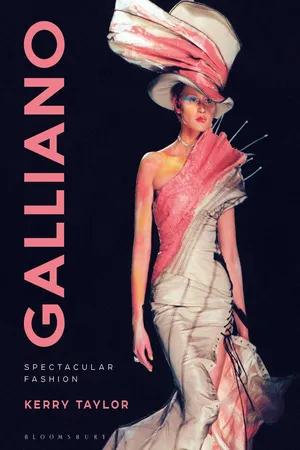
- 396 pages
- English
- ePUB (mobile friendly)
- Available on iOS & Android
eBook - ePub
About this book
Trusted by 375,005 students
Access to over 1.5 million titles for a fair monthly price.
Study more efficiently using our study tools.
Information
Galliano Arrives at Dior
Katell le Bourhis recalled the dramatic changes that took place in the previously sedate fashion house:
“You heard in the corridors the London music scene full blast. Then you saw people dressed in rags and jeans – it was the Galliano studio. They spoke only English, though John could speak good French. They had to have music and they had to have tea!”
Interview with the author, October 2016
Dior was arranged along traditional lines with rigid hierarchies and delineations. The ateliers for couture flou (dresses) and tailoring, where its white-coated staff transformed dreams into realities, was situated at the top of the building, with their own separate staircase. Galliano was later to introduce additional ateliers for Dior RTW alongside – the first couture house to do so.
Monsieur Arnault had his own dedicated lift. The main studio inhabited by Galliano and his team had its own staircase too. Katell le Bourhis recalls,
“John quickly changed the studio, he made it very private, no one was allowed entry without a magnetic card and within the main studio was his own large private office – a world within a world. Only the chosen few were allowed into this inner sanctum. Steven Robinson acted as an intermediary between John and the atelier. He was very talented too. I have never seen someone so devoted to a designer, so complex. He was a child who grew up and became very manipulative – but all that was for John and the clothes. He was first in every morning at 10am and if John was not there he could keep the show on the road. They adored to work together.”
Interview with the author, October 2016
The following May, Baufumé acquired a disused doll factory at 60 rue d’Avron in the northeast of Paris, which was transformed into a fabulous studio space for the Galliano label. It was spacious, light, with proper ateliers and offices and a pretty courtyard garden. Galliano loved being there, but increasingly his presence was required at Dior.
At Givenchy Galliano had his first taste of haute couture, but at Dior it was at another level entirely with an even larger skilled workforce and seemingly no restrictions. Dior was Arnault’s personal fiefdom and so for the first time in Galliano’s career, he was given free reign to create.
DIOR HAUTE COUTURE
Maasai
20 January 1997, 2.00 pm
Grand Hotel, Paris
50 looks

Label: woven “Christian Dior Haute Couture” with handwritten bolduc label behind.
“Christian Dior marked its 50th anniversary the best way possible – with a smash collection by Galliano.”
WWD, 21 January 1997
Galliano and the team worked solidly for eight weeks, taking just one day off for Christmas. They bought a turkey to roast, but forgot to turn on the oven. “It was awful. We were just so tired we ordered pizza” (Vogue, 4 January 1997).
Galliano had been impressed by the Givenchy atelier of around sixty skilled staff, but Dior was in another league altogether and represented the pinnacle of fashion excellence. Dior staff had been used to a standard eight-hour working day; now they complained they had been given just weeks to produce the entire collection, which involved late nights and last-minute adjustments. The fashion worker’s union representative complained that at Givenchy with McQueen it was as bad, if not worse: “we had two weeks to produce 50 models and some women in the workshop worked all night” (Mrs Brandely of the CGT Union, Guardian, 22 Jan 1997). The two bad boys from London were creating havoc in these previously calm and orderly ateliers.
The pressure was on – not only was this Galliano’s debut collection, but it was haute couture (rather than a pre-collection) and in the fiftieth anniversary of Maison Christian Dior, no less. On 12 February 1947, Christian Dior had shown his first collection, dubbed the “New Look”, which created headlines the world over. Would Galliano’s Dior make a similar sensation? He aimed to produce a collection that reinterpreted the Christian Dior “codes” but at the same time was new, young and exciting:
“I don’t want to do a retro New Look. I am trying to do something that would please Monsieur Dior and something that is modern . . . For me Dior is God!”
WWD, 16 January 1997
There were to be fifty looks (each given a name, as was Monsieur Dior’s tradition) shown by fifty top models, including all the “greats” – Naomi, Kate, Linda, Helena, Claudia, to name just a few.
Dior took over the entire ground floor of the Grand Hotel (couturiers were usually confined to just the ballroom) so that 791 gilded chairs and their occupants could be accommodated. The interior was painted Dior-grey and white to resemble the Dior couture salon, with pillars of 4000 fresh pink roses. Guests included Bernadette Chirac, France’s first lady, and the Duchess of York (who had been reputedly been paid £300,000 to write six fashion articles for Paris Match) sat next to the President of LVMH, Bernard Arnault. Fergie asked Galliano, “What can you do for a woman like me – one of the worst dressed in the world?” To which he mischievously suggested a corset: “even models wear them!” (Guardian, 29 January 1997).
The show opened with short, sexy tailored looks and short slip dresses, which may have startled some of the more traditional clients. When Galliano was asked about the “hooker” theme, he replied,
“When he first started Dior didn’t know how to get models, so he put an ad in the paper, and every h...
Table of contents
- Cover
- Title Page
- Table of Contents
- Introduction: The Genius of John Galliano
- Early Days
- The Move to Givenchy
- Galliano Arrives at Dior
- Renaissance
- Credits
- Index
- Acknowledgements
- eCopyright
Frequently asked questions
Yes, you can cancel anytime from the Subscription tab in your account settings on the Perlego website. Your subscription will stay active until the end of your current billing period. Learn how to cancel your subscription
No, books cannot be downloaded as external files, such as PDFs, for use outside of Perlego. However, you can download books within the Perlego app for offline reading on mobile or tablet. Learn how to download books offline
Perlego offers two plans: Essential and Complete
- Essential is ideal for learners and professionals who enjoy exploring a wide range of subjects. Access the Essential Library with 800,000+ trusted titles and best-sellers across business, personal growth, and the humanities. Includes unlimited reading time and Standard Read Aloud voice.
- Complete: Perfect for advanced learners and researchers needing full, unrestricted access. Unlock 1.5M+ books across hundreds of subjects, including academic and specialized titles. The Complete Plan also includes advanced features like Premium Read Aloud and Research Assistant.
We are an online textbook subscription service, where you can get access to an entire online library for less than the price of a single book per month. With over 1.5 million books across 990+ topics, we’ve got you covered! Learn about our mission
Look out for the read-aloud symbol on your next book to see if you can listen to it. The read-aloud tool reads text aloud for you, highlighting the text as it is being read. You can pause it, speed it up and slow it down. Learn more about Read Aloud
Yes! You can use the Perlego app on both iOS and Android devices to read anytime, anywhere — even offline. Perfect for commutes or when you’re on the go.
Please note we cannot support devices running on iOS 13 and Android 7 or earlier. Learn more about using the app
Please note we cannot support devices running on iOS 13 and Android 7 or earlier. Learn more about using the app
Yes, you can access Galliano by Kerry Taylor in PDF and/or ePUB format, as well as other popular books in Design & Fashion Design. We have over 1.5 million books available in our catalogue for you to explore.