From traditional print to digital formats for mobile phones and tablets, this book provides a clear introduction to the creative use of format in graphic design. Using 200 inspirational examples from contemporary international designers, Format for Graphic Designers guides the student through the role of format in both the purpose and the narrative of a design. The authors look at the physical aspects of formats - traditional and experimental, print and digital - to explore innovative solutions and, through case studies, explore how and why professional designers choose particular formats for a job. Covering everything from books and magazines, point-of-purchase displays, packaging, direct mail, brochures, and screen-based formats, the new edition illuminates this critical element of design practice for students, and provides them with a solid foundation on which to build their own designs.

- 208 pages
- English
- ePUB (mobile friendly)
- Available on iOS & Android
eBook - ePub
Format for Graphic Designers
About this book
Trusted by 375,005 students
Access to over 1 million titles for a fair monthly price.
Study more efficiently using our study tools.
Information

‘Societies have always been shaped more by the nature of the media by which men communicate than by the content of the communication.’
Marshall McLuhan
Chapter 3
Printed media
Some of the most important parts of history have been marked by the production of printed matter. From the Magna Carta through to the political propaganda posters of the twentieth century, printed matter is of unrivalled importance and stature.
Alongside these works of national and international importance, our cultural make-up is also constructed by the printed ephemera that surrounds us. Some printed items are intended to be kept as a record, as a cultural marker in time. There is also a plethora of printed items that are transitory and temporary in nature.
This section looks at the many outputs of printed media, from the book through to brochures and posters. The choice of format here is varied and often unconventional – with designers challenging the norms and conventions of any given media.
Standard sizes
Confusingly, design has evolved to run several different systems of standardisation, as described in the tables below and on the following spread.
In essence, book publishing formats are loosely based around standard paper sizes (imperial) that are folded and trimmed. Folio refers to pages that have been folded only once, quarto editions are formed by folding the paper twice and octavo is folded three times. Running concurrent with this, stationery and posters are based generally on either the ISO paper sizes (metric) or the US paper sizes, as shown on the following spread.
| Name | Metric (mm) | Imperial (in) |
| Demy | 229 x 152 | 9 x 6 |
| Royal | 235 x 191 | 9 ¼ x 7 ½ |
| Crown Royal | 280 x 210 | 11 x 8 ¼ |
| Classic hardback or C format paperback | 222 x 143 | 8 ¾ x 5 ⅝ |
| ‘Trade’ paperback or B format | 198 x 129 | 8 x 5 ¼ |
| Imperial folio | 390 x 550 | 15 ½ x 22 |
| Royal folio | 320 x 500 | 12 ½ x 20 |
| Imperial quarto | 280 x 300 | 11 x 15 |
| Crown folio | 250 x 300 | 10 x 15 |
| Royal quarto | 250 x 320 | 10 x 12 ½ |
| Medium quarto | 240 x 300 | 9 ½ x 12 |
| Demy quarto | 220 x 290 | 8 ¾ x 11 ¼ |
| Foolscap folio | 210 x 340 | 8 ½ x 13 ½ |
| Imperial octavo | 190 x 280 | 7 ½ x11 |
| Crown quarto | 190 x 250 | 7 ½ x 10 |
| Foolscap quarto | 170 x 210 | 6 3/4 x 8 ½ |
| Royal octavo | 150 x 250 | 6 ¼ x 10 |
| Medium octavo | 150 x 240 | 6 x 9 ½ |
| Demy octavo (demy 8vo) | 143 x 222 | 5 ⅝ x 8 ¾ |
| Large crown octavo | 129 x 198 | 5 ¼ x 8 |
| Crown octavo | 127 x 190 | 5 x 7 ½ |
| Foolscap octavo | 108 x 171.5 | 4 ¼ x 6 ¾ |
| ‘A’ format ‘Pulp fiction’ | 111 x 175 | 4 ¼ x 6 ⅞ |
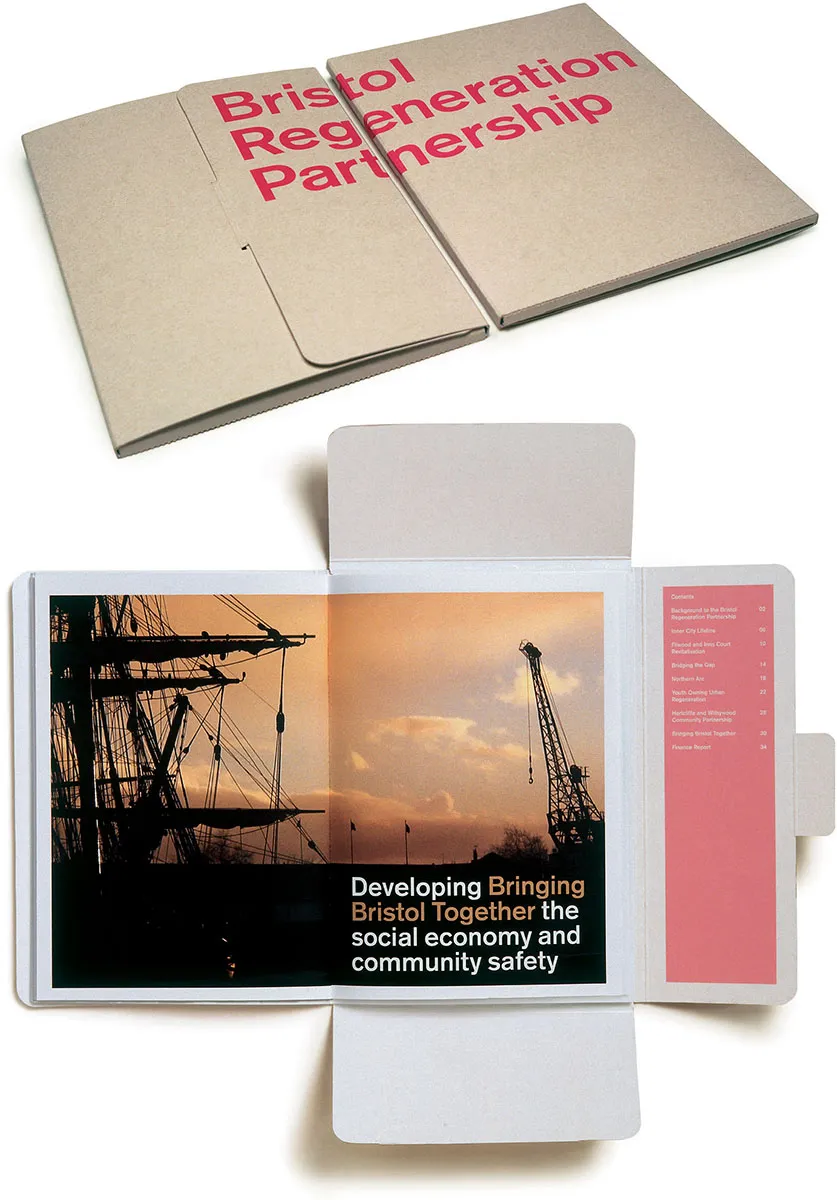
Shown here is an annual report, designed by Thirteen, for Bristol Regeneration Partnership. The design comprises an A5-format book stitched into its own mailable self-sealing greyboard envelope. Being perforated, the top and bottom flaps can be removed upon receipt, so that the object sheds its postal skin and functions purely as a book.
ISO and US paper sizes
The ISO paper size A standard is a system that allows easy enlarging or reducing from one size to the next. Each size is half of the size of the previous one, when folded parallel to the shorter lengths. The ratio of the length to the width is the square root of 2.
In contrast, the ANSI system (American National Standards Institute) has paper sizes based around the Letter (8.5 in x 11 in) format. Unlike the ISO standard sizes which have the single aspect ratio, ANSI standard sizes have two aspect ratios 1:1.2941 and 1:1.5455. This means that enlarging and reducing between sizes leaves irregular gaps and margins. The ANSI system is used in North America, Canada and parts of Mexico. The ISO system is generally adopted in other parts of the wor...
Table of contents
- Cover
- Title Page
- Contents
- Introduction
- Purpose and narrative
- Context
- Printed media
- Folding
- Binding
- Print and finish
- Glossary
- Index
- Acknowledgements
- Picture credits
- eCopyright
Frequently asked questions
Yes, you can cancel anytime from the Subscription tab in your account settings on the Perlego website. Your subscription will stay active until the end of your current billing period. Learn how to cancel your subscription
No, books cannot be downloaded as external files, such as PDFs, for use outside of Perlego. However, you can download books within the Perlego app for offline reading on mobile or tablet. Learn how to download books offline
Perlego offers two plans: Essential and Complete
- Essential is ideal for learners and professionals who enjoy exploring a wide range of subjects. Access the Essential Library with 800,000+ trusted titles and best-sellers across business, personal growth, and the humanities. Includes unlimited reading time and Standard Read Aloud voice.
- Complete: Perfect for advanced learners and researchers needing full, unrestricted access. Unlock 1.4M+ books across hundreds of subjects, including academic and specialized titles. The Complete Plan also includes advanced features like Premium Read Aloud and Research Assistant.
We are an online textbook subscription service, where you can get access to an entire online library for less than the price of a single book per month. With over 1 million books across 990+ topics, we’ve got you covered! Learn about our mission
Look out for the read-aloud symbol on your next book to see if you can listen to it. The read-aloud tool reads text aloud for you, highlighting the text as it is being read. You can pause it, speed it up and slow it down. Learn more about Read Aloud
Yes! You can use the Perlego app on both iOS and Android devices to read anytime, anywhere — even offline. Perfect for commutes or when you’re on the go.
Please note we cannot support devices running on iOS 13 and Android 7 or earlier. Learn more about using the app
Please note we cannot support devices running on iOS 13 and Android 7 or earlier. Learn more about using the app
Yes, you can access Format for Graphic Designers by Gavin Ambrose, Paul Harris in PDF and/or ePUB format, as well as other popular books in Design & Graphic Design. We have over one million books available in our catalogue for you to explore.