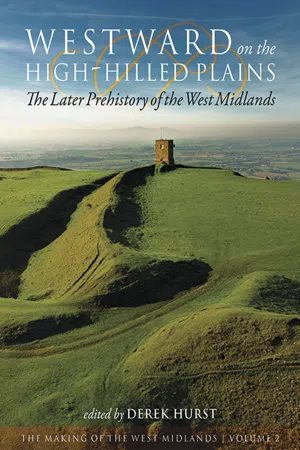
The West Midlands has struggled archaeologically to project a distinct regional identity, having largely been defined by reference to other areas with a stronger cultural identity and history, such as Wessex the South-West, and the North. Only occasionally has the West Midlands come to prominence, for instance in the middle Saxon period (viz. the kingdom of Mercia), or, much later, with rural south Shropshire being the birthplace of the Industrial rRevolution. Yet it is a region rich in natural mineral resources, set amidst readily productive farmland, and with major rivers, such as the Severn, facilitating transportation. The scale of its later prehistoric monuments, notably the hillforts, proclaims the centralisation of some functions, whether for security, exchange or emulation, while society supported the production and widespread distribution of specialised craft goods. Finally, towards the close of prehistory, localised kingdoms can be seen to emerge into view. In the course of reviewing the evidence for later prehistory from the Middle Bronze Age to Late Iron Age, the papers presented here adopt a variety of approaches, being either regional, county-wide, or thematic (eg. by site type, or artefactual typology), and they also encompass the wider landscape as reconstructed from environmental evidence. This is the second volume in a series – The Making of the West Midlands – that explores the archaeology of the English West Midlands region from the Lower Palaeolithic onwards. These volumes, based on a series of West Midlands Research Framework seminars, aim to transform perceptions of the nature and significance of the archaeological evidence across a large part of central Britain.
- 160 pages
- English
- ePUB (mobile friendly)
- Available on iOS & Android
eBook - ePub
About this book
Trusted by 375,005 students
Access to over 1.5 million titles for a fair monthly price.
Study more efficiently using our study tools.
Information
Subtopic
British HistoryIndex
History1
Introduction: Westward on the high-hilled plains
The West Midlands is an unusual region in many respects. Its existence is related purely to modern political and economic developments and owes little to either the underlying geology and topography or to the historical settlement patterns (Figure 1.1). This might be regarded as a disadvantage and there is certainly diversity to the region that defies easy synthesis. However, it could be regarded as an advantage, as it is clear the region encompasses a series of social, economic and natural boundaries that are of considerable interest to any archaeologist attempting to understand the development of regional cultures and identities in later prehistory. A considerable number of archaeologists find the definition and maintenance of regional identities a key area for contemporary research (Bevan 1999; Giles 2012; Sharples 2010).
In my job as a university lecturer I teach the ‘British Later Bronze Age’ and ‘Iron Age’. These courses are very broad and synthetic, and do not allow the detailed analysis of many of the ‘Different Iron Ages’ (Bevan 1999) that characterise the last millennium BC. The courses are split into thematic issues and case studies. My regional case studies have tended to focus on the usual suspects: Wessex, Yorkshire, the Atlantic Seaboard and, for local reasons, Wales. I have no specific incentive to examine the West Midlands as opposed to any other region. It is, therefore, interesting to note aspects of the West Midlands archaeology that are of such interest that they feature in the thematic lectures in my course; these demonstrate, to my mind, the national importance of the archaeological record of this region.
• On a broad scale the hillforts of the Welsh Marches are of considerable significance (Forde-Johnston 1976). These, though frequently linked geographically with the Wessex hillfort region, provide an interesting contrast to the evidence from that dominant region. They include some of the largest and most densely occupied hillforts known from Britain (Stanford 1974; 1981), and potentially they are very early, though the best dated examples The Breidden (Musson 1991) and Beeston Castle (Ellis 1993) lie just outside the West Midlands. They, therefore, provide important evidence for the development and significance of this very distinctive settlement form. The extensive excavation of large hillforts, such as Credenhill Hill Camp, Croft Ambrey and Midsummer Hill (Stanford 1970; 1974; 1981), has revealed regimented ranks of ‘4-posters’ that contrast with Wessex, and which require explanation, even if they cannot be interpreted as houses.
• The quality of the excavated record for these hillforts is very good. Stanford was a good field archaeologist and his recording of the hillforts at Croft Ambrey, and Midsummer Hill (Stanford 1974; 1981) is as good as, if not better than, other more celebrated practitioners of the era. Earlier excavations by Kathleen Kenyon at The Wrekin and Sutton Walls, and Thalassa Hencken on Bredon Hill (Kenyon 1942; 1953; Hencken 1938) were also good. Many of these sites produced substantial collections of artefacts, which include important assemblages of iron and bone tools that are still not common in many areas of Britain. The published excavations are sufficiently detailed to justify thorough reanalysis. All this could contribute a considerable amount to contemporary debate, and it is rather surprising that work on these artefact assemblages has so far been largely restricted to analysis of the ceramic record (Morris 1982).

Fig. 1.1 West Midlands topography with main places and rivers indicated as mentioned in the text of this volume.
• The regional evidence for the understanding of exchange networks is unparalleled for the British Isles. The geology of much of the region is sufficiently distinctive to allow for sourcing pottery and important stone quarries (Moore 2006). The pottery evidence is perhaps the most well-known aspect, and this region was instrumental in demonstrating that specialised pottery production existed in Iron Age Britain (Peacock 1968), and in providing a quantified approach to analysing the distribution networks that connected producers to individuals at a considerable distance from the source (Morris 1982; 1994). The evidence for the exploitation of salt at Droitwich and in Cheshire is even more important, as these are very unusual sources in Britain and the associated briquetage provides good evidence for the distribution of salt across a very wide area of western Britain (Morris 1985). The detailed analysis of these production and exchange networks is impossible to undertake in most of Britain where the geology is less conducive to investigation, or where the material culture simply does not exist.
• A particularly interesting discovery in the West Midlands is the burial evidence from Bredon Hill and Sutton Walls (Hencken 1938; Kenyon 1953). Both deposits have been interpreted as the result of warfare and certainly the remains at Bredon Hill had been systematically dismembered (Western and Hurst 2013). The only comparable deposit is the massacre level at South Cadbury which has recently been subjected to a detailed reinterpretation that has indicated the complexity of the depositional process (Barrett et al. 2000). The absence of a normal burial record for most of Iron Age Britain makes these deposits exceptionally important and provides some of the best evidence for the practice of warfare in Britain. These deposits have only recently been the subject of renewed study (Western and Hurst 2013), which has drawn attention to the international importance of the archaeological record of the region.
These are only some of the region’s greatest hits and I am sure others would have a different list. Nevertheless, they give an impression of the important contribution West Midlands archaeology has made to the understanding of Later Prehistoric studies in Britain. I would now like to look at the potential the region has for addressing issues, which seem to me to be of considerable importance in current archaeological practice.
Landscape and territory
Within the region the ability to compare and contrast different landscapes is very important, and understanding the very different nature of these landscapes should be one of the principal research objectives of the region.
It is immediately obvious that there is an important east-west division between the hillfort-rich landscapes of the Welsh Border counties, and the small enclosures that are so common in the low lying river valleys of Warwickshire and Staffordshire. This pattern was a feature of Cyril Fox’s Highland Lowland division of Britain (Fox 1952), and, though we can now dismiss the cultural assumptions that dominate Fox’s interpretation, we must still address the significant differences between the settlement patterns in each area (see Wigley, this volume).
There is also a major north/south division that ignores the landscape and which is best represented by material culture. This is reflected in a marked decline in the quantity and quality of the ceramics found in the northern counties of Shropshire and Staffordshire, compared to the southern counties of Herefordshire, Worcestershire and Warwickshire, and this may also be the case for other aspects of material culture, such as metal and stone tools, though these patterns are more difficult to determine. These divisions can be linked to the development of distinctive exchange networks in the Middle Iron Age, which in turn are normally explained as reflecting ethnic identities, such as between the Dubonni and the Cornovii. However, we need to explore the significance of these differences at the level of daily practice before we start to discuss ethnic and tribal affinities.
For example, it is worth asking why certain stone types are being used to temper specific types of pottery. Can we just assume that this is because of the thermal properties provided to the pot which make it a more efficient cooking utensil? I doubt it. If the decoration and form of pots is about building identities and defining communities, then it may be that a desire to be associated with particular localities is the most significant feature of the distribution networks. A Neolithic analogy is appropriate: it is now fairly acceptable to claim that stone axes were being quarried from specific sources because of the symbolic significance of the sources, which were located on very dramatic topographic locations (Edmonds and Bradley 1993). Is it possible that some of the sources of rock temper used in the Iron Age also had a symbolic significance to the producers and users of this pottery? The distribution of pottery has to be seen as a social process; it creates relationships between people, which are lubricated by stories that explain these relationships and place them in a broader cosmology. Ultimately these stories create an explanation for people’s existence as human beings, and place them in a world of rocks, soils, plants and animals.
The possibility of a symbolic significance for these ceramic sources may also be linked to some of the most important hillforts. The Malvern ridge is a dramatic landscape feature, which is highly visible, as anyone who has ever driven up the M5 will know. It acts as a boundary separating the very different landscapes of Herefordshire and Worcestershire. In most traditional societies this natural feature would be written into the mythological ancestry of the surrounding peoples. It would have a central role in the narrative of existence and provide an explanation for their being. It may be this mythological role that led to the construction of the two massive hillforts of Midsummer Hill and Herefordshire Beacon on the ridge. Do they control the mythology of place?
Directly opposite the Malverns is another prominent landscape feature, Bredon Hill. This isolated hill is the end of the Cotswold Ridge and looks down on the meeting of the rivers Avon and Severn. The hill is again controlled by the construction of a hillfort, but it is a very strange construction and difficult to interpret because of a massive landslip on the northern slopes. Nevertheless, it seems to have been densely occupied despite a very exposed location, and the importance may be reflected in the extreme violence that was used to kill and dismember the occupants.
Separating these two eminences is the River Severn, and, again, this natural feature must have had a prominent role in the cosmological, social and economic life of these communities. It is surprising, therefore, to find that this river does not appear to be marked by the activities of any prehistoric community. If this river was in Eastern England we would expect to recover Bronze Age, and probably Iron Age, metalwork from dredging, but this does not appear to be the case for the Severn, though the Ironbridge Gorge might be the exception (see Wigley, this volume). Is this a result of particular dredging practices which do not allow for the recovery of archaeological remains, or is it an accurate reflection of an archaeological reality? Did the people of the West Midlands have a religious practice that avoided rivers? As Dorling et al. observe (this volume) we know next to nothing about Iron Age religious practice in this region.
Site level
It is also necessary to consider the significance of the patterns recognised at the site level as part of this research process, and it is perhaps unfortunate that the analysis of sites was not a subject for detailed consideration in this volume. Certain aspects of settlements were a repeated feature of discussion during the original conference, and the nature of boundaries was one of these. This is a topic of considerable interest in later prehistoric research, and provides a thematic problem that cuts across different scales of the archaeological landscape:
• Large landscape boundaries are a conspicuous feature of some landscapes. Several of these have been identified in Warwickshire, and the redating of the cross-dykes of Shropshire to the prehistoric period is important. Pit alignments have a very interesting distribution, appearing in very limited areas on the river valleys of Warwickshire, Shropshire and Staffordshire.
• Field systems are also clearly a feature of some landscapes (notably at Kemerton, Worcestershire), though they are perhaps not as common as we would expect; recent work in Shropshire and Staffordshire suggests they are there, waiting to be explored (Wigley and Wardle, this volume).
• Enclosure boundaries are an important feature. The hillforts of the region are spectacularly well defined and can be used to distinguish the communities of the western uplands from the farmsteads occupying the less substantial enclosures of the eastern river valleys.
• Houses defined by shallow ditches are characteristic of the region. These should not be dismissed as drip gullies, as they are a deliberate feature that would be a conspicuous part of the domestic arena.
All of these boundaries need to be interpreted, and cannot simply be assumed to have an obvious function. The enclosure of the landscape is not necessarily an efficient way of organising agricultural landscapes, particularly those ...
Table of contents
- Front Cover
- Halftitle page
- Title page
- Copyright page
- Contents
- Preface
- Résumé
- Zusammenfassung
- 1. Introduction: Westward on the high-hilled plains
- 2. Cows, beans and the view: landscape and farming of the West Midlands in later prehistory
- 3. ‘The Bronze Age has lagged behind …’. Late Bronze Age settlement and landscape in the West Midlands
- 4. Burnt mounds and beyond: the later prehistory of Birmingham and the Black Country
- 5. Any more old iron age? An archaeological resource assessment for the Middle Bronze Age to Iron Age in Warwickshire and Solihull
- 6. Herefordshire: from the Middle Bronze Age to the later Iron Age
- 7. Fugitive pieces: towards a new understanding of the later second and first millennia BC in Shropshire
- 8. The Late Bronze Age and Iron Age in Staffordshire: the torc of the Midlands?
- 9. Middle Bronze Age to Late Iron Age Worcestershire
- 10. An overview of the ceramic basis within the broader West Midlands region
- 11. The potential of the Portable Antiquities Scheme and treasure finds for understanding the Iron Age in the West Midlands
- 12. Later prehistoric production and trade in the West Midlands
- 13. Touching the void: Iron Age landscapes and settlement in the West Midlands
Frequently asked questions
Yes, you can cancel anytime from the Subscription tab in your account settings on the Perlego website. Your subscription will stay active until the end of your current billing period. Learn how to cancel your subscription
No, books cannot be downloaded as external files, such as PDFs, for use outside of Perlego. However, you can download books within the Perlego app for offline reading on mobile or tablet. Learn how to download books offline
Perlego offers two plans: Essential and Complete
- Essential is ideal for learners and professionals who enjoy exploring a wide range of subjects. Access the Essential Library with 800,000+ trusted titles and best-sellers across business, personal growth, and the humanities. Includes unlimited reading time and Standard Read Aloud voice.
- Complete: Perfect for advanced learners and researchers needing full, unrestricted access. Unlock 1.5M+ books across hundreds of subjects, including academic and specialized titles. The Complete Plan also includes advanced features like Premium Read Aloud and Research Assistant.
We are an online textbook subscription service, where you can get access to an entire online library for less than the price of a single book per month. With over 1.5 million books across 990+ topics, we’ve got you covered! Learn about our mission
Look out for the read-aloud symbol on your next book to see if you can listen to it. The read-aloud tool reads text aloud for you, highlighting the text as it is being read. You can pause it, speed it up and slow it down. Learn more about Read Aloud
Yes! You can use the Perlego app on both iOS and Android devices to read anytime, anywhere — even offline. Perfect for commutes or when you’re on the go.
Please note we cannot support devices running on iOS 13 and Android 7 or earlier. Learn more about using the app
Please note we cannot support devices running on iOS 13 and Android 7 or earlier. Learn more about using the app
Yes, you can access Westward on the High-Hilled Plains by Derek Hurst in PDF and/or ePUB format, as well as other popular books in History & British History. We have over 1.5 million books available in our catalogue for you to explore.