- English
- ePUB (mobile friendly)
- Available on iOS & Android
eBook - ePub
Mechanically Responsive Materials for Soft Robotics
About this book
Offers a comprehensive review of the research and development of mechanically responsive materials and their applications in soft robots
Mechanically Responsive Materials for Soft Robotics offers an authoritative guide to the current state of mechanically responsive materials for the development of soft robotics. With contributions from an international panel of experts, the book examines existing mechanically responsive materials such as crystals, polymers, gels, and composites that are stimulated by light and heat. The book also explores the application of mechanical materials to soft robotics. The authors describe the many excellent mechanical crystals developed in recent years that show the ability to bend, twist, rotate, jump, self-heal, and shape memory. Mechanical polymer materials are described for evolution into artificial muscles, photomobile materials, bioinspired soft actuators, inorganic-organic hybrid materials, multi-responsive composite materials, and strain sensor materials.
The application of mechanical materials to soft robots is just the beginning. This book reviews the many challenging and versatile applications, such as soft microrobots made from photoresponsive elastomers, four-dimensional printing for assembling soft robots, self-growing of soft robots like plants, and biohybrid robots using muscle tissue. This important book:
-Explores recent developments in the use of soft smart materials in robotic systems
-Covers the full scope of mechanically responsive materials: polymers, crystals, gels, and nanocomposites
-Deals with an interdisciplinary topic of advanced smart materials research
-Contains extensive descriptions of current and future applications in soft robotics
Written for materials scientists, polymer chemists, photochemists, physical chemists, solid state chemists, inorganic chemists, and robotics engineers, Mechanically Responsive Materials for Soft Robotics offers a comprehensive and timely review of the most recent research on mechanically responsive materials and the manufacture of soft robotics.
Mechanically Responsive Materials for Soft Robotics offers an authoritative guide to the current state of mechanically responsive materials for the development of soft robotics. With contributions from an international panel of experts, the book examines existing mechanically responsive materials such as crystals, polymers, gels, and composites that are stimulated by light and heat. The book also explores the application of mechanical materials to soft robotics. The authors describe the many excellent mechanical crystals developed in recent years that show the ability to bend, twist, rotate, jump, self-heal, and shape memory. Mechanical polymer materials are described for evolution into artificial muscles, photomobile materials, bioinspired soft actuators, inorganic-organic hybrid materials, multi-responsive composite materials, and strain sensor materials.
The application of mechanical materials to soft robots is just the beginning. This book reviews the many challenging and versatile applications, such as soft microrobots made from photoresponsive elastomers, four-dimensional printing for assembling soft robots, self-growing of soft robots like plants, and biohybrid robots using muscle tissue. This important book:
-Explores recent developments in the use of soft smart materials in robotic systems
-Covers the full scope of mechanically responsive materials: polymers, crystals, gels, and nanocomposites
-Deals with an interdisciplinary topic of advanced smart materials research
-Contains extensive descriptions of current and future applications in soft robotics
Written for materials scientists, polymer chemists, photochemists, physical chemists, solid state chemists, inorganic chemists, and robotics engineers, Mechanically Responsive Materials for Soft Robotics offers a comprehensive and timely review of the most recent research on mechanically responsive materials and the manufacture of soft robotics.
Tools to learn more effectively

Saving Books

Keyword Search

Annotating Text

Listen to it instead
Information
Part I
Mechanically Responsive Crystals
1
Photomechanical Behavior of Photochromic Diarylethene Crystals
Seiya Kobatake and Daichi Kitagawa
Department of Applied Chemistry, Graduate School of Engineering, Osaka City University, 3‐3‐138 Sugimoto, Sumiyoshi‐ku, Osaka, 558‐8585, Japan
1.1 Introduction
Photochromism is defined as a reversible transformation reaction between two isomers having different absorption spectra, which is induced in one or both directions by photoirradiation [1]. Among many photochromic compounds, diarylethenes with heteroaryl groups including thiophene, furan, thiazole, and oxazole rings have excellent properties, such as thermal stability of both isomers, fatigue resistance, high coloration quantum yield, rapid response, and high reactivity even in the crystalline phase [2]. Such diarylethenes have potential applications in ultraviolet (UV) sensors, photoswitches, displays, optical waveguides, optical memories, holographic recording media, nonlinear optics, and actuators. Upon UV light irradiation, diarylethenes exhibit color changes because of a molecular structure change from the open‐ring isomer form to the closed‐ring isomer form. The colors remain stable in the dark at room temperature. The colored isomers revert to their original colorless isomer forms by irradiation with visible light. The reversible color changes can be repeated many times.
Photochromic compounds that undergo a photochromic reaction in the crystalline phase are known for paracyclophanes, triarylimidazole dimer, diphenylmaleronitrile, aziridines, 2‐(2,4‐dinitrobenzyl)pyridine, N‐salicylideneanilines, triazenes, and diarylethenes. The large change in geometrical structures prohibits photochromic reactions in the crystalline phase. Even in the crystalline phase, diarylethenes can undergo thermally irreversible and fatigue‐resistant photochromic reactions when diarylethene molecules are fixed in the antiparallel conformation and the distance between the reactive carbons is less than 4.2 Å [3]. The photocyclization reaction results in a color change in the crystals from colorless to yellow, red, blue, or green, as shown in Figure 1.1. The color of the crystals can be maintained if they are stored in the dark. The colored crystals return to the initial colorless ones by irradiation with visible light. In the crystalline phase, the photocyclization quantum yield is close to unity and the coloration/decoloration cycles can be repeated more than 104 times [2]. There are many studies describing the photochromism of diarylethene crystals, including investigations that report multicolor photochromism [4], dichroism under polarized light [5], fluorescence [6], three‐dimensional optical memory [7], diastereoselective cyclization [8], selective photochromic reaction under polarized light [9], theoretical studies [10], Raman spectroscopic studies [11], nanostructures [12], supramolecular architectures [13], nanocrystals [14], polymorphism [9a, 15], phase transitions [15b, c], surface wettability [15a, 16], and molecular motion observed by X‐ray crystallography [17]. The research on molecular motion observed by X‐ray crystallography demonstrated that photochromic reactions of diarylethene molecules in the crystals are accompanied by a change in the unit cell dimensions because of a decrease in the molecular volume resulting from photoisomerization of the open‐ring isomer to yield the closed‐ring isomer as shown in Figure 1.2 [2b]. The height of the triangle shape increases from 0.49 to 0.56 nm and the base width decreases from 1.01 to 0.90 nm. The side view indicates that the thickness of the molecule is reduced. The change in the geometrical structure of diarylethene molecules plays an important role in photomechanical phenomena.

Figure 1.1 Typical examples of diarylethenes that underwent photochromism in the single crystalline phase. Maximum absorption wavelength of the photogenerated closed‐ring isomers in crystals is shown in parentheses. When exposed to UV radiation crystals 1–3 turned to yellow, crystals 4–13 to red, crystals 14–16 to blue, and crystals 19–21 to green.
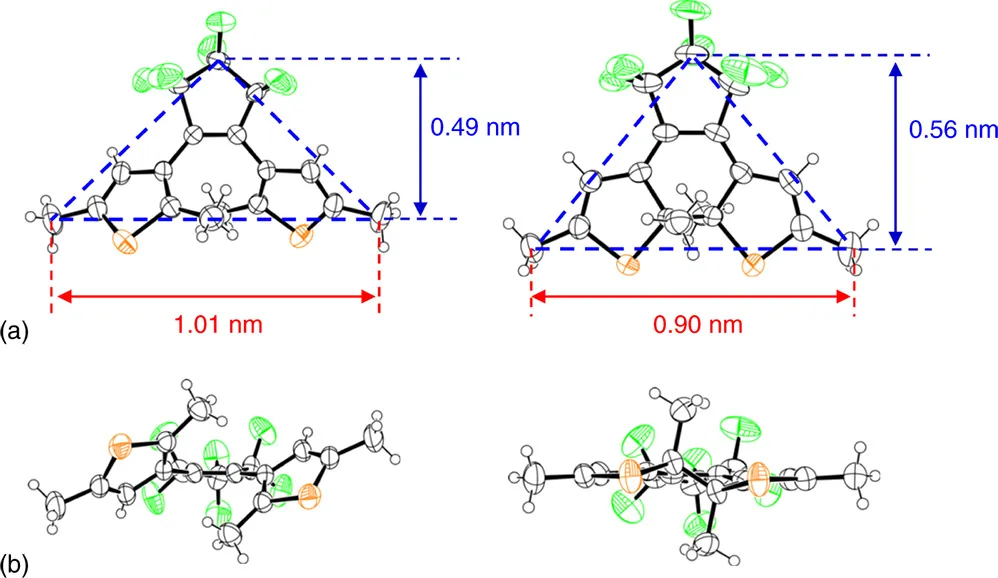
Figure 1.2 (a) Top and (b) side views of the geometrical structures of the open‐ and closed‐ring isomers of 1,2‐bis(2,5‐dimethyl‐3‐thienyl)perfluorocyclopentene (7) in crystals. The two isomers were isolated and independently recrystallized.
Source: Irie et al. 2014 [2b]. Adapted with permission from American Chemical Society.
In 2001, the crystal surface of diarylethene 18 was found to exhibit a photoreversible surface morphology change [18]. The flat crystal surface formed a step with a height of approximately 1 nm upon UV light irradiation. The step was erased by irradiation with visible light. The crystal thickness decreased as a result of the photochromic isomerization of the open‐ring isomer to yield the closed‐ring isomer. Another surface, w...
Table of contents
- Cover
- Table of Contents
- Preface
- Part I: Mechanically Responsive Crystals
- Part II: Mechanically Responsive Polymers and Composites
- Part III: Application of Mechanically Responsive Materials to Soft Robots
- Index
- End User License Agreement
Frequently asked questions
Yes, you can cancel anytime from the Subscription tab in your account settings on the Perlego website. Your subscription will stay active until the end of your current billing period. Learn how to cancel your subscription
No, books cannot be downloaded as external files, such as PDFs, for use outside of Perlego. However, you can download books within the Perlego app for offline reading on mobile or tablet. Learn how to download books offline
Perlego offers two plans: Essential and Complete
- Essential is ideal for learners and professionals who enjoy exploring a wide range of subjects. Access the Essential Library with 800,000+ trusted titles and best-sellers across business, personal growth, and the humanities. Includes unlimited reading time and Standard Read Aloud voice.
- Complete: Perfect for advanced learners and researchers needing full, unrestricted access. Unlock 1.4M+ books across hundreds of subjects, including academic and specialized titles. The Complete Plan also includes advanced features like Premium Read Aloud and Research Assistant.
We are an online textbook subscription service, where you can get access to an entire online library for less than the price of a single book per month. With over 1 million books across 990+ topics, we’ve got you covered! Learn about our mission
Look out for the read-aloud symbol on your next book to see if you can listen to it. The read-aloud tool reads text aloud for you, highlighting the text as it is being read. You can pause it, speed it up and slow it down. Learn more about Read Aloud
Yes! You can use the Perlego app on both iOS and Android devices to read anytime, anywhere — even offline. Perfect for commutes or when you’re on the go.
Please note we cannot support devices running on iOS 13 and Android 7 or earlier. Learn more about using the app
Please note we cannot support devices running on iOS 13 and Android 7 or earlier. Learn more about using the app
Yes, you can access Mechanically Responsive Materials for Soft Robotics by Hideko Koshima in PDF and/or ePUB format, as well as other popular books in Technology & Engineering & Materials Science. We have over one million books available in our catalogue for you to explore.