Winner of the Association of Dress Historians Book of the Year Award, 2021
In 1939, fashion became an economic and symbolic sphere of great importance in France. Invasive textile legislation, rationing and threats from German and American couturiers were pushing the design and trade of Parisian style to its limits. It is widely accepted that French fashion was severely curtailed as a result, isolated from former foreign clients and deposed of its crown as global queen of fashion. This pioneering book offers a different story. Arguing that Paris retained its hold on the international haute couture industry right throughout WWII, eminent dress historians and curators come together to show that, amid political, economic and cultural traumas, Paris fashion remained very much alive under the Nazi occupation – and on an international level.
Bringing exciting perspectives to challenge a familiar story and introducing new overseas trade links out of occupied France, this book takes us from the salons of renowned couturiers such as Edward Molyneux and Robert Piguet, French Vogue and Le Jardin des Modes and luxury Lyon silk factories, to Rio de Janeiro, Denmark and Switzerland, and the great American department stores of New York. Also comparing extravagant Paris occupation styles to austerity fashions of the UK and USA, parallel industrial and design developments highlight the unresolvable tension between luxury fashion and the everyday realities of wartime life. Showing that Paris strove to maintain world dominance as leader of couture through fashion journalism, photography and exported fashion forecasting, Paris Fashion and World War Two makes a significant contribution to the cultural history of fashion.
eBook - ePub
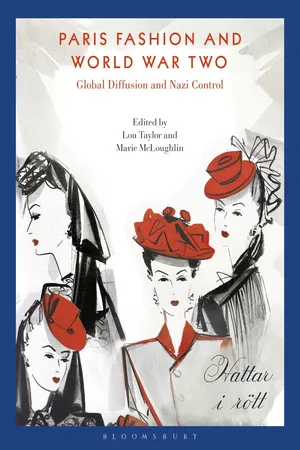
Paris Fashion and World War Two
Global Diffusion and Nazi Control
- 360 pages
- English
- ePUB (mobile friendly)
- Available on iOS & Android
eBook - ePub
Paris Fashion and World War Two
Global Diffusion and Nazi Control
About this book
Trusted by 375,005 students
Access to over 1 million titles for a fair monthly price.
Study more efficiently using our study tools.
Information

1941–42, German Reich, Nazi-occupied, neutral, and Allied territories across Europe


FIGURE 1.0
1941-42, German Reich, Nazi Occupied, neutral, and Allied territories across Europe. (Map adapted from Wikimedia Commons, licence CC-BY-SA-3.0).
Chapter 1
From Berlin to Paris
Lou Taylor*
Nazi Germany
Building on their certainty of the supremacy of the German Master Race, the goal of Hitler and his Third Reich was to create an empire that would last a thousand years, incorporating the whole of Europe and beyond. Kershaw writes that ‘The barbarism and destructiveness which were inherent in the vain attempt to realize [the goal of racial purification and racial empire] were infinite in extent, just as the expansionism and extension of aggression to other peoples were boundless’ (Kershaw 1999: 240).
In every annexed and occupied country these policies were set in place by Hitler’s military leaders, troops, civilian administrators and their collaborators, all sharing a ruthless sense of national and personal entitlement to own everything in their path. Based on his personal wartime experiences, Airey Neave wrote in 1978 that ‘No reconstruction can convey the true extent of their infamy’ (Neave 1978:25). In last two years of the war, Neave had been the chief organiser of MI9, a secret organisation master-minding underground escape lines in occupied North-West Europe. For this, Neave received the Distinguished Service Order (DSO). He was also awarded the French Croix de Guerre for his work with the French Resistance. In 1945 he was employed by the British War Crimes Executive at the Nuremberg War Crimes Tribunal. His first job was to serve indictment warrants personally on the twenty-two surviving Nazi leaders jailed in Nuremberg and charged with war crimes and crimes against humanity. These included Goering, Frank, Hess, Ley, Speer and Sauckel.1 After witnessing the Tribunal, he wrote:
these trials ‘revealed in plain language, the character of the Nazi’s’ system. Without evidence, the world might never have known the full truth of the Jewish extermination plan and the slave labour programme of Albert Speer. It demonstrated what kind of people perpetuated these colossal racial abominations. They were not supermen. They were ‘ordinary people’ . . . invested by Hitler with unbridled power. . . . As their power increased they learned to wield it without restraint. Manipulation, perversion and corruption of the law, allied to absolute rule unchecked by legal or democratic sanction, turned many of them into beasts.
(Neave 1978: 25–27)
Elwyn-Jones, on the British prosecuting team, stated plainly that at the 1946–1949 American-run trials of leading Nazi industrialists, including some who oversaw spoliation of industries in Occupied France, their ‘criminality’ too became clear. To give examples, Emil Puhl, vice president of the Reichsbank, was charged and jailed for receiving and disposing of gold from occupied territories and from concentration camp loot (Elwyn-Jones 1983: 128).2 Hans Kerl, who oversaw textile industries across Germany and in France and other conquered European territories, was charged with ‘spoliation in occupied territories’ and sentenced to fifteen years in jail (see Chapter 2 and Figure 2.3). As also became clear at these trials, Nazi anti-Semitic legislation was applied energetically in both annexed regions and occupied territories. Jews were deported to concentration camps from all of these – except in Denmark, which was the only country to actively resist the deportation of its Jewish community. Secretly warned that round-ups were to start, 7,200 Danish Jews were helped to leave, mostly by small ships to neutral Sweden.3
Nazi high society
Nazi military, diplomatic and industrial leaders and their wives, weighted with self-aggrandizement and with this same ruthless sense of entitlement, lived lives of extreme luxury built on the spoils of war wealth, from the gold teeth of those murdered at Auschwitz, from bribes, from the looting of Jewish banks, businesses and property and from public and private art and museum collections, whilst their wives wore couture, competing with each other over leadership in German fashion.
By 1933 Reichsmarschall Herman Goering was Hitler’s second in command, a leading member of the Nazi Party, head of the Luftwaffe, founder of the Gestapo and a ‘fervent anti-semite’. He was named at Nuremberg ‘as the instigator of the concentration camps’ (Neave 1978: 92, 243). By 1933, having already amassed a fortune, Goering built himself a huge, luxury country residence, Carinhall, northeast of Berlin. As Nancy Yeide proves, here he stored and exhibited much of his huge looted art collection, which included 1,570 old master paintings pillaged from all over annexed and occupied Europe and also from various German collections (Yeide 2009: 28–213). Edsell writes that ‘he was denied nothing’ (Edsell R., quoted in Yeide 2009: 3). Yeide further shows that Goering visited Paris twenty-five times in 1941–1942, selecting freely from looted paintings stored at Nazi art repository at the Jeu de Paume and attending auctions at the Hotel Drouot to buy paintings (Yeide 2009: 13).4 With such frequent travel to Paris, it is no surprise that find that Goering’s second wife, the retired actress Emmy Sonnemann, wore couture clothes made in Paris as well as Berlin (Figure 1.1A).
Goering, with his wife Emmy, finally surrendered to the American 36th Infantry Division on 9 May 1945 (Yeide 2009: 17), still in direct possession of six Memling paintings. When Goering, who kept emeralds in his pockets (Edsell R., quoted in Yeide 2009: 3) and who had a ‘passion for jewellery,’ arrived under US guard at Nuremberg jail with his ‘finger nails varnished red,’ he brought with him ‘sixteen monogrammed suitcases, a red hat box and a valet’ (Neave 1978: 68).

FIGURE 1.1A
Emmy and Herman Goering with Magda and Joseph Goebbels, Reich Minister for Propaganda, attending a press ball in Berlin, 3 February 1935 (Getty 541086559).

FIGURE 1.1B
Hans Frank, Governor General of Occupied Poland’s General Government, with his wife, Brigitte, and Goebbels at a soirée in Krakow on 1 September 1940, marking the first anniversary of the outbreak of war (with thanks to the National Digital Photographic Archive, Warsaw, no: SM02-3385. Photograph by Paul Brander).
Hans Frank, Governor General of the Occupied Polish Territories from October 1939–1944, lived in luxury in one of the greatest historical palaces of Europe, Wawel Castle in Cracow, just seventy kilometres from the concentration camp at Auschwitz. When his private villa in Bavaria was searched in 1945, American forces found Leonardo de Vinci’s painting Lady with an Ermine dated to 1490 and Rembrandt’s Landscape With the Good Samaritan, both stolen from the world famous Czartoryski Gallery in Cracow and both finally returned to the city.5 Frank’s wife, Brigitte, an ex-secretary, became the First Lady in the General Government. Not so young or slim, nevertheless photographs show that she wore fashionable bias-cut satin evening dresses, furs and jewels. She liked to be called ‘the Queen of Poland’.6
With his fashionable wife, Maria, and living grandly too in another vast castle, was Arthur Karl Greiser, the Reich Governor of the Poznan Region of Eastern Poland. This huge fortress was being rebuilt as Hitler’s home in his Eastern Territories (Michal 2004: 25).7 Wearing couture clothes was thus just one of the many benefits of the war for the wives of these men. Some continued to procure their couture clothes in Paris as well as Berlin all through the war.

FIGURE 1.1C
Arthur and Maria Greiser at the Hunters Ball, 5 November 1937. (Copyright Bundesarchiv 183-C15532.)
Luxury goods and couture fashion in Nazi Germany
High-ranking leaders and their wives therefore lived lives of great luxury, attending many occasions when wearing fashionable evening dress was required – at concerts, balls, the opera, for soirées and receptions at the best restaurants in Berlin, with elegant day wear worn at Nazi public occasions and official functions.
Anneliese Ribbentrop was a leading Nazi fashion celebrity. Probably whilst her husband was German Ambassador to London, in 1936–1938,8 one of their daughters was placed in a private finishing school in Bexhill, the Augusta-Victoria College, which featured the swastika and the flags of Germany and Britain on the school blazer badge.
The German couture industry provided the elegant clothes required by women from this circle, whose photographs were published widely in the German press for the general public to admire and copy and whose images were seen in filmed news reports.
Significantly for the story in this book, both Irene Guenther and Isabelle Belting state that Paris remained the arbiter of German fashion throughout the war years. In her meticulous and moving 2004 study o...
Table of contents
- Cover
- Title Page
- Dedication
- Table of Contents
- Notes on Contributors
- Introduction
- Chapter 1: From Berlin to Paris
- Chapter 2: The Lyon haute nouveauté fashion textile industry during World War Two: design making, exhibition and international diffusion
- Chapter 3: Shortages in Paris 1940–1945: frivolous accessories become essential needs
- Chapter 4: ‘Much news from the fashion frontier’: Swedish neutrality and diffusion of Paris fashion during World War Two
- Chapter 5: From Paris haute couture to New York: maintaining the French domination of fashion across the Atlantic, 1939–1946, through women’s magazines
- Chapter 6: New York and Paris fashions during World War Two: a competitive love affair
- Chapter 7: Lisbon as a centre of couture fashion in World War Two and its Paris and international connections
- Chapter 8: Fashion in Denmark in the ‘Five Dark Years’
- Chapter 9: The diffusion, reception and use of Paris style information in Brazil and its couture salons: 1939–1946
- Chapter 10: Annexed, neutral and occupied: the worlds of couture in Austria, Switzerland and Belgium and their relationships with Paris couture, 1939–1946
- Chapter 11: 1944: London plans to become the ‘meridian’ of world fashion
- Chapter 12: Paris fashion: an international product for an international clientele
- Chapter 13: The liberation of Paris and the state of the haute couture industry: late August 1944–1946
- Chapter 14: The end of the war in Europe to 1947: rejuvenating the international business of haute couture
- Conclusion
- A Letter from Nuremberg, 1946
- List of Illustrations
- Index
- Acknowledgements
- eCopyright
Frequently asked questions
Yes, you can cancel anytime from the Subscription tab in your account settings on the Perlego website. Your subscription will stay active until the end of your current billing period. Learn how to cancel your subscription
No, books cannot be downloaded as external files, such as PDFs, for use outside of Perlego. However, you can download books within the Perlego app for offline reading on mobile or tablet. Learn how to download books offline
Perlego offers two plans: Essential and Complete
- Essential is ideal for learners and professionals who enjoy exploring a wide range of subjects. Access the Essential Library with 800,000+ trusted titles and best-sellers across business, personal growth, and the humanities. Includes unlimited reading time and Standard Read Aloud voice.
- Complete: Perfect for advanced learners and researchers needing full, unrestricted access. Unlock 1.4M+ books across hundreds of subjects, including academic and specialized titles. The Complete Plan also includes advanced features like Premium Read Aloud and Research Assistant.
We are an online textbook subscription service, where you can get access to an entire online library for less than the price of a single book per month. With over 1 million books across 990+ topics, we’ve got you covered! Learn about our mission
Look out for the read-aloud symbol on your next book to see if you can listen to it. The read-aloud tool reads text aloud for you, highlighting the text as it is being read. You can pause it, speed it up and slow it down. Learn more about Read Aloud
Yes! You can use the Perlego app on both iOS and Android devices to read anytime, anywhere — even offline. Perfect for commutes or when you’re on the go.
Please note we cannot support devices running on iOS 13 and Android 7 or earlier. Learn more about using the app
Please note we cannot support devices running on iOS 13 and Android 7 or earlier. Learn more about using the app
Yes, you can access Paris Fashion and World War Two by Lou Taylor, Marie McLoughlin, Lou Taylor,Marie McLoughlin in PDF and/or ePUB format, as well as other popular books in Storia & Design della moda. We have over one million books available in our catalogue for you to explore.