eBook - ePub
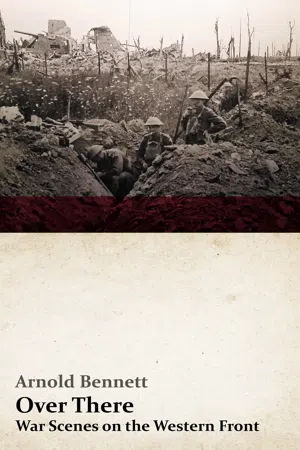
Over There - War Scenes on the Western Front
With an Essay From Arnold Bennett By F. J. Harvey Darton
- 92 pages
- English
- ePUB (mobile friendly)
- Available on iOS & Android
eBook - ePub
Over There - War Scenes on the Western Front
With an Essay From Arnold Bennett By F. J. Harvey Darton
About this book
"Over There" is a 1915 account of life on the 'Western Front' during the First World War by English writer Arnold Bennett. The Western Front was the central area of battle during the war. It was defined by a line of trenches created by both sides that stretched from the North Sea to the Swiss frontier with France and which changed little during the war. This volume will appeal to those with an interest in the First World War and especially the horrors and hardships of life for those on the front lines. Enoch Arnold Bennett (1867–1931) was an English writer. Although he is perhaps best remembered for his popular novels, Bennett also produced work in other areas including the theatre, propaganda, journalism, and film. Other notable works by this author include: "Helen with a High Hand" (1910), "The Card" (1911), and "Hilda Lessways" (1911). Contents include: "The Industrious Apprentice", "The Zone of Paris", "On the French Front", "Ruins", "At Grips", "The British Lines", "The Unique City", etc. Many vintage books such as this are becoming increasingly scarce and expensive. It is with this in mind that we are republishing this volume now in an affordable, modern, high-quality edition complete with an introductory essay by F. J. Harvey Darton.
Trusted by 375,005 students
Access to over 1.5 million titles for a fair monthly price.
Study more efficiently using our study tools.
Information
Topic
StoriaI.
THE ZONE OF PARIS
From the balcony you look down upon massed and variegated tree- tops as though you were looking down upon a valley forest from a mountain height. Those trees, whose hidden trunks make alleys and squares, are rooted in the history of France. On the dusty gravel of the promenade which runs between the garden and the street a very young man and a girl, tiny figures, are playing with rackets at one of those second-rate ball games beloved by the French petite bourgeoisie. Their jackets and hats are hung on the corner of the fancy wooden case in which an orange-tree is planted. They are certainly perspiring in the heavy heat of the early morning. They are also certainly in love. This lively dalliance is the preliminary to a day’s desk-work. It seems ill-chosen, silly, futile. The couple have forgotten, if they ever knew, that they are playing at a terrific and long-drawn moment of crisis in a spot sacred to the finest civilisation.
From the balcony you can see, close by, the Louvre, with its sculptures extending from Jean Goujon to Carpeaux; the Church of St. Clotilde, where Cesar Franck for forty years hid his genius away from popularity; the railway station of the Quai d’Orsay, which first proved that a terminus may excite sensations as fine as those excited by a palace or a temple; the dome of the Invalides; the unique facades, equal to any architecture of modern times, to the north of the Place de la Concorde, where the Ministry of Marine has its home. Nobody who knows Paris, and understands what Paris has meant and still means to humanity, can regard the scene without the most exquisite sentiments of humility, affection, and gratitude. It is impossible to look at the plinths, the mouldings, the carving of the Ministry of Marine and not be thrilled by that supreme expression of national art.
And all this escaped! That is the feeling which one has. All this beauty was menaced with disaster at the hands of beings who comprehended it even less than the simple couple playing ball, beings who have scarcely reached the beginnings of comprehension, and who joined a barbaric ingenuousness to a savage cruelty. It was menaced, but it escaped. Perhaps no city was ever in acuter peril; it escaped by a miracle, but it did escape. It escaped because tens of thousands of soldiers in thousands of taxi- cabs advanced more rapidly than any soldiers could be expected to advance. “The population of Paris has revolted and is hurrying to ask mercy from us!” thought the reconnoitring simpletons in Taubes, when they noted beneath them the incredible processions of taxi- cabs going north. But what they saw was the Sixth Army, whose movement changed the campaign, and perhaps the whole course of history.
“A great misfortune has overtaken us,” said a German officer the next day. It was true. Greater than he suspected.
The horror of what might have happened, the splendour of what did happen, mingle in the awed mind as you look over the city from the balcony. The city escaped. And the event seems vaster and more sublime than the mind can bear.
The streets of Paris have now a perpetual aspect of Sunday morning; only the sound of church-bells is lacking. A few of the taxi- cabs have come back; but all the auto-buses without exception are away behind the front. So that the traffic is forced underground, where the railways are manned by women. A horse-bus, dug up out of the past, jogs along the most famous boulevard in the world like a country diligence, with a fat, laughing peasant-woman clinging to its back-step and collecting fare-moneys into the immense pocket of her black apron. Many of the most expensive and unnecessary shops are shut; the others wait with strange meekness for custom. But the provision shops and all the sturdy cheap shops of the poor go on naturally, without any self-consciousness, just as usual. The pavements show chiefly soldiers in a wild, new variety of uniforms, from pale blue to black, imitated and adapted from all sources, and especially from England—and widows and orphans. The number of young girls and women in mourning, in the heavy mourning affected by the Latin race, is enormous. This crape is the sole casualty list permitted by the French War Office. It suffices. Supreme grief is omnipresent; but it is calm, cheerful, smiling. Widows glance at each other with understanding, like initiates of a secret and powerful society.
Never was Paris so disconcertingly odd. And yet never was it more profoundly itself. Between the slow realisation of a monstrous peril escaped and the equally slow realisation of its power to punish, the French spirit, angered and cold, knows at last what the French spirit is. And to watch and share its mood is positively ennobling to the stranger. Paris is revealed under an enchantment, On the surface of the enchantment the pettinesses of daily existence persist queerly.
Two small rooms and a kitchen on a sixth floor. You could put the kitchen, of which the cooking apparatus consists of two gas-rings, in the roots of the orange-tree in the Tuileries gardens. Everything is plain, and stringently tidy; everything is a special item, separately acquired, treasured. I see again a water-colour that I did years ago and had forgotten; it lives, protected by a glazed frame and by the pride of possession. The solitary mistress of this immaculate home is a spinster sempstress in the thirties. She earns three francs a day, and is rich because she does not spend it all, and has never spent it all. Inexpressibly neat, smiling, philosophic, helpful, she has within her a contentious and formidable tiger which two contingencies, and two only, will arouse. The first contingency springs from any threat of marriage. You must not seek a husband for her; she is alone in the world, and she wants to be. The second springs from any attempt to alter her habits, which in her sight are as sacredly immutable as the ritual of an Asiatic pagoda.
Last summer she went to a small town, to which is attached a very large military camp, to help her sister-in-law in the running of a cafe. The excursion was to be partly in the nature of a holiday; but, indefatigable on a chair with a needle, she could not stand for hours on her feet, ministering to a sex of which she knew almost nothing. She had the nostalgia of the Parisian garret. She must go home to her neglected habits. The war was waging. She delayed, from a sense of duty. But at last her habits were irresistible. Officers had said lightly that there was no danger, that the Germans could not possibly reach that small town. Nevertheless, the train that the spinster-sempstress took was the last train to leave. And as the spinster-sempstress departed by the train, so the sister-in-law departed in a pony-cart, with a son and a grandmother in the pony- cart, together with such goods as the cart would hold; and, through staggering adventures, reached safety at Troyes.
“And how did you yourself get on?” I asked the spinster-sempstress.
She answered:
“It was terrible. Ordinarily it is a journey of three or four hours. But that time it lasted three days and two nights. The train was crammed with refugees and with wounded. One was obliged to stand up. One could not move.”
“But where did you sleep?”
“I did not sleep. Do I not tell you one was obliged to stand up? I stood up all the first night. The floor was thirty centimetres deep in filth. The second night one had settled down somewhat. I could sit.”
“But about eating?”
“I had a little food that I brought with me.”
“And drinking?”
“Nothing, till the second day. One could not move. But in the end we arrived. I was broken with fatigue. I was very ill. But I was home. The Boches drank everything in the cafe, everything; but the building was spared—it stood away from the firing. How long do you think the war will last?”
“I’m beginning to think it will last a long time.”
“So they say,” she murmured, glancing through the window at the prospect of roofs and chimney-cowls. “Provided that it finishes well...”
Except by the look in her eyes, and by the destruction of her once good complexion, it was impossible to divine that this woman’s habits had ever been disturbed in the slightest detail. But the gaze and the complexion told the tale.
Next: the Boulevard...
Table of contents
- THE INDUSTRIOUS APPRENTICE
- I.
- II.
- III.
- IV.
- V.
- VI.
Frequently asked questions
Yes, you can cancel anytime from the Subscription tab in your account settings on the Perlego website. Your subscription will stay active until the end of your current billing period. Learn how to cancel your subscription
No, books cannot be downloaded as external files, such as PDFs, for use outside of Perlego. However, you can download books within the Perlego app for offline reading on mobile or tablet. Learn how to download books offline
Perlego offers two plans: Essential and Complete
- Essential is ideal for learners and professionals who enjoy exploring a wide range of subjects. Access the Essential Library with 800,000+ trusted titles and best-sellers across business, personal growth, and the humanities. Includes unlimited reading time and Standard Read Aloud voice.
- Complete: Perfect for advanced learners and researchers needing full, unrestricted access. Unlock 1.5M+ books across hundreds of subjects, including academic and specialized titles. The Complete Plan also includes advanced features like Premium Read Aloud and Research Assistant.
We are an online textbook subscription service, where you can get access to an entire online library for less than the price of a single book per month. With over 1.5 million books across 990+ topics, we’ve got you covered! Learn about our mission
Look out for the read-aloud symbol on your next book to see if you can listen to it. The read-aloud tool reads text aloud for you, highlighting the text as it is being read. You can pause it, speed it up and slow it down. Learn more about Read Aloud
Yes! You can use the Perlego app on both iOS and Android devices to read anytime, anywhere — even offline. Perfect for commutes or when you’re on the go.
Please note we cannot support devices running on iOS 13 and Android 7 or earlier. Learn more about using the app
Please note we cannot support devices running on iOS 13 and Android 7 or earlier. Learn more about using the app
Yes, you can access Over There - War Scenes on the Western Front by Arnold Bennett,F. J. Harvey Darton in PDF and/or ePUB format, as well as other popular books in Storia & Biografie nell'ambito delle scienze sociali. We have over 1.5 million books available in our catalogue for you to explore.