Pencils You Should Know traces the evolution of pencils over time and across the globe. From the humble, handcrafted pencil of the 19th century to the novelty writing implement of the 1990s, each object in this book tells a different story.
This book features a selection of 75 modern and vintage pencils curated by pencil powerhouse Caroline Weaver, owner of legendary New York pencil emporium CW Pencil Enterprise. Pencil fanatics will find old favorites here—the original Blackwing 602 puts in an appearance, of course—and make exciting new discoveries, too.
• Vintage pencils and accessories are photographed against vibrant, colorful backgrounds and accompanied by Weaver's insightful commentary.
• A love letter to one of the most important inventions in human history
This supremely charming book celebrates the enduring magic of the pencil.
Trace the history of the pencil over time and across the globe, and discover everything you need to know about this simple yet ingenious invention.
• A great book for pencil collectors, admirers, historians, artists, writers—anyone who gets excited about the new Palomino Blackwing, a perfectly sharpened No. 2 Ticonderoga
• Fans of The Pencil by Henry Petroski, How to Sharpen Pencils by David Rees and John Hodgman, and The Pencil Perfect by Caroline Weaver will want this in their collection.
The perfect book for pencil devotees, analog and vintage ephemera lovers, designers, and fans of CW Pencil Enterprise
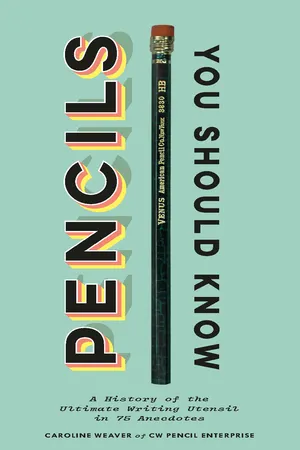
eBook - ePub
Pencils You Should Know
A History of Ultimate Writing Utensil in 75 Anecdotes
- 168 pages
- English
- ePUB (mobile friendly)
- Available on iOS & Android
eBook - ePub
About this book
Trusted by 375,005 students
Access to over 1.5 million titles for a fair monthly price.
Study more efficiently using our study tools.
Information
Topic
DesignSubtopic
Art TechniquesThe Pencils

Lead Pencils
1830s — John Thoreau & Co. — Concord, Massachusetts, USA
John Thoreau was the first commercially successful pencil maker in American history. He started crafting pencils by hand in Concord, Massachusetts, in the 1810s, with the help of his son Henry David, who would later become a famous writer. Early Thoreau pencils were made with a combination of graphite, glue, bayberry wax, and spermaceti. They were cased in cedar by hand and sanded until round. Thoreau’s pencils were rustic in appearance—unfinished, simply branded, and sold in bundles of twelve. Legend says that it was Henry David who came up with the idea to make pencils of different grades, numbered 1 through 4, from dark/soft to light/firm, just as we’re used to grading them today.

Star No. 2 Pencil
1881 — A.W. Faber — New York City, New York, USA
In the 1600s, German cabinetmaker Kaspar Faber founded global pencil giant A.W. Faber, now known as Faber-Castell. The Faber family has played a major role in pencil history for the past four centuries, making pencils in many countries and under several brand names. In the 1800s the Fabers set up a subsidiary in New York to take advantage of a new market and the plentiful resources of the United States. One of the pencil models they made in their new Manhattan factory was the Star, stained in three different finishes. Star pencils are unusual in that they are printed with the date of their trademark registration. At this point, pencils were still largely made by hand, which is evident in the square shape of the lead, which would have been cut from pure graphite and cased in manually.

No. 123 HB Pencil
1940s — Cumberland Pencil Company — Cumbria, England
The first graphite was discovered in England’s Lake District in the 1560s when a tree was uprooted during a storm, its roots covered in a strange black substance resembling lead. At the time, not enough was known about the chemistry to identify the substance’s unique properties and give it an appropriate name. For many years it was referred to simply as “black lead.” (This is why we still often call graphite “lead,” although the core of a pencil has actually never contained lead at all.) The site of this discovery was converted into a graphite mine; it is no longer in operation, yet to this day it is known as the source of the purest graphite ever discovered. Some of the earliest wood-cased pencils were made by the local Cumberland Pencil Company, now known as Derwent Cumberland Pencil Company. Though this example is from the 1940s, they were made in the style of the very simple, handmade pencils of the 1800s.

American Graphite Pencil
Late 1800s — Joseph Dixon Crucible Company — Jersey City, New Jersey, USA
Joseph Dixon was a well-known nineteenth-century inventor and industrialist. His accomplishments, which include developing camera technology, inventing the double-crank steam engine, and devising a method for printing banknotes, span many industries. He was the first in the United States to use graphite for practical purposes—most notably for making crucibles, his main business in his New Jersey factory—though his real passion was making pencils, a skill that he painstakingly tried to perfect for decades. Dixon was also among the first to take advantage of the progress of the industrial revolution to mechanize the craft, and toward the end of his life he finally started making a profit on his wood-cased masterpieces. This is an example of an early Dixon pencil, with a little crucible logo on it. The Dixon name is now mostly associated with the Ticonderoga, a pencil made after Joseph Dixon’s death—and that has become an American classic.

Crayon 6626 Pencils
Late 1800s — Eberhard Faber Pencil Company — New York City, New York, USA
John Eberhard Faber, a member of the famous Faber family, moved to New York in the late 1800s to run the U.S. branch of the family business. He soon decided to go it alone, however, and started his own competitive brand of American-made pencils. This bundle is from the late 1800s, wrapped in a style that was very common in the nineteenth century before boxes became the fashion. Operating out of New York City, Eberhard Faber and his descendants are responsible for some of the most iconic American pencils ever made. Ironically, they were eventually acquired by none other than Faber-Castell—the parent company that Eberhard Faber originally abandoned.

Crayon Velours Pencil
Early 1800s — Conté — Paris, France
This abnormally long, beautifully ornate French pencil came from the early 1800s, when th...
Table of contents
- Cover
- Title
- Copyright
- Contents
- Introduction
- The Pencils
- Appendix A Diagrams, Scales, and Explanations
- Appendix B Glossary
- About the Author
- Chronicle Ebooks
Frequently asked questions
Yes, you can cancel anytime from the Subscription tab in your account settings on the Perlego website. Your subscription will stay active until the end of your current billing period. Learn how to cancel your subscription
No, books cannot be downloaded as external files, such as PDFs, for use outside of Perlego. However, you can download books within the Perlego app for offline reading on mobile or tablet. Learn how to download books offline
Perlego offers two plans: Essential and Complete
- Essential is ideal for learners and professionals who enjoy exploring a wide range of subjects. Access the Essential Library with 800,000+ trusted titles and best-sellers across business, personal growth, and the humanities. Includes unlimited reading time and Standard Read Aloud voice.
- Complete: Perfect for advanced learners and researchers needing full, unrestricted access. Unlock 1.5M+ books across hundreds of subjects, including academic and specialized titles. The Complete Plan also includes advanced features like Premium Read Aloud and Research Assistant.
We are an online textbook subscription service, where you can get access to an entire online library for less than the price of a single book per month. With over 1.5 million books across 990+ topics, we’ve got you covered! Learn about our mission
Look out for the read-aloud symbol on your next book to see if you can listen to it. The read-aloud tool reads text aloud for you, highlighting the text as it is being read. You can pause it, speed it up and slow it down. Learn more about Read Aloud
Yes! You can use the Perlego app on both iOS and Android devices to read anytime, anywhere — even offline. Perfect for commutes or when you’re on the go.
Please note we cannot support devices running on iOS 13 and Android 7 or earlier. Learn more about using the app
Please note we cannot support devices running on iOS 13 and Android 7 or earlier. Learn more about using the app
Yes, you can access Pencils You Should Know by Caroline Weaver in PDF and/or ePUB format, as well as other popular books in Design & Art Techniques. We have over 1.5 million books available in our catalogue for you to explore.