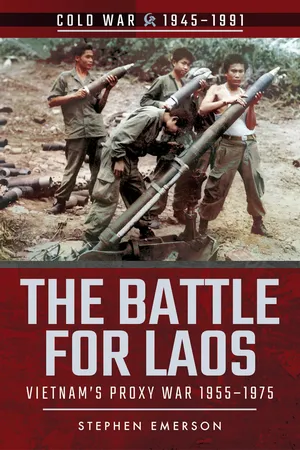
A history of the "secret war" in Southeast Asia in which nearly three million tons of bombs decimated a newly independent nation.
By 1959 the newly independent Kingdom of Laos was transforming into a Cold War battleground for global superpower competition, having been born out of the chaos following the French military defeat and withdrawal from Indochina in 1954. The country was soon engulfed in a rapidly evolving civil war as rival forces jockeyed for power and swelling foreign intervention intensified the fighting.
Adding even more fuel to the fire, "neutral" Laos's geographic entanglement in the war in neighboring South Vietnam deepened in the early 1960s as Hanoi's reliance on the Ho Chi Minh Trail for moving men and matériel through the southern Laotian panhandle grew exponentially, making it a priority target of American interdiction efforts. For almost twenty years, the fighting between the Western-supported Royal Lao government and the communist-supported Pathet Lao would rage across the plains, jungles, and mountaintops largely unseen by most of the world. Thousands on each side would die and many more would be displaced as the conflict on the ground ebbed and flowed from season to season and year to year. And in the skies above, American and Royal Laotian aircraft would rain down their deadly payloads, decimating large swaths of the countryside in pursuit of victory. Nearly three million tons of bombs would be dropped on Laotian territory between 1965 and 1973, leaving a legacy of unexploded ordnance that lingers to this day. The battle for Laos is a tale of entire communities and generations caught up in a war seemingly without end, one that pitted competing foreign interests and their proxies against each other and was forever tied to Washington's pursuit of victory in Vietnam. This book tells the story of this so-called "secret war."
- 128 pages
- English
- ePUB (mobile friendly)
- Available on iOS & Android
eBook - ePub
About this book
Trusted by 375,005 students
Access to over 1.5 million titles for a fair monthly price.
Study more efficiently using our study tools.
Information
1. THE LAND OF A MILLION ELEPHANTS
Long the backwater of Southeast Asia, the remote and sparsely populated Kingdom of Laos—the land of a million elephants—would find itself by the early 1950s embroiled in the monumental struggle between East and West in Southeast Asia. While events in the northeast of the Indochinese peninsula would garner much more attention, the emerging war in Laos assumed increasing strategic importance for the United States in its effort to halt the spread of communism in the region. It, however, would be a very different kind of war. Largely unseen in this so-called “secret war,” the Western-supported Royal Lao government forces would be pitted against the communist Pathet Lao and their North Vietnamese allies for the next 20 years as the landscape of Laos was transformed into yet another Cold War battleground. At the same time the escalating conflict in Vietnam and Hanoi’s growing reliance on the Laotian panhandle for moving men and matériel into the south would further entangle Laos in the wider war in Southeast Asia. Thus, the future of Laotian people would become tied to competing regional and global foreign interests outside their control—a power struggle, whose outcome would ultimately seal their fate.
The Collapse of French Indochina
Following the end of World War II in the Pacific and the defeat of imperial Japan, indigenous nationalist movements rose up across Indochina to assert their right of self-determination. In early September 1945 Ho Chi Minh and his Indochinese Communist Party announced the creation of the Democratic Republic of Vietnam in Hanoi. Likewise, on October 12, 1945 Prince Phetsarath Ratanavongsa and his Lao Issara or Free Laos movement declared their independence from France and broke away from the French Union. None of this went over well with the French, who with the help of Allied forces systematically began reoccupying Indochina: Cochin China at the end of 1945, Tonkin by March 1946, and re-entering Vientiane in April. While the granting of internal autonomy to King Sisavang Vong of Luang Prabang seemed to assuage Lao nationalist sentiment, the outbreak of fighting between the Viet Minh and French in Hanoi in December 1946 signaled the start of the First Indochina War. Over the course of the next eight years the conflict would engulf the associated states of the French Union, pit France and its Western allies against the Viet Minh and its global communist allies, and turn Southeast Asia into a critical new Cold War battleground. It would also increasingly force Laotians to choose sides.
While the fighting became widespread as the Indochina conflict evolved—reaching into northern Laos, parts of central Annam, around Saigon, and even into the far south of the Mekong Delta—the most intense and decisive fighting of the war would be in the north’s Tonkin region. It was here that for nearly eight years Ho Chi Minh’s Viet Minh forces slugged it out against the French army and their French Union allies. From September 1945 to July 1954, Paris would send almost half a million men to the Indochina theater in an effort to crush the Viet Minh insurgency and salvage the honor of France. In the end, some 110,000 French and local French Union soldiers would be lost in the attempt.1
French Indochina Chronology
| 1862–63 | Cochin China (Saigon) becomes a French colony; Cambodia falls under French protection |
| 1874 | Annam in central Vietnam becomes a French protectorate |
| 1885 | Tonkin in the north of Vietnam becomes a French protectorate |
| 1893 | Laos falls under French protection 1930 Ho Chi Minh founds the Vietnamese Communist Party; renamed the Indochinese Communist Party to spur revolution throughout Indochina |
| June 1940 | France surrenders to Nazi Germany; Vichy government assumes administration of Indochina |
| September 1940 | Japan occupies Indochina; joint administration with Vichy government |
| March 1945 | Japanese troops seize direct control of Indochina; French officials imprisoned or executed |
| September 1945 | Japan signs terms of surrender; Ho Chi Minh proclaims Democratic Republic of Vietnam in the north |
| 1945–46 | French and allied forces reoccupy Indochina |
| December 1947 | Fighting breaks out in Hanoi between French and Viet Minh forces signaling start of First Indochina War |
| 1949 | Elysée Accords establish Associated States within the French Union of Indochina. State of Vietnam in the south, Cambodia, and Laos granted internal autonomy, but foreign relations and defense under French control |
| May 1950 | Start of American military and economic assistance to French and Associated States forces battling communist insurgents |
| September–October | French forces in Tonkin suffer defeat at the hands of the |
| 1950 | Viet Minh in battles along the Chinese border |
| January–May 1951 | Viet Minh are repulsed during series of attacks against the De Lattre Line protecting Hanoi and the Red River Delta |
| April 1953 | Viet Minh invasion of Laos; royal capital at Luang Prabang threatened |
| March–May 1954 | Battle of Dien Bien Phu; French suffer catastrophic defeat |
| April–July 1954 | Geneva Conference talks aimed at ending the war |
| July 21, 1954 | Geneva Peace Accords signed; Laos gains independence |
More significantly for the region, what had started out as a simple campaign of French colonial re-conquest and restoration of global prestige had morphed into a major Cold War confrontation that would likely determine the future fate of region, and possibly of Western security, for decades to come.
Following Mao Zedong’s victory over his Chinese Nationalist foes in 1949, Peking turned its attention toward actively assisting its Viet Minh communist brethren in their struggle against the French. In addition to providing critical rear bases and training for Ho’s forces, the Chinese also provided tons of weapons and equipment, assigned hundreds of Chinese military advisers to Viet Minh combat units, and kept up a steady stream of supplies flowing across the border into northern Tonkin.2 This assistance not only began to transform the nature of the war in Indochina, given the ability of the Viet Minh to go toe to toe with French Union forces, but it would force a likeminded American escalation in aid and rising U.S. military involvement in the region.
The outbreak of the Korean War in June 1950, followed by direct Chinese intervention in that conflict, vividly underscored the frailty of Asian security. It also energized the United States to go all out in its support of its Western ally in Indochina. American military equipment and supplies, from aircraft and tanks to ammunition and medicine began to flood into Indochina, creating an assistance program that was second only to support for U.S. combat troops in Korea.3 All this would come at a steep price. This internationalization of the Indochina conflict would not only change the nature of the warfare, but increasingly give Washington a greater say in the final outcome of the war. But then again, Paris had little choice: the war was going badly and it desperately needed the Americans’ help.
Although this massive assistance—$342 million in 1953 congressional appropriations alone4—and other changes within the French military hierarchy and structure in Indochina bought time, underlying political problems and an ineffective counterinsurgency strategy failed to reverse the tide of war. Moreover, the French had failed not only to stem the Viet Minh advance, but they had now ceded the battlefield initiative to the enemy. Domestic political pressure was also building in France by 1954 to negotiate an end to the war. Time was clearly running out and the collapse of French Indochina was a distinct possibility.
This sent alarm bells ringing in Washington with American security officials warning of the most severe consequences, including “the establishment of Communist control over Indochina … that would almost certainly result in the Communization of all of Southeast Asia.”5 This new sense of urgency pushed U.S. military planners to consider a post-French Indochina strategy, one that was designed to prevent the countries of region from passing into the communist orbit by strengthening the ability of independent Indochinese states to politically and militarily resist communist-backed aggression. Central to this effort would be American aid directed at developing indigenous forces to provide for their own security. It would be this focus that would come to define American engagement in Laos for the next two decades.

The Japanese occupation of French Indochina during World War II signaled the death knell of French colonialism and fueled the rise of nationalism and demands for selfdetermination.
The growing U.S. concern over the future of French Indochina was well founded. By early 1954 the eyes of the world were trained on the besieged French garrison at Dien Bien Phu in what was shaping up to be the decisive battle of the war. In the run-up to the battle, General Vo Nguyen Giap’s forces struck vital communication lines between Hanoi and Haiphong and the main French airfields in the Red River Delta. Meanwhile, Viet Minh irregulars launched guerrilla attacks in the far south of the Vietnamese peninsula and still other Viet Minh forces launched incursions into Laos to divert French forces. In mid-March the assault on Dien Bien Phu began with the northern positions being overrun in a matter of days. The writing was on the wall. Ultimately, the capitulation of the garrison in early May 1954 after a bloody 56-day siege and the formal signing of the Geneva Peace Accords on July 21, 1954 would be the closing act for French Indochina.
The French Defense of Laos
Strategically insignificant with regard to the military struggle between Viet Minh and French Union forces that was being played out elsewhere in Indochina, especially in neighboring Tonkin and the north’s Red River Delta, Laos remained an isolated and neglected backwater for most of the war. Thus, the defense of the country was left to a handful of regular French units intermingled with colonial troops and elements of the newly constituted Lao National Army. These forces exercised de facto control over the country by occupying major towns and cities and manning a loose collection of defensive outposts spread across the countryside. Sporadic fighting against Viet Minh irregulars and their Pathet Lao allies was generally limited to countering small-scale attacks, hit-and-run raids, ambushes, and skirmishing.
All this would begin to change in the late autumn of 1952 as Laos assumed new importance in both the Viet Minh and French calculus.
Following a series of military setbacks in the Red River Delta, General Vo Nguyen Giap redirected his attention to the mountainous and dense jungle region of northwestern Tonkin near the border with Laos. It was part of his plan to engage the French on more favorable terrain and force them to divert resources from the defense of Hanoi and the Red River Delta. Moreover, from this location Giap could also mount an invasion into weakly defended Laos, which would further stretch French forces and burnish the image of the Pathet Lao insurgency. Thus, even as the fighting escalated in western Tonkin, some of Giap’s forces crossed the Ma River into northeast Laos and launched a series of harassing attacks against French and Lao units near the town of Sam Neua.
The real test, however, would come in early 1953 when thousands of Viet Minh soldiers crossed the frontier into northern Laos at Sop Nao and linked up with Pathet Lao fighters. With the notable exception of the heroic garrison at Muong-Khoua, the feeble French defenses quickly collapsed in the face of this onslaught: outposts were overrun, units disintegrated, and columns of civilians and soldiers streamed southward. By late April the royal capital at Luang Prabang was nearly encircled and the remaining French strongpoints on the Plain of Jars were isolated and in danger of falling. Despite this deteriorating military situation, King Sisavang Vong refused to abandon the royal capital and French treaty obligations forced Paris to come to his aid...
Table of contents
- Cover
- Title
- Copyright
- Contents
- Maps
- Glossary
- 1. The Land of A Million Elephants
- 2. A Nation Divided
- 3. Into the Vietnamese Quagmire
- 4. Raising the Stakes
- 5. Escalation
- 6. The Beginning of the End
- 7. The Final Act
- Notes
- Bibliography
- Acknowledgements
- Plates section
Frequently asked questions
Yes, you can cancel anytime from the Subscription tab in your account settings on the Perlego website. Your subscription will stay active until the end of your current billing period. Learn how to cancel your subscription
No, books cannot be downloaded as external files, such as PDFs, for use outside of Perlego. However, you can download books within the Perlego app for offline reading on mobile or tablet. Learn how to download books offline
Perlego offers two plans: Essential and Complete
- Essential is ideal for learners and professionals who enjoy exploring a wide range of subjects. Access the Essential Library with 800,000+ trusted titles and best-sellers across business, personal growth, and the humanities. Includes unlimited reading time and Standard Read Aloud voice.
- Complete: Perfect for advanced learners and researchers needing full, unrestricted access. Unlock 1.5M+ books across hundreds of subjects, including academic and specialized titles. The Complete Plan also includes advanced features like Premium Read Aloud and Research Assistant.
We are an online textbook subscription service, where you can get access to an entire online library for less than the price of a single book per month. With over 1.5 million books across 990+ topics, we’ve got you covered! Learn about our mission
Look out for the read-aloud symbol on your next book to see if you can listen to it. The read-aloud tool reads text aloud for you, highlighting the text as it is being read. You can pause it, speed it up and slow it down. Learn more about Read Aloud
Yes! You can use the Perlego app on both iOS and Android devices to read anytime, anywhere — even offline. Perfect for commutes or when you’re on the go.
Please note we cannot support devices running on iOS 13 and Android 7 or earlier. Learn more about using the app
Please note we cannot support devices running on iOS 13 and Android 7 or earlier. Learn more about using the app
Yes, you can access The Battle for Laos by Stephen Emerson in PDF and/or ePUB format, as well as other popular books in History & Asian History. We have over 1.5 million books available in our catalogue for you to explore.