- 392 pages
- English
- ePUB (mobile friendly)
- Available on iOS & Android
eBook - ePub
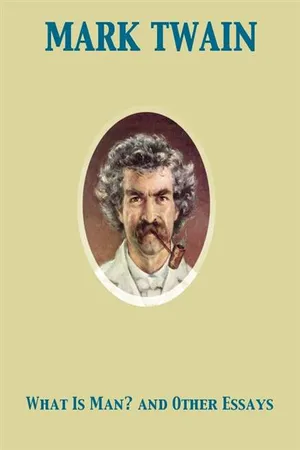
What Is Man? and Other Essays
Trusted by 375,005 students
Access to over 1.5 million titles for a fair monthly price.
Study more efficiently using our study tools.
Information
Topic
LiteraturSubtopic
AltertumswissenschaftenENGLISH AS SHE IS TAUGHT
In the appendix to Croker’s Boswell’s Johnson one finds this anecdote:
Cato’s soliloquy.—One day Mrs. Gastrel set a little girl to repeat to him (Dr. Samuel Johnson) Cato’s Soliloquy, which she went through very correctly. The Doctor, after a pause, asked the child:
“What was to bring Cato to an end?”
She said it was a knife.
“No, my dear, it was not so.”
“My aunt Polly said it was a knife.”
“Why, Aunt Polly’s knife may do, but it was a Dagger, my dear.”
He then asked her the meaning of “bane and antidote,” which she was unable to give. Mrs. Gastrel said:
“You cannot expect so young a child to know the meaning of such words.”
He then said:
“My dear, how many pence are there in sixpence?”
“I cannot tell, sir,” was the half-terrified reply.
On this, addressing himself to Mrs. Gastrel, he said:
“Now, my dear lady, can anything be more ridiculous than to teach a child Cato’s Soliloquy, who does not know how many pence there are in a sixpence?”
In a lecture before the Royal Geographical Society Professor Ravenstein quoted the following list of frantic questions, and said that they had been asked in an examination:
Mention all names of places in the world derived from Julius Caesar or
Augustus Caesar.
Augustus Caesar.
Where are the following rivers: Pisuerga, Sakaria, Guadalete, Jalon,
Mulde?
Mulde?
All you know of the following: Machacha, Pilmo, Schebulos, Crivoscia,
Basces, Mancikert, Taxhem, Citeaux, Meloria, Zutphen.
Basces, Mancikert, Taxhem, Citeaux, Meloria, Zutphen.
The highest peaks of the Karakorum range.
The number of universities in Prussia.
Why are the tops of mountains continually covered with snow (sic)?
Name the length and breadth of the streams of lava which issued from the
Skaptar Jokul in the eruption of 1783.
Skaptar Jokul in the eruption of 1783.
That list would oversize nearly anybody’s geographical knowledge. Isn’t it reasonably possible that in our schools many of the questions in all studies are several miles ahead of where the pupil is?—that he is set to struggle with things that are ludicrously beyond his present reach, hopelessly beyond his present strength? This remark in passing, and by way of text; now I come to what I was going to say.
I have just now fallen upon a darling literary curiosity. It is a little book, a manuscript compilation, and the compiler sent it to me with the request that I say whether I think it ought to be published or not. I said, Yes; but as I slowly grow wise I briskly grow cautious; and so, now that the publication is imminent, it has seemed to me that I should feel more comfortable if I could divide up this responsibility with the public by adding them to the court. Therefore I will print some extracts from the book, in the hope that they may make converts to my judgment that the volume has merit which entitles it to publication.
As to its character. Every one has sampled “English as She is Spoke” and “English as She is Wrote”; this little volume furnishes us an instructive array of examples of “English as She is Taught”—in the public schools of—well, this country. The collection is made by a teacher in those schools, and all the examples in it are genuine; none of them have been tampered with, or doctored in any way. From time to time, during several years, whenever a pupil has delivered himself of anything peculiarly quaint or toothsome in the course of his recitations, this teacher and her associates have privately set that thing down in a memorandum-book; strictly following the original, as to grammar, construction, spelling, and all; and the result is this literary curiosity.
The contents of the book consist mainly of answers given by the boys and girls to questions, said answers being given sometimes verbally, sometimes in writing. The subjects touched upon are fifteen in number: I. Etymology; II. Grammar; III. Mathematics; IV. Geography; V. “Original”; VI. Analysis; VII. History; VIII. “Intellectual”; IX. Philosophy; X. Physiology; XI. Astronomy; XII. Politics; XIII. Music; XIV. Oratory; XV. Metaphysics.
You perceive that the poor little young idea has taken a shot at a good many kinds of game in the course of the book. Now as to results. Here are some quaint definitions of words. It will be noticed that in all of these instances the sound of the word, or the look of it on paper, has misled the child:
Aborigines, a system of mountains.
Alias, a good man in the Bible.
Amenable, anything that is mean.
Ammonia, the food of the gods.
Assiduity, state of being an acid.
Auriferous, pertaining to an orifice.
Capillary, a little caterpillar.
CORNIFEROUS, rocks in which fossil corn is found.
Emolument, a headstone to a grave.
Equestrian, one who asks questions.
Eucharist, one who plays euchre.
Franchise, anything belonging to the French.
Idolater, a very idle person.
Ipecac, a man who likes a good dinner.
Irrigate, to make fun of.
Mendacious, what can be mended.
Mercenary, one who feels for another.
Parasite, a kind of umbrella.
Parasite, the murder of an infant.
Publican, a man who does his prayers in public.
Tenacious, ten acres of land.
Here is one where the phrase “publicans and sinners” has got mixed up in the child’s mind with politics, and the result is a definition which takes one in a sudden and unexpected way:
Republican, a sinner mentioned in the Bible.
Also in Democratic newspapers now and then. Here are two where the mistake has resulted from sound assisted by remote fact:
Plagiarist, a writer of plays.
Demagogue, a vessel containing beer and other liquids.
I cannot quite make out what it was that misled the pupil in the following instances; it would not seem to have been the sound of the word, nor the look of it in print:
Asphyxia, a grumbling, fussy temper.
QUARTERNIONS, a bird with a flat beak and no bill, living in New
Zealand.
Zealand.
QUARTERNIONS, the name given to a style of art practiced by the
Phoenicians.
Phoenicians.
QUARTERNIONS, a religious convention held every hundred years.
Sibilant, the state of being idiotic.
Crosier, a staff carried by the Deity.
In the following sentences the pupil’s ear has been deceiving him again:
The marriage was illegible.
He was totally dismasted with the whole performance.
He enjoys riding on a philosopher.
She was very quick at repertoire.
He prayed for the waters to subsidize.
The leopard is watching his sheep.
They had a strawberry vestibule.
Here is one which—well, now, how often we do slam right into the truth without ever suspecting it:
The men employed by the Gas Company go around and speculate the meter.
Indeed they do, dear; and when you grow up, many and many’s the time you will notice it in the gas bill. In the following sentences the little people have some information to convey, every time; but in my case they fail to connect: the light always went out on the keystone word:
The coercion of some things is remarkable; as bread and molasses.
Her hat is contiguous because she wears it on one side.
He preached to an egregious congregation.
The captain eliminated a bullet through the man’s heart.
You should take caution and be precarious.
The supercilious girl acted with vicissitude when the perennial time came.
The last is a curiously plausible sentence; one seems to know what it means, and yet he knows all the time that he doesn’t. Here is an odd (but entirely proper) use of a word, and a most sudden descent from a lofty philosophical altitude to a very practical and homely illustration:
We should endeavor to avoid extremes—like those of wasps and bees.
And here—with “zoological” and “geological” in his mind, but not ready to his tongue—the small scholar has innocently gone and let out a couple of secrets which ought never to have been divulged in any circumstances:
There are a good many donkeys in theological gardens.
Some of the best fossils are found in theological gardens.
Under the head of “Grammar” the little scholars furnish the following information:
Gender is the distinguishing nouns without regard to sex.
A verb is something to eat.
Adverbs should always be used as adjectives and adjectives as adverbs.
Every sentence and name of God must begin with a caterpillar.
“Caterpillar” is well enough, but capital letter would have been stricter. The following is a brave attempt at a solution, but it failed to liquify:
When they are going to say some prose or poetry before they say the poetry or prose they must put a semicolon just after the introduction of the prose or poetry.
The chapter on “Mathematics” is full of fruit. From it I take a few samples—mainly in an unripe state:
A straight line is any distance between two places.
Parallel lines are lines that can never meet until they run together.
A circle is a round straight line with a hole in the middle.
Things which are equal to each other are equal to anything else.
To find the number of square feet in a room you multiply the room by the number of the feet. The product is the result.
Right you are. In the matter of geography this little book is unspeakably rich. The questions do not appear to have applied the microscope to the subject, as did those quoted by Professor Ravenstein; still, they proved plenty difficult enough without that. These pupils did not hunt with a microscope, they hunted with a shot-gun; this is shown by the crippled condition of the game they brought in:
America is divided into the Passiffic slope and the Mississippi valey.
North America is separated by Spain.
America consists from north to south about five hundred miles.
The United States is quite a small country compared with some other countrys, but it about as industrious.
The capital of the United States is Long Island.
The five seaports of the U.S. are Newfunlan and Sanfrancisco.
The principal products of the U.S. is earthquakes and volcanoes.
The Alaginnies are mountains in Philadelphia.
The Rocky Mountains are on the western side of Philadelphia.
Cape Hateras is a vast body of water surrounded by land and flowing into the Gulf of Mexico.
Mason and Dixon’s line is the Equator.
One of the leading industries of the United States is mollasses, book-covers, numbers, gas, teaching, lumber, manufacturers, paper-m...
Table of contents
- WHAT IS MAN?
- I
- II
- A Little Story
- III
- Further Instances
- IV
- Admonition
- A Parable
- V
- The Man-Machine Again
- After an Interval of Days
- The Thinking-Process
- VI
- Free Will
- Not Two Values, But Only One
- A Difficult Question
- The Master Passion
- Conclusion
- THE DEATH OF JEAN
- THE TURNING-POINT OF MY LIFE
- I
- II
- III
- HOW TO MAKE HISTORY DATES STICK
- THE MEMORABLE ASSASSINATION
- A SCRAP OF CURIOUS HISTORY
- SWITZERLAND, THE CRADLE OF LIBERTY
- AT THE SHRINE OF ST. WAGNER
- WILLIAM DEAN HOWELLS
- ENGLISH AS SHE IS TAUGHT
- ON GIRLS
- A SIMPLIFIED ALPHABET
- AS CONCERNS INTERPRETING THE DEITY
- I
- II
- CONCERNING TOBACCO
- THE BEE
- TAMING THE BICYCLE
- I
- II
- IS SHAKESPEARE DEAD?
- II
- III
- Facts
- IV
- V
- VI
- VII
- VIII
- IX
- X
- XI
- XII
- XIII
Frequently asked questions
Yes, you can cancel anytime from the Subscription tab in your account settings on the Perlego website. Your subscription will stay active until the end of your current billing period. Learn how to cancel your subscription
No, books cannot be downloaded as external files, such as PDFs, for use outside of Perlego. However, you can download books within the Perlego app for offline reading on mobile or tablet. Learn how to download books offline
Perlego offers two plans: Essential and Complete
- Essential is ideal for learners and professionals who enjoy exploring a wide range of subjects. Access the Essential Library with 800,000+ trusted titles and best-sellers across business, personal growth, and the humanities. Includes unlimited reading time and Standard Read Aloud voice.
- Complete: Perfect for advanced learners and researchers needing full, unrestricted access. Unlock 1.5M+ books across hundreds of subjects, including academic and specialized titles. The Complete Plan also includes advanced features like Premium Read Aloud and Research Assistant.
We are an online textbook subscription service, where you can get access to an entire online library for less than the price of a single book per month. With over 1.5 million books across 990+ topics, we’ve got you covered! Learn about our mission
Look out for the read-aloud symbol on your next book to see if you can listen to it. The read-aloud tool reads text aloud for you, highlighting the text as it is being read. You can pause it, speed it up and slow it down. Learn more about Read Aloud
Yes! You can use the Perlego app on both iOS and Android devices to read anytime, anywhere — even offline. Perfect for commutes or when you’re on the go.
Please note we cannot support devices running on iOS 13 and Android 7 or earlier. Learn more about using the app
Please note we cannot support devices running on iOS 13 and Android 7 or earlier. Learn more about using the app
Yes, you can access What Is Man? and Other Essays by Mark Twain in PDF and/or ePUB format, as well as other popular books in Literatur & Altertumswissenschaften. We have over 1.5 million books available in our catalogue for you to explore.