eBook - ePub
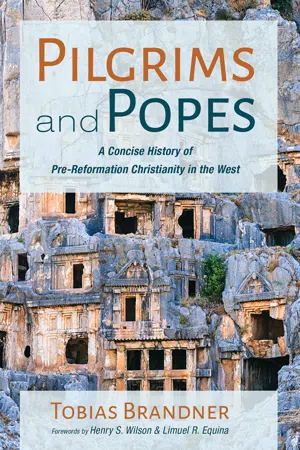
Pilgrims and Popes
A Concise History of Pre-Reformation Christianity in the West
- 316 pages
- English
- ePUB (mobile friendly)
- Available on iOS & Android
eBook - ePub
About this book
Pilgrims and Popes introduces the foundational fifteen hundred years of the history of Christianity, from Jesus to the eve of the Reformation. The crucial decisions of the first centuries have indelibly shaped the subsequent journey of the Christian faith movement. The book tells how the Christian faith story unfolded in dialectic movements: hegemony and emancipation; institutionalization and protest; petrification and renewal; missionary involvement in the world and separation from the world.
The book bridges the gap between the present and the seemingly remote world of the first fifteen hundred years of Christianity in the West by engaging with present-day readers' cultures and contexts. The rich material is presented in an easily readable way, combined with charts and with questions for discussion and deepening reflection. This study book will be a welcome learning tool in classrooms and in churches, particularly in the context of the Global South.
Trusted by 375,005 students
Access to over 1.5 million titles for a fair monthly price.
Study more efficiently using our study tools.
Information
Topic
Theology & ReligionSubtopic
Christian DenominationsPart I
The History of the Early Church
Chapter 1
Christianity in the First and Early Second Century
The story of Christianity begins with a small group of rural people at the fringes of the great Roman Empire, a reform movement within Judaism led by Galilean farmers, fishermen, and other disenfranchised groups. Within only a few decades, the movement found new followers in urban areas as it transcended geographical, religious, cultural, and social boundaries. From its Palestinian origins, it spread around the Mediterranean and reached to the ends of the Roman Empire. From its Jewish origins, it became a movement that attracted non-Jewish followers, split with Judaism and gained official status under the Roman Empire.
This chapter will address the following questions:
• What is the relationship of Jesus to Christianity?
• What was Paul’s role in the spread of early Christianity?
• Why did a Jewish reform movement spread to Gentiles (non-Jewish people)?
• Why was this Jesus movement more successful among Gentiles than were other reform movements?
• Why was this movement successful in the Hellenistic world and among Gentiles, but less so in Palestine and among Jews?
• How did a Jewish sect become a religion that attracted followers throughout the Roman Empire?
• How did a reform movement led by countryside peasants become a faith community that attracted city dwellers?
• Why did the Jesus movement, which started as a reform movement within Judaism, eventually separate from Judaism?
This first chapter traces the events and the decisions that set the early Christian movement on a track of continuous growth to reach new people groups. Our knowledge of the important decisions and events from this time is based mainly on the stories of the Bible—the Gospels, Acts, the epistles of Paul, and other letters—and to a lesser degree on some clues from historians like Josephus and Tacitus. Additionally, recent archeological findings have offered new evidence and insights into the social history of the Roman Empire.
From Jesus to the earliest church in Jerusalem
Jesus did not intend to found a new religion. With his public ministry lasting only two or three years, he had neither the time nor the desire to establish a new religious community. Accordingly, Jesus did not lay down many rules for community life. His expectation of an imminent radical change in history and the coming kingdom of God made the establishment of an organized form of religion irrelevant. Rather, his intention was to restore Israel’s traditional covenantal relationship with God and to revive communal solidarity, responding to the exploitation and marginalization of disenfranchised people at the periphery of a large empire. The stories of the New Testament offer a rare glimpse of the hopes and dreams of those who have found themselves at the bottom of civilization. Jesus’ calling of the Twelve revitalized, in countercultural form, the glory of old Israel and its twelve tribes. Jesus’ Galilean peasant protest movement was not solely aimed at individuals but served as a way of transforming wider community life, and it assumed a national dimension with Jesus’ journey to Jerusalem. Jesus thus must be seen as launching a reform movement within Judaism, but one that in its criticism of established religious life already carried the seed of a potential break with Judaism.
The Earliest Reference to Jesus outside of Christianity
The text below from the Antiquities of Josephus is the earliest reference to Jesus in non-Christian literature. It is assumed that the words describing him as the Christ are Christian interpolations: there is no indication that Josephus had accepted the Christian claim that Jesus was the Messiah the Jews were expecting.
Now, there was about this time Jesus, a wise man, if it be lawful to call him a man, for he was a doer of wonderful works, a teacher of such men as receive the truth with pleasure. He drew over to him both many of the Jews, and many of the Gentiles. He was (the) Christ. And when Pilate, at the suggestion of the principal men amongst us, had condemned him to the cross, those that loved him at the first did not forsake him; for he appeared to them alive again the third day; as the divine prophets had foretold these and ten thousand other wonderful things concerning him. And the tribe of Christians, so named from him, are not extinct at this day.
Source: Flavius Josephus, Antiquities of the Jews XVIII, 3:3, in Purinton, Christianity and Its Judaic Heritage, 185.
The earliest church in Jerusalem remained within the framework of Jesus’ relationship to Judaism. The followers of the Jesus movement gathering in Jerusalem saw themselves as belonging to the Jewish community that, naturally, observed the Mosaic law. There is evidence that this group stressed its Jewish character even more than during Jesus’ lifetime, as it expanded from a community of Galileans to include Jews from Jerusalem. They saw themselves as a group of specially elected people waiting together for the second coming of Christ as king at the end of time. How exactly the earliest church in Jerusalem lived—did it really practice a form of primitive communism or is this simply an idealization?—remains a subject of scholarly debate. It is known that other radical Jewish groups like the Essenes did donate all their individual wealth and personal possessions to a communal treasury, so it may well be possible that the Jesus movement did the same.
First steps beyond traditional Judaism
Very soon, something crucial led the church on a course that increasingly steered it beyond its origins in Judaism: foreign-born Jews (in contrast to local Jews), who maintained a separate communal identity in Judaism, joined the community in Jerusalem.
We can find a similar difference between traditional local churches (in cities of the Global South or elsewhere), which tend to be homogeneous and use the vernacular, and English-speaking local churches that appeal to local people who have returned from overseas and thus have mixed, international congregations.
Living together in this earliest church in Jerusalem were two groups, both Jewish and both observing the law: so-called Hebrews, Aramaic-speaking Jews of the Jesus movement who were more traditionalist; and so-called Hellenists, Greek-speaking Jews who were more shaped by Greek culture and may have been more open to change. These cultural differences soon led to tensions between the two groups. We can find hints of this in Acts 6—8:3, a story about the Hellenists feeling marginalized in the affairs of the church; as a consequence, seven deacons were appointed to feed the “neglected” Hellenists. However, it turned out that one of the Seven, Stephen, was more interested in preaching, and his powerful sermon brought him into conflict with the authorities.
Interestingly, the subsequent persecution by Jewish authorities was directed not against all followers of the Jesus movement, but only against the Hellenists who, as a consequence, spread the Christian faith beyond the boundaries of Israel and set up the first Christian community, consisting of both Jews and Gentiles, in Antioch. The Hellenist Jews served as the first bridge to the non-Jewish world because they were more willing to include Gentiles in the new community. Antioch then became the second and alternative (to Jerusalem) center of Christianity.

Fig. 1.1: Summary: From Jesus to Christianity in the first century
Now, a second crucial development occurred. Whenever the Hellenist Jews went to a place to spread the vision of a new community as inspired by Jesus, they naturally did so in the synagogue, where the Jews gathered. Among those listening, a strong response came from a group of people called “God-fearers” (in Greek, theosebeis), devout non-Jewish sympathizers of Judaism who had never formally converted to Judaism because they found it too daunting to undergo circumcision and observe all the purity laws. They were thus attracted by the teaching that Christians did not need to be circumcised or follow all the Mosaic law. These God-fearers can be described as a second bridge to the Gentile world. We can thus describe the spread of the gospel to the Gentiles as follows:

Fig. 1.2: From Judai...
Table of contents
- Title Page
- Foreword by Henry S. Wilson
- Foreword by Limuel R. Equina
- Abbreviations
- Introduction
- Part I: The History of the Early Church
- Part II: The History of the Medieval Church
- Epillogue: Faith, God-Talk, and Historical Studies
- Bibliography
Frequently asked questions
Yes, you can cancel anytime from the Subscription tab in your account settings on the Perlego website. Your subscription will stay active until the end of your current billing period. Learn how to cancel your subscription
No, books cannot be downloaded as external files, such as PDFs, for use outside of Perlego. However, you can download books within the Perlego app for offline reading on mobile or tablet. Learn how to download books offline
Perlego offers two plans: Essential and Complete
- Essential is ideal for learners and professionals who enjoy exploring a wide range of subjects. Access the Essential Library with 800,000+ trusted titles and best-sellers across business, personal growth, and the humanities. Includes unlimited reading time and Standard Read Aloud voice.
- Complete: Perfect for advanced learners and researchers needing full, unrestricted access. Unlock 1.5M+ books across hundreds of subjects, including academic and specialized titles. The Complete Plan also includes advanced features like Premium Read Aloud and Research Assistant.
We are an online textbook subscription service, where you can get access to an entire online library for less than the price of a single book per month. With over 1.5 million books across 990+ topics, we’ve got you covered! Learn about our mission
Look out for the read-aloud symbol on your next book to see if you can listen to it. The read-aloud tool reads text aloud for you, highlighting the text as it is being read. You can pause it, speed it up and slow it down. Learn more about Read Aloud
Yes! You can use the Perlego app on both iOS and Android devices to read anytime, anywhere — even offline. Perfect for commutes or when you’re on the go.
Please note we cannot support devices running on iOS 13 and Android 7 or earlier. Learn more about using the app
Please note we cannot support devices running on iOS 13 and Android 7 or earlier. Learn more about using the app
Yes, you can access Pilgrims and Popes by Tobias Brandner in PDF and/or ePUB format, as well as other popular books in Theology & Religion & Christian Denominations. We have over 1.5 million books available in our catalogue for you to explore.