![]()
CHAPTER 1: TECHNOLOGY IS A DOUBLE-EDGED SWORD
Technology giveth and technology taketh away, and not always in equal measure. A new technology sometimes creates more than it destroys. Sometimes, it destroys more than it creates. But it is never one-sided. (Postman, 1990)
Despite Postman’s dire prediction, society has profited immensely from the development, implementation, and operation of new information technologies. Our lives have been enriched by the increased prosperity, expanded opportunity, and greater variety that advances in information technology provide. But technology can be a double-edged sword. Reconciling technology, privacy, and security to achieve a workable balance can be a daunting task. Organizations across the globe are relying on technological innovations to spur new growth. Cloud computing, social media, and mobile devices, among other technologies, have shown vast advances during the past few years as these trends are embraced.
But it’s important to understand that every new innovation also brings new cybersecurity risks. Billions of mobile devices are connecting to government and corporate networks, and with each touch point there is also the potential for introducing vulnerabilities. Additionally, with more data being produced and touched by more and more individuals the potential for information theft or leakage grows exponentially.
To combat an increase in cybersecurity vulnerabilities as a result of this ever-increasing connectivity, organizations should shift their approach to focus on protecting the valuable information, rather than limiting their efforts on hardening information system endpoints.
The increasingly quickening pace of technology over the past decades has created a double-edged sword for society. There are those on both sides that find the advantages and disadvantages of its spread into every aspect of life. Technology’s varied uses run from car navigation to the taking over of jobs once done by people. The sword has both good and bad edges, but it is a presence that everyone has had to accept in some way. (Modern Technology Council, 2013)
From the printing press to the information age
The information age is a product of information technology. This is not, however, its distinguishing feature. Despite what many may believe, technology in some form has always been a part of humanity, even in the most primitive of societies. The factor that distinguishes the period of information revolution following the invention of the printing press, and the same factor that distinguishes our technological world today, is that the entire human condition has experienced radical change and has entered into a period of recognizable growth dynamics based on information expansion associated with technological innovations.
As with the printing press, the introduction of the new Internet-based information technology is much more than just a technological discovery to which society must adjust. The explosive growth of the Internet – a worldwide telecommunications network – and a global information society have brought about a transformation of our social systems. As a result, not only the information technology, but also human beings, social relationships, economic standards, norms, and ethical values have evolved.
There are visible parallels between events surrounding the invention of the printing press and the proliferation of the written word and the societal changes that are appearing as a consequence of new information technology. These two inventions, although occurring in completely different time periods, have each had an enormous impact on the world in the areas of education, history, communication and many others. These changes have been so compelling that one might contend that these will be as dramatic as the events of the scientific revolution, the spread of knowledge, and the Reformation, which all had their roots in the propagation of information as a result of the creation of the printing press.
Unintended consequences will certainly impact the future of society as a result of the new information technology. With every technological advance, creative destruction also occurs. The cataclysmic societal and cultural changes that occurred subsequent to the invention of the printing press were completely unpredictable. In fact, it took more than a century for these to be recognized.
The printing press
The invention of the printing press fully transformed the way in which information was created, reproduced, sold, and consumed. It brought into being new economic institutions and relationships and altered old ones beyond recognition. As a result, the printing press represents the only comparable event in the history of communications to the recent information technology revolution.
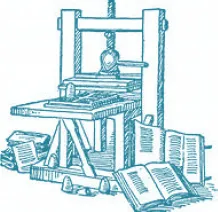
Gutenberg’s first printing press was invented by converting an old wine press into a printing machine. His first prints were made in the German city of Mainz in 1450, and by 1490 the printing press had permeated 110 cities in six different countries and more than eight million books had been printed; each providing access to information that had never before been available to the average citizen. By the end of the century the technology had spread throughout Europe, setting in motion the first information explosion – a precursor to today’s information revolution.
Figure 1 Gutenberg’s printing press
Source: University of Klagenfurt, Virtual Exhibitions in Informatics
It is clear that the printing press radically altered the manner in which information was collected, stored, retrieved, criticized, discovered, and promoted – leading eventually and inevitably to the Reformation, the Renaissance, and the scientific revolution.
The printed works enabled by the printing press forced the Reformation, for without crucial access to the printed editions of religious texts and the emerging variations on the relevant dogma issues, Martin Luther may not have had sufficient incentive to develop his revolutionary new theological concepts. Also, without enhanced access to the creation of printed texts, Luther would not have been able to spread his new ideas beyond a few elite.
The Renaissance also owes its spread across Europe to the printing press. While there had been preceding efforts to evolve humanistic concepts prior to the so-called ‘Italian Renaissance’, it was not until the printing press and the subsequent ability to put those ideas into the hands of the average citizen that they were able to proliferate and thrive.
Nowhere was the effect of the printing press as evident as in the scientific revolution. Science relies on the concept of the accumulation of knowledge. The collection and universal availability of scientific data relied on the printing press, whereupon new contributions of knowledge could become part of a permanent accumulation.
It must be noted that the printing press did not invent the book; rather, it changed how books contributed to the preservation and distribution of knowledge. Until the printing press, books were meticulously hand-copied and, consequently, distribution was limited to an extremely small number of the learned and clerics. The printing press allowed the production of thousands of copies of a single manuscript. In essence, books that once were limited to the libraries of the elite could now be found in the homes of the populace.
The printing press also changed how information could be retrieved. Prior to the printing press, the ability to retrieve information was largely dependent on the capability of an individual to recall the location of the information. Indexed books were essentially unknown. After the printing press, however, indexing became part of a more orderly, systematic approach to printed text.
One of the greatest, most immediate and most identifiable consequences of the invention of the printing press was the revolution in education and learning. Previously limited to scholars and clerics, learning through books gradually expanded to become part of the daily life of children and adolescents; thus exposing young citizens to a very different developmental process than that experienced by the youth of medieval society. As more people at all levels of society learned to read, the gap between the elite and the common man slowly narrowed. Social status changed dramatically.
If the printing press first fostered the positive concepts of modern individuality, it was also a major factor in the destruction of the medieval constructs of society and community. The printing press represented an example of technology that fostered change, creating both good and bad. The path taken by society after the printing press has led unalterably to what many term a revolution resulting in the advent of the ‘new information age’.
Reference
The University of Calgary, The Applied History Research Group (1998), ‘The End of Europe’s Middle Ages.’ URL: www.ucalgary.ca/applied_history/tutor/endmiddle/langlit.html#press.
Further Reading: |
Dewar, J. A. (2000) The information age and the printing press: Looking backward to see ahead (P 8014) [Electronic version]. Retrieved June 20, 2002 from www.rand.org/publications/P/P8014. Eisenstein, E. (1979) The Printing Press as an Agent of Change. New York: Cambridge University Press. Online at: www.rand.org/pubs/papers/P8014/index2.html. |
From the information age1 to the shift age2
Unlike the printing press, no single person invented the new information technologies. Instead, they were the result of advances in computer technology, reductions in the cost of manufacturing personal computers and mobile devices and the resulting increase in their popularity, and the evolution of networking technology.
As emerging information technologies become increasingly prevalent, it also becomes clear that society as a whole finds itself in the midst of an information revolution equally as profound and certainly as far-reaching as the one initiated by Gutenberg and the invention of the printing press. As then, it is not the technology itself that defines this information revolution, but rather the unprecedented capability to enable a degree of one-to-many and many-to-many communication never before seen.
Over 100 years ago, the emergence of the telegraph presented an evolution in mass communication and information sharing begun by Gutenberg and his printing press. While it provided a new means of communication and caused noticeable changes in the speed of communication, it nonetheless remained limited by regulation and technological capability; thus ensuring that it did not expand beyond a select group of users. Consequently, its effects were limited. Short generations later, the telephone appeared, also altering the course of communication. But, like the telegraph, the telephone also was limited in its expansion capability and, consequently, its effects were also restricted. Neither change in communications represented a revolution in the society in which they were introduced.
From the beginning of records and through the industrial age, land, human labor, and physical possessions were the key ingredients of wealth. In this traditional paradigm, the creation of wealth required the transformation of tangible raw materials into some form of product. Over time, the nature of the product has evolved until today we see information and intellectual property serving as the raw material for the development of wealth. There is hardly an organization today that does not rely on information to survive.
Recent decades, however, have witnessed a radical change equal in force to the printing press in the means by which information is collected, stored, retrieved, criticized, discovered, and promoted. The pervasive spread of technology and the means of instant communication and information sharing have created a second information revolution. One of the distinguishing features of today’s information revolution – just as in the day of Gutenberg – is the affordability of the new technologies, as well as access by the masses, rather than by an elite few.
Perceptions of the world and its population are being changed through the availability of information in the form of electronic media. Today’s generations already experience information only in electronic documents rather than the written word. In fact, the many-to-many communication medium o...