- 296 pages
- English
- ePUB (mobile friendly)
- Available on iOS & Android
eBook - ePub
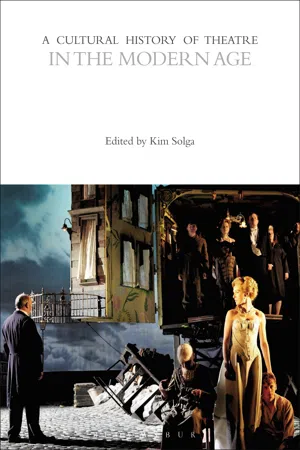
A Cultural History of Theatre in the Modern Age
About this book
To call something modern is to assert something fundamental about the social, cultural, economic and technical sophistication of that thing, over and against what has come before. A Cultural History of Theatre in the Modern Age provides an interdisciplinary overview of theatre and performance in their social and material contexts from the late 19th century through the early 2000s, emphasizing key developments and trends that both exemplify and trouble the various meanings of the term 'modern', and the identity of modernist theatre and performance.
Highly illustrated with 40 images, the ten chapters each take a different theme as their focus: institutional frameworks; social functions; sexuality and gender; the environment of theatre; circulation; interpretations; communities of production; repertoire and genres; technologies of performance; and knowledge transmission.
Highly illustrated with 40 images, the ten chapters each take a different theme as their focus: institutional frameworks; social functions; sexuality and gender; the environment of theatre; circulation; interpretations; communities of production; repertoire and genres; technologies of performance; and knowledge transmission.
Tools to learn more effectively

Saving Books

Keyword Search

Annotating Text

Listen to it instead
Information
CHAPTER ONE
Institutional Frameworks
Theatre, State, and Market in Modern Urban Performance1
MICHAEL MCKINNIE
In 2013, new hoardings were installed outside a construction site on Queen Street West in Toronto, Canada’s largest city (Figure 1.1).
Spelled out in large block letters, the message on them read: ‘COMING SOON TO THE NEIGHBOURHOOD: NOT ANOTHER CONDO’. This was accompanied by the reassuring, ‘Don’t worry, we’re not tearing this beautiful heritage building down. We’re revitalizing it and turning it into a new live arts hub and incubator’ (Figure 1.2).
The heritage building under renovation was a modest brick structure first opened in 1909 as the west-end branch of the Toronto Public Library. Designed in the Beaux Arts style commonly employed by architects of the thousands of public libraries, like this one, sponsored by American industrialist Andrew Carnegie in the early twentieth century, the site had more recently been occupied by the City of Toronto’s Department of Public Health and was badly in need of attention. Following a CDN$6.2 million renovation, the building was reopened in 2014 as the latest home of The Theatre Centre, a modest-sized theatre company that has produced a mix of experimental performance and community arts in a variety of downtown venues since its founding in 1981 (Figure 1.3).
The opening of any new theatre facility is an important event in a city where demand for performance venues has long outstripped supply. But this one is especially notable in that it involved The Theatre Centre, whose recurring difficulties in establishing a ‘permanent home’ have, perhaps more than for any other theatre company in Toronto, symbolized the difficulty of those companies gaining secure tenure in the city’s high-cost property market during the past four decades.2 The location of The Theatre Centre’s new home is also significant: this stretch of Queen Street West is a historically working-class part of the city now experiencing large-scale urban transformation, as private developers build thousands of apartments marketed for sale to affluent professionals. The message on the hoarding during construction of the new Theatre Centre – ‘NOT ANOTHER CONDO’ – acknowledged, in a tongue-in-cheek way, the disquiet of many Torontonians about the scale and speed of development in their city, which has been encouraged by the municipal state and accelerated by global financialization.3 It also illustrates how the building’s heritage and its history as a civic institution (a lineage theatre may also claim) are key to managing the anxieties that such developments provoke.

FIGURE 1.1: Hoarding outside The Theatre Centre, Toronto, during refurbishment, 2013. Photo: Lilya Sultanova. Reproduced with kind permission of The Theatre Centre.

FIGURE 1.2: Hoarding outside The Theatre Centre, Toronto, 2013. Photo: Lilya Sultanova. Reproduced with kind permission of The Theatre Centre.

FIGURE 1.3: The Theatre Centre, Toronto, 2014. Photo: Tiana Roebuck. Reproduced with kind permission of The Theatre Centre.
The redevelopment of The Theatre Centre prompts a number of important questions that go beyond a single theatre company in one city. How might we begin to conceive the relationship between theatre and other institutions, such as the state and the market economy? How does doing this call into question modern (or more precisely, modern Euro-American) theatre’s historically agonistic stance toward institutions? What are some of the changing ways that theatre, as an institution, is embedded with capital and the state? And how should we regard theatre’s promise that it can simultaneously capitalize upon and resolve the social antagonisms that market relations entail?
My use of the term ‘embedded’ here echoes political economist Karl Polanyi, who sought to theorize the emergence and spread of the market economy in Europe from the late eighteenth century onwards.4 For Polanyi, this involved a historical transition from ‘societies with markets’ to ‘market societies’. Marketization entails the market no longer being seen as a social institution among many other social institutions, but rather appearing, as Jean-Christophe Agnew puts it, as ‘a timeless, natural arrangement for human needs’.5 The problem, however, is that the market is an inherently volatile institution; regardless of the doctrines of neo-classical economics, it is unable to subordinate social relations and subjects to the motive of gain entirely, and so it cannot marketize on its own. Marketization, therefore, has historically involved a lot of heavy lifting by an array of other ‘embedded’ social institutions (primarily, but not only, the state and the law) whose purview is not primarily economic. These help manage – sometimes successfully, sometimes not – the social tensions and contradictions that marketization inevitably produces.
To be sure, Polanyi’s argument has its limitations. As the Marxist sociologist Michael Burawoy points out, Polanyi tends to subsume multiple historical phases of marketization within a ‘singular wave of marketisation giving way to a singular countermovement—what he calls the “great transformation”’.6 Polanyi also arguably underestimates the ability of capital to overcome the crises that marketization involves and, although he notes the importance of institutions other than the market, the state, and the law within marketization, his consideration of these is limited (and characterizing them as supplying ‘protective covering’ for the market during the process risks being reductive about their purpose within a highly complex institutional scene).7 But for my purposes here, Polyani’s key contribution is less empirical than heuristic: he prompts us to consider how any number of social institutions, including cultural ones such as theatre, need not be subsumed within the market in order still to be caught up with marketization. And it is worth asking what distinctive role theatre might play, however ambivalently, as a result of this imbrication.
In order to do this, though, it is necessary to set aside any inherited resistance to thinking of theatre as an institution in the first place. As I will discuss, scholars of modern theatre have given remarkably little thought to theatre as an institution – what sort of institution it might be, how it might come into being, and what it might do in the public sphere. This disinterest partly results from disciplinary training and conventions but also reflects a general unease about institutions within modern theatre practice and scholarship, a (sometimes well founded) suspicion most obviously directed towards the state and towards theatre itself. It has also inflected the ways in which the history of modern theatre has been told and how theatre’s relationship to other institutions – and to itself as an institution – has been understood.8 If taken at face value, though, it risks distracting from the complex ways in which theatre’s efficacy often depends on its interpenetration with key political and economic institutions, and on its own institutionality.
One place where this embeddedness has historically been most evident is in the sites where performance happens, especially during periods of significant urban change. Theatre and urban planning have been closely entwined since the shape of European cities began to be determined less by happenstance and more by conscious design during the eighteenth and nineteenth centuries. Seen as forms of urban and economic development, the earlier modern theatres built in, say, Berlin and Paris find their more contemporary analogues not only in the monumental arts centres built by welfare states following the Second World War but also in the networks of smaller theatres upon which the creative city strategies that cities around the world have adopted in recent years depend. In the latter part of this chapter, then, I will consider modern theatre as an institution implicated in the related processes of urbanization and marketization, through one of its most recent iterations: a form of property development within a financialized urban economy. I argue that venues such as the new Theatre Centre in Toronto are made possible by theatre’s institutional intimacy with the municipal state and the urban real estate market, and by the company’s agility in working with the political economic scripts they supply. But the same urban development that opens up new opportunities for theatre-building may also produce significant social unease, and The Theatre Centre also recognizes this. Here the institutionality of theatre is important as well, since it helps make tenable theatre’s promise that it can ameliorate the social antagonisms that large-scale urban change entails.
Given the scale of these forces, why examine a relatively modest theatre development like The Theatre Centre? And why focus on Toronto as an exemplary ‘modern’ theatre city? First, the particular way that the ‘mixed economy’ model of theatre financing – comprising some combination of income derived from box office, public subsidy, and private philanthropy – that has evolved in Canada means that most not-for-profit theatre companies occupy a kind of middle position between the more market-dominated model of the United States and the much more generously state-funded model common in continental Europe.9 This often necessitates theatre engaging in a rather intricate and improvisatory choreography with the state and the market simultaneously. On the one hand, it would be untenable for arts organizations like The Theatre Centre to operate without public funding, and so they must be attuned to the constantly shifting terms that obtaining this subsidy involves. On the other hand, the amount of public subsidy available is often insufficient to cover such organizations’ production costs, so the market cannot be ignored either. But given that an experimental and community arts company is likely only to generate limited box office and philanthropic income, engagement with the market may occur by somewhat refracted means; in the case of The Theatre Centre and a growing number of arts organizations in Toronto, this has been through the urban pl...
Table of contents
- Cover
- Half-Title Page
- Series Page
- Title Page
- Contents
- List Of Illustrations
- Notes on Contributors
- Series Preface
- Editor’s Acknowledgements
- Introduction: The Impossible Modern Age
- 1 Institutional Frameworks: Theatre, State, and Market in Modern Urban Performance
- 2 Social Functions: Consumers and Producers
- 3 Sexuality and Gender: New Stories and New Spaces on the Modern Stage
- 4 The Environment of Theatre: ‘Home’ in the Modern Age
- 5 Circulations: Visual Sovereignty, Transmotion, and Tribalography
- 6 Interpretations: The Stakes of Audience Interpretation in Twentieth-Century Political Theatre
- 7 Communities of Production: A Materialist Reading with an Offstage View
- 8 Genres and Repertoires: Redressing the Nation in Ireland and Japan
- 9 Technologies of Performance: Machinic Staging and Corporeal Choreographies
- 10 Knowledge Transmission: Media and Memory
- Notes
- Bibliography
- Index
- Copyright
Frequently asked questions
Yes, you can cancel anytime from the Subscription tab in your account settings on the Perlego website. Your subscription will stay active until the end of your current billing period. Learn how to cancel your subscription
No, books cannot be downloaded as external files, such as PDFs, for use outside of Perlego. However, you can download books within the Perlego app for offline reading on mobile or tablet. Learn how to download books offline
Perlego offers two plans: Essential and Complete
- Essential is ideal for learners and professionals who enjoy exploring a wide range of subjects. Access the Essential Library with 800,000+ trusted titles and best-sellers across business, personal growth, and the humanities. Includes unlimited reading time and Standard Read Aloud voice.
- Complete: Perfect for advanced learners and researchers needing full, unrestricted access. Unlock 1.4M+ books across hundreds of subjects, including academic and specialized titles. The Complete Plan also includes advanced features like Premium Read Aloud and Research Assistant.
We are an online textbook subscription service, where you can get access to an entire online library for less than the price of a single book per month. With over 1 million books across 990+ topics, we’ve got you covered! Learn about our mission
Look out for the read-aloud symbol on your next book to see if you can listen to it. The read-aloud tool reads text aloud for you, highlighting the text as it is being read. You can pause it, speed it up and slow it down. Learn more about Read Aloud
Yes! You can use the Perlego app on both iOS and Android devices to read anytime, anywhere — even offline. Perfect for commutes or when you’re on the go.
Please note we cannot support devices running on iOS 13 and Android 7 or earlier. Learn more about using the app
Please note we cannot support devices running on iOS 13 and Android 7 or earlier. Learn more about using the app
Yes, you can access A Cultural History of Theatre in the Modern Age by Kim Solga in PDF and/or ePUB format, as well as other popular books in Storia & Storia del XX secolo. We have over one million books available in our catalogue for you to explore.