The Pied Flycatcher is one of Europe's best-studied species.
The first detailed work on it was begun in the 1930s by German ornithologists, but it was Lars von Haartman's Finnish study that both established long-term research on the species and founded many of the central themes of modern ornithology. Soon after, in the late 1940s, Bruce Campbell set up an intensive project in southwest England, which also still runs to this day. Many other eminent ornithologists followed and in 1979 Arne Lundberg and Rauno Alatalo started their own work in Sweden, Finland and latterly the north of England.
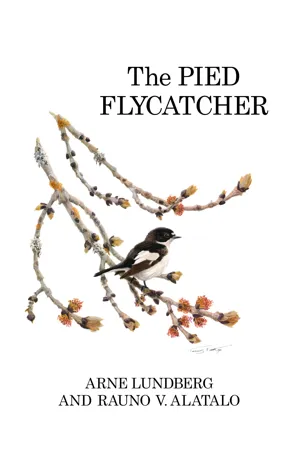
A Palaearctic migrant, the Pied Flycatcher is notable for its very variable male plumage and complex territorial and polygynous breeding system. They take readily to nest boxes and have provided excellent opportunities for the study of a wide range of biological problems.
This broad review of the species provides not only a detailed biology of this fascinating little bird, but a commentary on many of the most interesting problems in bird behaviour and ecology.
Illustrated by Tomas Part.
- 280 pages
- English
- ePUB (mobile friendly)
- Available on iOS & Android
eBook - ePub
The Pied Flycatcher
About this book
Information

References
ALATALO, R. V. 1978. Varpuslintujen munaluvusta Oulussa. Suomenselän Linnut 13: 114–119. (In Finnish).
ALATALO, R. V. & ALATALO, R. H. 1979. Resource partitioning among a flycatcher guild in Finland. Oikos 23: 46–54.
ALATALO, R. V. & LUNDBERG, A. 1984a. Polyterritorial polygyny in the pied flycatcher Ficedula hypoleuca – evidence for the deception hypothesis. Annales Zoologici Fennici 21: 217–228.
ALATALO, R. V. & LUNDBERG, A. 1984b. Density dependence in breeding success of the pied flycatcher Ficedula hypoleuca. Journal of Animal Ecology 53: 969–977.
ALATALO, R. V. & LUNDBERG, A. 1986a. Heritability and selection on tarsus length in the pied flycatcher (Ficedula hypoleuca). Evolution 40: 574–583.
ALATALO, R. V. & LUNDBERG, A. 1986b. The sexy son hypothesis: data from the pied flycatcher (Ficedula hypoleuca). Animal Behaviour 34: 1454–1462.
ALATALO, R. V. & LUNDBERG, A. 1989. Clutch size of the Pied Flycatcher (Ficedula hypoleuca) – an experiment. Ornis Fennica 66: 15–23.
ALATALO, R. V. & LUNDBERG, A. 1990. Polyterritorial polygyny in the pied flycatcher. In: Slater, P. J. B., Rosenblatt, J. S. & Beer, C. (eds). Advances in the study of behavior. Vol. 19: 1–27. San Diego, Calif.: Academic Press.
ALATALO, R. V., CARLSON, A., LUNDBERG, A. & ULFSTRAND, S. 1981. The conflict between male polygamy and female monogamy: the case of the pied flycatcher Ficedula hypoleuca. American Naturalist 117: 738–753.
ALATALO, R. V., GUSTAFSSON, L. & LUNDBERG, A. 1982a. Hybridization and breeding success of the Collared and the Pied Flycatcher on the island of Gotland. Auk 99: 285–291.
ALATALO, R. V., LUNDBERG, A. & BJÖRKLUND, M. 1982b. Can the song of male birds attract other males? An experiment with the pied flycatcher Ficedula hypoleuca. Bird Behaviour 4: 42–5.
ALATALO, R. V., LUNDBERG, A. & STÅHLBRANDT, K. 1982c. Why do pied flycatcher females mate with already-mated males? Animal Behaviour 30: 585–593.
ALATALO, R. V., CARLSON, A., LUNDBERG, A. & ULFSTRAND, S. 1984a. Male deception or female choice in the pied flycatcher Ficedula hypoleuca: a reply. American Naturalist 123: 282–285.
ALATALO, R. V., GUSTAFSSON, L. & LUNDBERG, A. 1984b. Why do young passerine birds have shorter wings than older birds? Ibis 126: 410–415.
ALATALO, R. V., GUSTAFSSON, L. & LUNDBERG, A. 1984c. High frequency of cuckoldry in pied and collared flycatchers. Oikos 42: 41–47.
ALATALO, R. V., LUNDBERG, A. & STÅHLBRANDT, K. 1984d. Female mate choice in the pied flycatcher Ficedula hypoleuca. Behavioral Ecology and Sociobiology 14: 253–261.
ALATALO, R. V., LUNDBERG, A. & ULFSTRAND, S. 1985. Habitat selection in the pied flycatcher Ficedula hypoleuca. In: Cody, M. (ed.), Habitat selection in birds: 59–83. New York: Academic Press.
ALATALO, R. V., GUSTAFSSON, L. & LUNDBERG, A. 1986a. Do females prefer older males in polygynous bird species? American Naturalist 127: 241–245.
ALATALO, R. V., LUNDBERG, A. & GLYNN, C. 1986b. Female pied flycatchers choose territory quality and not male characteristics. Nature 323: 152–153.
ALATALO, R. V., GOTTLANDER, K. & LUNDBERG, A. 1987. Extra-pair copulations and mate guarding in the polyterritorial pied flycatcher Ficedula hypoleuca. Behaviour 101: 139–155.
ALATALO, R. V., CARLSON, A. & LUNDBERG, A. 1988a. The search cost in mate choice of the Pied Flycatcher. Animal Behaviour 36: 289–291.
ALATALO, R. V., CARLSON, A. & LUNDBERG, A. 1988b. Nest cavity size and clutch size of Pied Flycatchers Ficedula hypoleuca breeding in natural tree-holes. Ornis Scandinavica 19: 317–319.
ALATALO, R. V., GOTTLANDER, K. & LUNDBERG, A. 1988c. Conflict or cooperation between parents in feeding nestlings in the Pied Flycatcher Ficedula hypoleuca. Ornis Scandinavica 19: 31–32.
ALATALO, R. V., GUSTAFSSON, L. & LUNDBERG, A. 1989. Extra-pair paternity and heritability estimates of tarsus length in pied and collared flycatchers. Oikos 56: 54–58.
ALATALO, R. V., CARLSON, A. & LUNDBERG, A. 1990a. Polygyny and breeding success of Pied Flycatchers nesting in natural cavities. In: Blondel, J., Gosler, A., Lebreton, J.-D. & McCleery, R. (eds). Population biology in passerine birds. An integrated approach: 323–330. Berlin: Springer.
ALATALO, R. V., ERIKSSON, D., GUSTAFSSON, L. & LUNDBERG, A. 1990b. Hybridization between Pied and Collared Flycatchers – sexual selection and speciation theory. Journal of Evolutionary Biology 3: 375–389.
ALATALO, R. V., GLYNN, C. & LUNDBERG, A. 1990c. Singing rate and female attraction in the pied flycatcher: an experiment. Animal Behaviour 39: 601–603.
ALATALO, R. V., LUNDBERG, A. & RÄTTI, O. 1990d. Male polyterritoriality and imperfect female choice in the pied flycatcher Ficedula hypoleuca. Behavioral Ecology 1: 171–177.
ALATALO, R. V., LUNDBERG, A. & SUNDBERG, J. 1990e. Can female preference explain sexual dichromatism in the pied flycatcher Ficedula hypoleuca?. Animal Behaviour 39: 244–252.
ALERSTAM, T. 1982. Fågelflyttning. Lund: Signum.
ALERSTAM, T. 1985. Breeding birds in a deciduous woodland: effects of providing supernumerary nest-boxes in a high-density bird community. Anser 24: 213–234. (In Swedish with English summary).
ALERSTAM, T. & HÖGSTEDT, G. 1983. The role of the geomagnetic field in the development of birds’ compass sense. Nature 306: 463–465.
ALERSTAM, T., EBENMAN, B., SYLVÉN, M., TAMM, S. & ULFSTRAND, S. 1978. Hybridization as an agent of competition between two bird allospecies: Ficedula albicollis and F. hypoleuca on the island of Gotland in the Baltic. Oikos 31: 326–331.
ASHMOLE, N. P. 1963. The regulation of numbers of tropical oceanic birds. Ibis 103: 458–473.
ASKENMO, C. 1977a. Some aspects of the reproduction strategy of the pied flycatcher Ficedula hypoleuca (Pallas). Doctoral dissertation, University of Gothenburg, Gothenburg.
ASKENMO, C. 1977b. Effects of addition and removal of nestlings on nestling weight, nestling survival, and female weight loss in the Pied Flycatcher Ficedula hypoleuca (Pallas). Ornis Scandinavica 8: 1–8.
ASKENMO, C. 1979. Reproductive effort and return rate of male pied flycatchers. American Naturalist 114: 748–753.
ASKENMO, C. 1982. Clutch size flexibility in the Pied Flycatcher Ficedula hypoleuca. Ardea 70: 189–196.
ASKENMO, C. E. H. 1984. Polygyny and nest site selection in the pied flycatcher. Animal Behaviour 32: 972–980.
BAKER, R. R. & PARKER, G. A. 1979. The evolution of bird coloration. Philosophical Transactions of the Royal Society of London, Series B, 287: 63–130.
BAPTISTA, L. F. & PETRINOVICH, L. 1986. Song development in the white crowned sparrow: social factors and sex differences. Animal Behaviour 34: 1359–1371.
BARROWCLOUGH, G. F. 1978. Sampling bias in dispersal studies based on a finite area. Bird Banding 49: 333–341.
BARROWCLOUGH, G. F. & SIBLEY, F. C. 1980. Feather pigmentation and abrasion: test of a hypothesis. Auk 97: 881–883.
BERGMAN, S. 1934. Iakttagelser över den svart och vita flugsnapparens, Muscicapa atricapilla, uppfödning av sina ungar. Fauna och Flora 29: 161–166. (In Swedish).
BERNDT, R. 1960. Zur Disper...
Table of contents
- Cover
- Copyright page
- Contents
- List of photographs
- List of figures
- List of tables
- Acknowledgements
- Chapter 01 - The Pied Flycatcher: Background
- Chapter 02 - Taxonomy and Distribution
- Chapter 03 - Migration, Moult, and Age and Sex Determination
- Chapter 04 - Nesting, Habitat and Breeding Densities
- Chapter 05 - Foraging Techniques and Diet
- Chapter 06 - Breeding Time and Clutch Size
- Chapter 07 - Egg-Laying, Incubation and Caring for Young
- Chapter 08 - Longevity, Age at First Breeding, and Dispersal
- Chapter 09 - Song
- Chapter 10 - Male Plumage Colour and its Variation
- Chapter 11 - Pair Formation and Female Choice
- Chapter 12 - Mating Systems
- Chapter 13 - Hybridization
- Chapter 14 - Breeding in Natural Cavities
- Appendix 01 - Morphology of the collared flycatcher and four subspecies of The Pied Flycatcher
- Appendix 02 - Diet of The Pied Flycatcher
- Appendix 03 - Breeding data for The Pied Flycatcher
- Appendix 04 - Return rates in different parts of europe
- Appendix 05 - Plumage colour of pied flycatcher males
- Appendix 06 - Polyterritorial bird species in europe
- Appendix 07 - Polyterritoriality distances
- Appendix 08 - Frequency of polygyny
- Appendix 09 - List of latin names
- References
Trusted by 375,005 students
Access to over 1.5 million titles for a fair monthly price.
Study more efficiently using our study tools.
Frequently asked questions
Yes, you can cancel anytime from the Subscription tab in your account settings on the Perlego website. Your subscription will stay active until the end of your current billing period. Learn how to cancel your subscription
No, books cannot be downloaded as external files, such as PDFs, for use outside of Perlego. However, you can download books within the Perlego app for offline reading on mobile or tablet. Learn how to download books offline
Perlego offers two plans: Essential and Complete
- Essential is ideal for learners and professionals who enjoy exploring a wide range of subjects. Access the Essential Library with 800,000+ trusted titles and best-sellers across business, personal growth, and the humanities. Includes unlimited reading time and Standard Read Aloud voice.
- Complete: Perfect for advanced learners and researchers needing full, unrestricted access. Unlock 1.5M+ books across hundreds of subjects, including academic and specialized titles. The Complete Plan also includes advanced features like Premium Read Aloud and Research Assistant.
We are an online textbook subscription service, where you can get access to an entire online library for less than the price of a single book per month. With over 1.5 million books across 990+ topics, we’ve got you covered! Learn about our mission
Look out for the read-aloud symbol on your next book to see if you can listen to it. The read-aloud tool reads text aloud for you, highlighting the text as it is being read. You can pause it, speed it up and slow it down. Learn more about Read Aloud
Yes! You can use the Perlego app on both iOS and Android devices to read anytime, anywhere — even offline. Perfect for commutes or when you’re on the go.
Please note we cannot support devices running on iOS 13 and Android 7 or earlier. Learn more about using the app
Please note we cannot support devices running on iOS 13 and Android 7 or earlier. Learn more about using the app
Yes, you can access The Pied Flycatcher by Arne Lundberg,Rauno V. Alatalo in PDF and/or ePUB format, as well as other popular books in Biological Sciences & Zoology. We have over 1.5 million books available in our catalogue for you to explore.