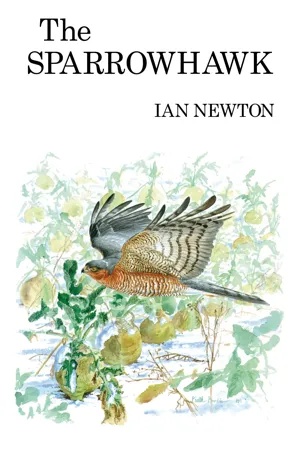
Dr Newton is now a senior ornithologist with the Natural Environment Research Council and the book draws on his wide knowledge of the Sparrowhawk, as well as that of other workers in Britain and abroad.
The text gives a detailed account of all aspects of the Sparrowhawk's lifestyle, population levels and trends, and the impact of man and environment on the species in recent times.
The book also has the benefit of Dr Newton's particular interest in population regulation and breeding performance, and in the remarkable contrast in size between the Sparrowhawk sexes (males being half the weight of females), which means that they diverge, almost as separate species, in habitat preference, diet and in response to circumstance.
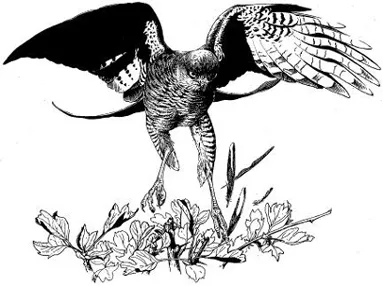
The narrative is fully supported by diagrams, tables and photographs, and is embellished by Keith Brockie's evocative and accomplished drawings.
- 420 pages
- English
- ePUB (mobile friendly)
- Available on iOS & Android
eBook - ePub
The Sparrowhawk
About this book
Information
Tables 1–63
TABLE 1: Wing lengths of Sparrowhawks of different sex and age, from birds trapped in south Scotland. SD = standard deviation, SE = standard error.
| Age (years) | No. | Mean | SD | SE | Range | |
| Males | 1 | 41 | 198·95 | 3·71 | 0·58 | 192–209 |
| 2 | 58 | 200·00 | 3·68 | 0·48 | 193–209 | |
| 3 | 18 | 200·89 | 4·60 | 1·08 | 193–211 | |
| All adults (2+) | 171 | 199·52 | 3·98 | 0·30 | 188–211 | |
| Females | 1 | 98 | 234·10 | 4·59 | 0·46 | 223–246 |
| 2 | 119 | 235·13 | 4·58 | 0·42 | 224–247 | |
| 3 | 43 | 236·93 | 5·23 | 0·80 | 226–251 | |
| All adults (2+) | 476 | 236·63 | 4·81 | 0·22 | 222–251 | |
Significance of differences: males, l v 2, t97 = 1·39, ns; 2 v 3, t74 = 0·84, ns; l v 2+ , t210 = 0·83, ns; females, l v 2, t215 = l·65, P<0·1; 2 v 3, t160 = 2·13, P<0·05, l v 2+, t144 = 4·97, P< 0·001; ns – not significant.
TABLE 2: Sparrowhawk iris colour in relation to age and sex, south Scotland. From Newton & Marquiss 1982b.
| Lemon: shades | Yellow: shades | Orange: shades | Red: shades | ||||||||
| Age from hatch | 1 | 2 | 3 | 4 | 5 | 6 | 7 | 8 | 9 | 10 | Mean shade |
| Males | |||||||||||
| 2 months (August) | 3 | 5 | 14 | 1 | 3 | 2·85 | |||||
| 3 months (September) | 2 | 9 | 3 | 1 | 3·07 | ||||||
| 1 year (April–July) | 4 | 7 | 15 | 2 | 4·54 | ||||||
| 2 year (April–July) | 4 | 12 | 21 | 2 | 6·54 | ||||||
| 3 year (April–July) | 1 | 2 | 4 | 1 | 1 | 6·89 | |||||
| 4 year (April–July) | 2 | 1 | 3 | 1 | 6·43 | ||||||
| 5 + year (April–July) | 1 | 3 | 1 | 1 | 7·91 | ||||||
| Females | |||||||||||
| 2 months (August) | 1 | 5 | 12 | 2·61 | |||||||
| 3 months (September) | 1 | 4 | 7 | 2·50 | |||||||
| 1 year (April–July) | 1 | 8 | 25 | 24 | 1 | 4·27 | |||||
| 2 year (April–July) | 19 | 46 | 13 | 6 | 5·07 | ||||||
| 3 year (April–July) | 3 | 14 | 9 | 7 | 1 | 5·68 | |||||
| 4 year (April–July) | 2 | 4 | 8 | 6 | 1 | 6·00 | |||||
| 5 year (April–July) | 2 | 9 | 8 | 2 | 5·48 | ||||||
| 6 year (April–July) | 2 | 4 | 3 | 1 | 5·30 | ||||||
| 7 year (April–July) | 3 | 1 | 3 | 2 | 5·44 | ||||||
| 8 year (April–July) | 1 | 1 | 1 | 1 | 5·50 | ||||||
Notes: For χ2 tests, records were grouped in colour categories 1–3, 4·6 and 7–10. Comparing August/September with year 1: males. χ2 = 26·7, P<0·001; females, χ2 = 54·0, P<0·001; year 1 with year 2: males, χ2 = 26·5, P<0·001, females, χ22 = 17·5, P<0·001; year 2 with year 3: males, χ2 = 0·002, ...
Table of contents
- Cover
- Copyright page
- Contents
- List of plates
- List of figures
- List of tables
- Acknowledgements
- Chapter 01 - Background, study areas and methods
- Chapter 02 - The Sparrowhawk
- Chapter 03 - Nesting habitat
- Chapter 04 - Nest spacing and breeding density
- Chapter 05 - Ranging behaviour
- Chapter 06 - Population trends
- Chapter 07 - Hunting and feeding behaviour
- Chapter 08 - Food
- Chapter 09 - The Sparrowhawk as a predator
- Chapter 10 - Breeding season
- Chapter 11 - The breeding cycle: early stages
- Chapter 12 - The breeding cycle: eggs and incubation
- Chapter 13 - The breeding cycle: growth of young
- Chapter 14 - The breeding cycle: parental care
- Chapter 15 - The breeding cycle: post-fledging period
- Chapter 16 - Seasonal trend in breeding success
- Chapter 17 - Nest failures
- Chapter 18 - Age and breeding
- Chapter 19 - Moult
- Chapter 20 - Dispersal
- Chapter 21 - Territory and mate fidelity
- Chapter 22 - Migration
- Chapter 23 - Mortality
- Chapter 24 - Effects of pesticides
- Chapter 25 - Conclusions
- Appendix 01 - Finding nests
- Appendix 02 - Persecution of Sparrowhawks
- Appendix 03 - Procedures for analyses of nest spacing and prey densities, relevant to Chapter 4
- Appendix 04 - Causes and diagnosis of nest failure
- Bibliography
- Tables
Trusted by 375,005 students
Access to over 1.5 million titles for a fair monthly price.
Study more efficiently using our study tools.
Frequently asked questions
Yes, you can cancel anytime from the Subscription tab in your account settings on the Perlego website. Your subscription will stay active until the end of your current billing period. Learn how to cancel your subscription
No, books cannot be downloaded as external files, such as PDFs, for use outside of Perlego. However, you can download books within the Perlego app for offline reading on mobile or tablet. Learn how to download books offline
Perlego offers two plans: Essential and Complete
- Essential is ideal for learners and professionals who enjoy exploring a wide range of subjects. Access the Essential Library with 800,000+ trusted titles and best-sellers across business, personal growth, and the humanities. Includes unlimited reading time and Standard Read Aloud voice.
- Complete: Perfect for advanced learners and researchers needing full, unrestricted access. Unlock 1.5M+ books across hundreds of subjects, including academic and specialized titles. The Complete Plan also includes advanced features like Premium Read Aloud and Research Assistant.
We are an online textbook subscription service, where you can get access to an entire online library for less than the price of a single book per month. With over 1.5 million books across 990+ topics, we’ve got you covered! Learn about our mission
Look out for the read-aloud symbol on your next book to see if you can listen to it. The read-aloud tool reads text aloud for you, highlighting the text as it is being read. You can pause it, speed it up and slow it down. Learn more about Read Aloud
Yes! You can use the Perlego app on both iOS and Android devices to read anytime, anywhere — even offline. Perfect for commutes or when you’re on the go.
Please note we cannot support devices running on iOS 13 and Android 7 or earlier. Learn more about using the app
Please note we cannot support devices running on iOS 13 and Android 7 or earlier. Learn more about using the app
Yes, you can access The Sparrowhawk by Ian Newton in PDF and/or ePUB format, as well as other popular books in Biological Sciences & Zoology. We have over 1.5 million books available in our catalogue for you to explore.