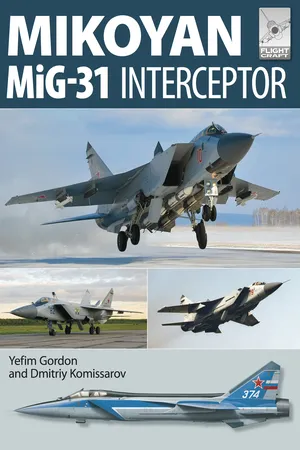
- 96 pages
- English
- ePUB (mobile friendly)
- Available on iOS & Android
eBook - ePub
About this book
A history of this advanced Russian jet, including useful information for model makers.
The MiG-31 started life as an advanced derivative of the famous MiG-25P interceptor, becoming the first Soviet fourth-generation combat aircraft. First flown in 1975, it differed from its progenitor primarily in having a crew of two (pilot and weapons systems operator), a highly capable passive phased-array radar—a world first—and new R-33 long-range missiles as its primary armament.
The maximum speed was an impressive Mach 2.82, the cruising speed being Mach 2.35. The type entered service in 1981; more than 500 copies were built between 1981 and 1994. The powerful radar and other avionics allowed the MiG-31 to operate as a "mini-AWACS" scanning the airspace and guiding other interceptors to their targets; a flight of three such aircraft in line abreast formation could cover a strip 800 km (500 miles) wide.
To this day the MiG-31 remains one of the key air defense assets of the Russian Air Force. This book describes the MiG-31's developmental history, including upgrade programs, and features a comprehensive survey of the MiG-31 model-making kits available on the market.
The MiG-31 started life as an advanced derivative of the famous MiG-25P interceptor, becoming the first Soviet fourth-generation combat aircraft. First flown in 1975, it differed from its progenitor primarily in having a crew of two (pilot and weapons systems operator), a highly capable passive phased-array radar—a world first—and new R-33 long-range missiles as its primary armament.
The maximum speed was an impressive Mach 2.82, the cruising speed being Mach 2.35. The type entered service in 1981; more than 500 copies were built between 1981 and 1994. The powerful radar and other avionics allowed the MiG-31 to operate as a "mini-AWACS" scanning the airspace and guiding other interceptors to their targets; a flight of three such aircraft in line abreast formation could cover a strip 800 km (500 miles) wide.
To this day the MiG-31 remains one of the key air defense assets of the Russian Air Force. This book describes the MiG-31's developmental history, including upgrade programs, and features a comprehensive survey of the MiG-31 model-making kits available on the market.
Tools to learn more effectively

Saving Books

Keyword Search

Annotating Text

Listen to it instead
Information
Publisher
Pen & Sword AviationYear
2011eBook ISBN
9781473869196Subtopic
Storia militare e marittimaThe MiG-31 in Action
In early 1980 a handful of MiG-31s were delivered to an operational PVO unit for evaluation. Full-scale deliveries began in 1982; the first units to receive the MiG-31 were stationed in the Moscow Air Defence Zone, beyond the Arctic Circle and in the Soviet Far East.
The new interceptor was particularly needed in the latter two areas where the air defence situation had deteriorated considerably in the early 1980s. US Air Force SR-71A reconnaissance aircraft operating from Kadena AB in Japan and RAF Mildenhall in the UK had been intruding into Soviet airspace for quite a while; in the Far East they reconnoitred the militarily sensitive areas of the Kamchatka Peninsula and Sakhalin Island, and in the High North they penetrated as deep as Arkhangel’sk, another area packed with sensitive military installations. The Blackbird’s exceptional speed and altitude performance rendered it virtually invulnerable – then-current Soviet SAMs had practically no chances of hitting the high-flying Mach 3 spyplane. Incursions into Soviet airspace by US Navy carrier-borne aircraft also became more frequent. The MiG-23P Flogger-G and Su-15TM interceptors forming the backbone of the PVO Aviation in the Far East were no match for the SR-71s; nor could they oppose on equal terms the brand-new McDonnell Douglas F-15C Eagle, Grumman F-14A/D Tomcat and McDonnell Douglas F/A-18 Hornet fighters. Only a high-altitude, high-speed interceptor armed with long-range AAMs could oppose the Blackbird and other modern reconnaissance aircraft at long range.
By the autumn of 1980, when the MiG-31’s test programme was basically completed, the first production interceptors were beginning to reach the operational units of the PVO. However, the first units to receive the Foxhound were the 54th Kerchenckiy GvIAP (Gvardeyskiy istrebitel’nyy aviatsion-nyy polk – Guards Fighter Regiment), an operational conversion unit of the PVO Aviation’s 148th TsBP i PLS (Tsentr boyevoy pod-gotovki i pereoochivaniya lyotnovo sostava – Combat Training & Aircrew Conversion Centre) at Savasleyka AB, Gor’kiy Region, and the 786th IAP stationed at Pravdinsk, also in the vicinity of Gor’kiy. It was in these two units that the new MiG-31-33 aerial intercept weapons system underwent service trials. The 54th Regiment’s honorary appellation had been given for the unit’s part in liberating the city of Kerch on the Crimea Peninsula in 1944.
In January 1982 the aircrews of the 174th Pechengskiy Red Banner IAP stationed in Monchegorsk on the Kola Peninsula started their conversion training; the unit had received this honorary appellation for its part in defending the city of Pechenga (formerly Petsamo, Murmansk Region) during the Great Patriotic War and was named after Boris F. Safonov, a Soviet Navy fighter ace killed in action. The regiment had previously flown the Yak-28P, converting fully to the MiG-31 in 1983. In September 1983 the new MiGs also arrived in the Far East, re-equipping the 365th IAP at Sokol AB near the town of Dolinsk on Sakhalin Island (not to be confused with Sokol airport in Magadan, which is much farther up north). In the PVO’s first-line fighter units the MiG-31 supplanted the 1960s-vintage Su-15TM and the Tu-128, which were getting long in the tooth.

Two 764th IAP airmen pose with one of the regiment’s MiG-31s, ‘85 Blue’, on the military side of Perm’-Bol’shoye Savino airport. The airmen are wearing different helmets (a ZSh-7‘bone dome’ helmet on the left and a GSh-5 full-face pressure helmet on the right), indicating this is a rather carelessly arranged propaganda shot.

MiG-31 sans suffixe ‘70 Red’ flies over the Russian countryside, displaying the Mikoyan OKB logo on the nose and the Guards badge on the air intake.
Gradually other PVO fighter regiments re-equipped with the MiG-31; by the late 1980s the type was in service with units deployed at nearly 20 airbases and joint civil/military airports. In the European part of the Soviet Union alone there were the 54th GvIAP at Savasleyka AB, the 57th GvIAP at Noril’sk-Alykel’ AP (delivered in 1991), the 72nd Polotskiy GvIAP at Amderma AP, the Nenets Autonomous District (delivered in 1987), the 83rd IAP in Rostov-on-Don (delivered in 1993), the 153rd IAP at Morshansk (Tambov Region, delivered in 1990), the 174th IAP at Monchegorsk (delivered in 1982-83), the 180th GvIAP at Gromovo AB (Leningrad Region), the 445th IAP at Savvatiya AB (Kotlas, Arkhangel’sk Region), the 518th Berlinskiy IAP at Arkhangel’sk-Talagi AP (delivered in 1985), the 611th Pere-myshl’skiy IAP at Dorokhovo AB (Bezhetsk, Kalinin Region, now Tver’ Region), the 786th IAP at Pravdinsk in the western Kaliningrad Region exclave (delivered in 1981-82; later re-equipped with MiG-31Bs) and the 790th IAP at Khotilovo AB (Kalinin Region, now Tver’ Region, delivered in 1993-94). In 1993 the 72nd GvIAP and 445th IAP were pooled to form the 458th GvIAP which took up residence at Savvatiya AB.
In the Urals the type saw service with the 764th IAP at Perm’-Bol’shoye Savino AP (MiG-31Bs/BSs delivered in 1993-94). Siberian units equipped with the MiG-31 were the 64th IAP at Omsk-Severnyy AP (seven delivered in 1987, a further 12 before 1990), the 350th IAP in Bratsk (five delivered in 1988 and a further 12 before the end of 1989), the 712th GvIAP at Kansk-Yoozhnyy AB (Krasnoyarsk Region, MiG-31Bs delivered in 1993) and the 763rd IAP at Komsomol’skiy-2 AB near Yugorsk, the Khanty-Mansi Autonomous District (delivered in 1984). In the Far East the MiG-31 was operated by the 365th IAP and 777th IAP at Sokol AB (the latter unit reequipped in 1987-88), the 530th IAP at Chugooyevka AB (aka Sokolovka AB, Primor’ye Territory; delivered in 1989-90) and the 865th IAP at Petropavlovsk-Kamchatskiy/Yelizovo airport (delivered in 1986-87). The 865th IAP was later transferred to the Pacific Fleet air arm, becoming the only Naval Aviation fighter regiment to fly the Foxhound.

MiG-31 sans suffixe ‘08 Red’, a 174th GvIAP aircraft, is named ‘Boris Safonov’ after a famous Soviet Naval Aviation fighter ace.

The hardstand of the Pacific Fleet’s 865th IAP – the only naval; fighter regiment to operate the MiG-31 – at Petropavlovsk-Kamchatskiy/Yelizovo airport.
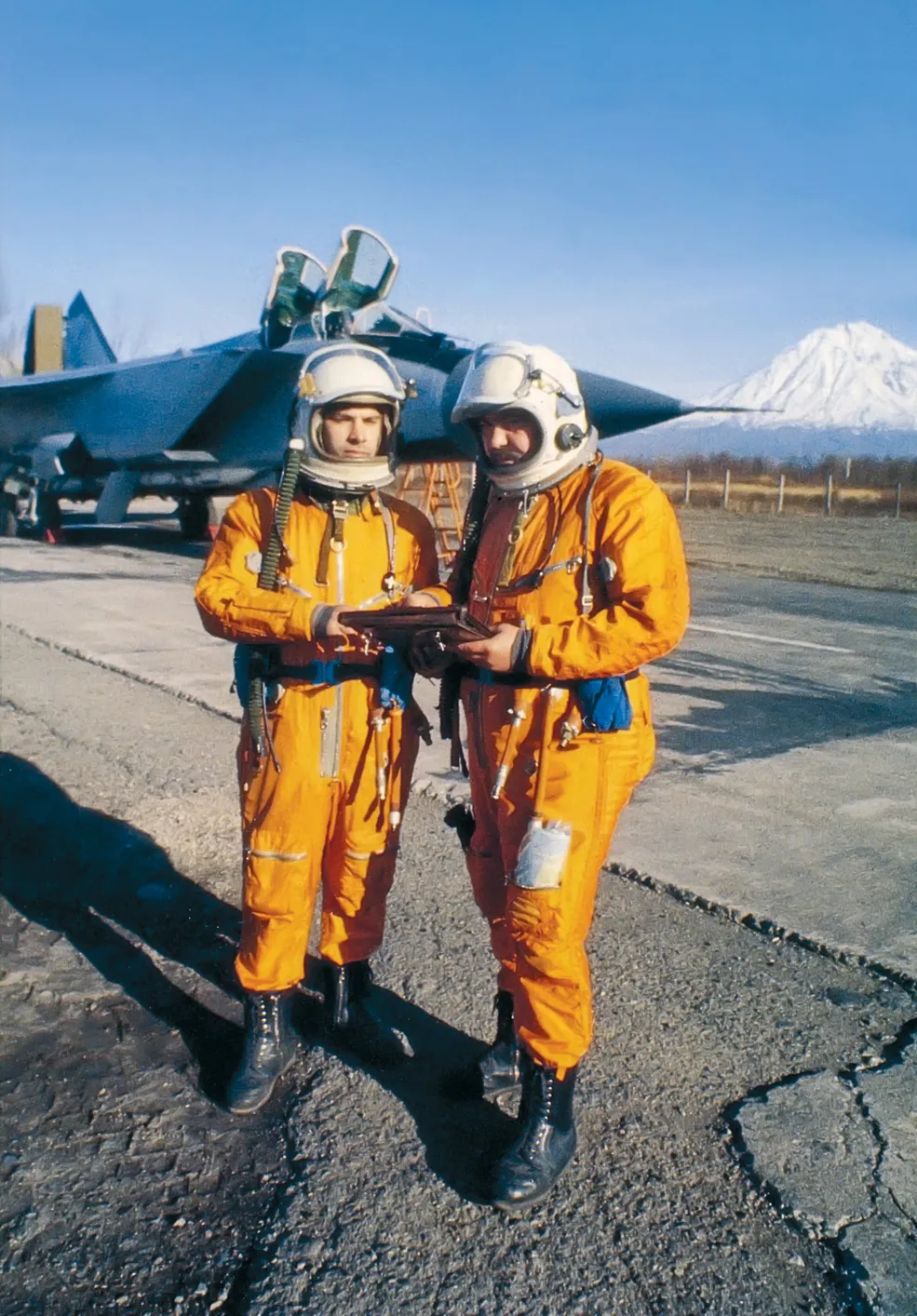
The crew of a 865th IAP MiG-31 pose for a photo, clad in pressure suits and GSh-5 pressure helmets.
In Central Asia the MiG-31 served with two units in Kazakhstan – a regiment at Sary-Shagan AB (probably the 738th IAP, 12 MiG-31Bs were delivered in 1991) and the 356th IAP at Zhana-Semey AB near Semi-palatinsk (the first batch was delivered in 1986, later the MiG-31Bs from Sary-Shagan were transferred to this airfield).
The regiments equipped with the new interceptors covered two directions of probable strategic strikes by the potential adversary (read: NATO) – the North and Far East. However, their first combat task was counteracting the SR-71. The Blackbirds used a harassment tactic, intruding into Soviet airspace to a depth of several dozen kilometres and challenging the PVO system to retaliate. The very short time spent by these aircraft over Soviet territory made it all but impossible to shoot them down with a SAM; yet, the radar systems of the PVO were switched to combat alert mode, and their operational parameters were comfortably recorded by US ELINT aircraft flying over international waters, safe from attack.
Initially the fielding of the MiG-31-33 intercept system did not have any major impact on the number of flights of NATO aircraft along the Soviet borders, yet the cases of these aircraft coming too close became less frequent. For example, until 1984 the attempts of the 365th IAP flying Su-15TMs (or possibly the 777th IAP, which was likewise based at Sokol AB and also converted to the MiG-31 in the 1980s) to intercept the SR-71 proved futile; with the advent of the MiG-31 they quickly made the Blackbird crews realise it was best to stay away from the Soviet borders. As an example one can cite an intercept which took place in the Far East on 8th March 1984: a pair of MiG-31s blocked an SR-71 so effectively over international waters that it had to return to Kadena AB without completing its objective.

A 865th IAP MiG-31 is readied for a sortie, with one of the surrounding volcanoes as a backdrop.
As mentioned earlier, the first evidence about the ‘MiG-25MP’ had reached the West as early as 1976 after Viktor Belenko’s defection. Reliable information about the new interceptor’s capabilities was not yet available; therefore, proceeding from the knowledge about its progenitor, the aircraft was tentat...
Table of contents
- Cover
- Title Page
- Copyright
- Contents
- Introduction
- From ‘Bats’ to ‘Dogs’: The MiG-31 Takes Shape
- The Kennel: Foxhound Versions
- Upgrades and Special Versions
- The New Generation of Foxhounds
- The MiG-31 in Action
- The MiG-31 in Detail
- The Modeller’s Corner
- Line Drawings
- The MiG-31 in Colour
Frequently asked questions
Yes, you can cancel anytime from the Subscription tab in your account settings on the Perlego website. Your subscription will stay active until the end of your current billing period. Learn how to cancel your subscription
No, books cannot be downloaded as external files, such as PDFs, for use outside of Perlego. However, you can download books within the Perlego app for offline reading on mobile or tablet. Learn how to download books offline
Perlego offers two plans: Essential and Complete
- Essential is ideal for learners and professionals who enjoy exploring a wide range of subjects. Access the Essential Library with 800,000+ trusted titles and best-sellers across business, personal growth, and the humanities. Includes unlimited reading time and Standard Read Aloud voice.
- Complete: Perfect for advanced learners and researchers needing full, unrestricted access. Unlock 1.4M+ books across hundreds of subjects, including academic and specialized titles. The Complete Plan also includes advanced features like Premium Read Aloud and Research Assistant.
We are an online textbook subscription service, where you can get access to an entire online library for less than the price of a single book per month. With over 1 million books across 990+ topics, we’ve got you covered! Learn about our mission
Look out for the read-aloud symbol on your next book to see if you can listen to it. The read-aloud tool reads text aloud for you, highlighting the text as it is being read. You can pause it, speed it up and slow it down. Learn more about Read Aloud
Yes! You can use the Perlego app on both iOS and Android devices to read anytime, anywhere — even offline. Perfect for commutes or when you’re on the go.
Please note we cannot support devices running on iOS 13 and Android 7 or earlier. Learn more about using the app
Please note we cannot support devices running on iOS 13 and Android 7 or earlier. Learn more about using the app
Yes, you can access Mikoyan MiG-31 by Yefim Gordon,Dmitriy Komissarov in PDF and/or ePUB format. We have over one million books available in our catalogue for you to explore.