- 128 pages
- English
- ePUB (mobile friendly)
- Available on iOS & Android
eBook - ePub
About this book
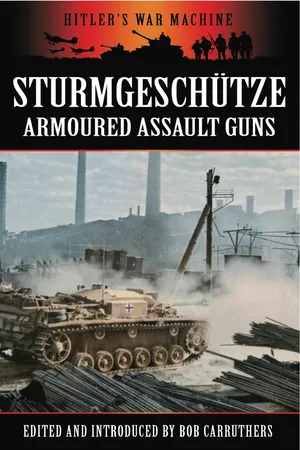
An overview of the Wehrmacht's little-known mobile assault guns designed to provide close infantry support against enemy field defenses in World War II.
The Stürmgeschutze rumbling forward into action is one of the iconic images of World War II. As mobile assault guns, the StuGs were essentially designed as infantry support weapons, but they also proved themselves as highly effective tank destroyers.
Written by Emmy Award-winning author Bob Carruthers this fascinating study encompasses the design, development and combat history of the StuG II and IV.
Drawing on a variety of rare primary sources and photographs this outstanding study explains the role of the StuG in context and examines the combat records of the StuG aces such as Franz von Malachowski, and Knight's Cross holder Oberwachtmeister Hugo Primozic of Stug.Abt.667.
Indispensable reading for anyone with an interest in armored warfare, this book is part of the Hitler's War Machine series, a new military history range compiled and edited by Emmy Award winning-author and historian Bob Carruthers. The series draws on primary sources and contemporary documents to provide a new insight into the true nature of Hitler's Wehrmacht.
Trusted by 375,005 students
Access to over 1 million titles for a fair monthly price.
Study more efficiently using our study tools.
Information
Subtopic
20th Century HistoryIndex
HistoryCHAPTER 1
STURMGESCHÜTZE III & IV
The Sturmgeschütz rumbling forward into action is one of the iconic images of World War II. The StuG, as it is often known, is frequently mistaken for a main battle tank, however, this is something of misconception. There were many occasions on which the Sturmgeschütz (or Sturmgeschütze in the plural) performed the same functions as a tank, as mobile artillery, the StuGs were essentially infantry support weapons and were designed for a specific tactical purpose which was very different to that of the tank formations.
Whereas the tanks were intended to force a breakthrough and keep going deep into enemy territory the StuG, on the other hand, was intended to provide close infantry support against enemy field defences using direct-fire from its main gun. As the war wore on the Sturmgeschütze, with considerable success, were also utilised in the role of tank destroyers and mobile artillery so there undoubtedly was some blurring of the roles.
In consequence of their versatility, Sturmgeschütze III and IV mobile assault guns were manufactured, in a large number of variants, from 1939 to 1945. Over 10,000 vehicles were eventually produced by the hard-pressed German armaments industry making the Sturmgeschütz, in all of its variants, the most produced German armoured fighting vehicle of the war.
Although the Sturmgeschütz III was not actually deployed until 1940, a small number of what were essentially prototype machines were deployed for the campaign in the west. During the course of the war the anti-tank qualities of the up-gunned Sturmgeschütz III were soon appreciated, and as a result the Sturmgeschütz III entered a sustained production run and eventually accounted for the longest armoured fighting vehicle production run in Germany during World War II. Sturmgeschütze saw action on all fronts and, as the situation deteriorated, they were pressed into service for a wide number of ancillary roles.

Sturmgeschützschütz rolling across the open steppe during the heady days of the advance into the Russian hinterland during June 1941.
The most widely produced vehicle of the Sturmgeschütz family was, of course, the now legendary Sturmgeschütz III. It was not a purpose designed vehicle; as it was built around the proven chassis of the Panzer III tank which was adapted to provide a new type of armoured fighting vehicle for a very specific role. The StuG III was intended to provide a mobile, well armoured, but relatively light artillery piece for close infantry support in the assault.
All StuG IIIs were operated by a four man crew which comprised a commander, gunner, loader/radio operator and driver. The smaller crew and lack of a turret were the main disadvantages of the StuG but the low silhouette to an extent compensated.
The Sturmgeschütz III was still under development and was therefore not available in a combat role for the 1939 invasion of Poland. It finally made its operational debut in France in 1940 where it first saw action in the field but only in relatively small numbers. Only twenty four machines were actually deployed, but the evidence from the field was convincing and the Sturmgeschütz III was considered to be an instant success. The Sturmgeschütz III was again deployed and proved its effectiveness in the lightning campaigns which swept the Wehrmacht through the Balkans and into Greece. In June 1941 the Sturmgeschütz III was deployed in greater numbers for the attack on Russia and, to a far more limited extent, they also saw action with Rommel in North Africa.

A Sturmgeschütz commander in action Russia 1942.
The Russian front was to become Hitler’s nemesis and the first signs of impending doom came in the form of the T-34 and the KV-1. Increasingly the Sturmgeschütze III were being called upon to combat this new breed of Russian armour, but the short barrelled main armament was not adequate to develop the high muzzle velocity required for armour piercing rounds, rendering them unsuitable for this role.
The situation in the field was increasingly desperate, but in late 1942, the problem was to an extent solved when the ineffective short barrelled 75mm gun was replaced with the long barrelled high velocity StuK 40 L/48. Equipped with this gun, the StuG III soon proved itself to be a highly effective tank destroyer. Its extremely low silhouette meant that the StuG III was capable of lying in wait to ambush Soviet tank formations. As a result of the constant programme of modification and upgrading, which lasted throughout the war, variations of the StuG III, and its later rival the StuG IV, served very effectively as assault guns, mobile artillery and tank destroyers.

A Stug III struggles to cope with the unexpectedly severe weather during the first winter of the war on the Russian front.

Stug III in the streets of Kharkov; October 1941.
The StuG III was conceived to fill an obvious gap for a selfpropelled artillery piece which could be brought right up to the front lines in support of fast moving infantry. However, it was not initially clear which arm of the Wehrmacht would actually field the new weapon. The Panzerwaffe was the obvious choice as the natural user of tracked fighting vehicles, but in 1939 Germany’s tank arm was undergoing a rapid and ambitious expansion programme which was focussed on developing tanks as a breakthrough weapon. In 1939 there were simply no resources to spare for the formation of StuG units which were intended to perform a secondary battlefield role as viewed from the narrow perspective of the Panzerwaffe.
The infantry branch lacked the knowledge, infrastructure and the resources to satisfactorily implement the full capabilities of the new machines. It was therefore agreed, after much discussion, that the StuG IIIs would best be employed as part of the Heer’s artillery arm. The crews of the StuGs were therefore artillerymen rather than tank men and retained the grey uniform as opposed to the Panzer black of the tank men.
From the outset the Sturmgeschütze were therefore organised along artillery lines initially formed into batteries, then into battalions (which were later designated as brigades in order to try and exaggerate the numbers in an attempt to deceive Allied intelligence). A report of the first of the StuG III’s in combat was promulgated to American troops by the Military Intelligence Service in December 1941 some six months after the commencement of Operation Barbarossa.

An early production model StuG III in action during the advance into Russia.
THE CONTEMPORARY VIEW NO.1
GERMAN ARMORED ASSAULT ARTILLERY
SOURCE
This bulletin is based upon the report of an American official observer in Berlin. The translated article, which deals with the employment of a battery of armored assault artillery of the “Greater Germany” Infantry Regiment on the French-Luxemburg border, originally appeared in Die Woche, a German weekly magazine.
Intended propagandistic effects should not be overlooked.
CONTENTS
1. Translation
2. Comments of Official Observer
1. TRANSLATION
“A motorized platoon, with 2 antitank guns attached, constituted the leading element of our advance guard as we marched west from Vance, which is 20 miles west of Luxemburg, to Étalle (figure 1). As the vehicles approached Étalle on May 10, they encountered hostile armored scout cars, and during the ensuing engagement a report was received at regimental headquarters that Villers was occupied by French cavalry. The 2d Battalion was accordingly ordered to attack Villers immediately. For 3 hours they advanced toward the village, meeting increasing resistance, and were finally stopped at the eastern edge by strong hostile fire.

Figure 1. Area around Étalle and Neufchâteau.

Armored tanks and assault guns in the streets of Kharkov.
“Meanwhile the 1st Battalion, with the armored assault artillery battery attached, had arrived at Neuhabich, where the battalion commander ordered a rifle company to make contact with the 2d Battalion. Advancing slowly south from Neuhabich, the rifle company finally reached Villers, where it also met heavy resistance. The company commander, after considering the situation, sent the following oral message to the rear: ‘Assault battery to the front!’

SdKfz 253 with headlights removed and round plate covering the hole. The SdKfz 253 command vehicle proved inadequate for the task and was phased out from 1942 onwards.
“The 3d Platoon of the armored assault artillery battery dashed forward to engage in its first fight. The platoon commander, in his command vehicle, was followed by Assault Guns No. 5 and No. 6. The platoon encountered no resistance until it arrived at the center of town, where it received heavy machine-gun fire. Two rounds from each of the assault guns silenced the machine guns.
‘Assault Gun No. 6 went into action, firing at the nearby buildings. One shell exploded in a courtyard among some French cavalry horses. The animals which were uninjured galloped away, frightened by the explosion.
Assault Gun No. 5 swung into position in the churchyard to silence hostile machine guns which were firing from two windows in a large building close by. The platoon commander ordered the gun commander to fire on this target, and two rounds from the assault gun served to silence them.
“Finally, the enemy evacuated the main street and the center of the town, but machine-gun resistance was renewed at the western edge of the village. Momentarily, it was thought that the assault guns should be sent ahead again. But the riflemen and the partially armored antitank-weapons on self-propelled mounts were able to reduce this resistance unassisted.
“The 2d Battalion remained in Villers during the night. Field kitchens were moved up, the men were fed, and medical personnel cared for the wounded. The 3d Platoon of the assault battery obtained some rest just in rear of the front line, the men sleeping in their vehicles. The next morning, at 5 a.m., the advance guard and the 3d Platoon of the assault battery moved out toward Mellier.
“The armored assault guns soon reached a destroyed bridge across a tributary of the Semois River. The pioneers, although hard at work, had not yet completed their task here; but the guns managed to ford the river. The regimental commander, in order to get up to the front, took a seat in a...
Table of contents
- Cover
- Title Page
- Copyright
- Contents
- Introduction
- Chapter 1: Sturmgeschütze III & IV
- Chapter 2: The Development of the Sturmgeschütz
- Chapter 3: The sturmgeschütz in Combat
- Chapter 4: The Stug Design Path
- Chapter 5: The Main Characteristics
- Chapter 6: The Sturmgeschütz and Other nations
- More from the Same Series
Frequently asked questions
Yes, you can cancel anytime from the Subscription tab in your account settings on the Perlego website. Your subscription will stay active until the end of your current billing period. Learn how to cancel your subscription
No, books cannot be downloaded as external files, such as PDFs, for use outside of Perlego. However, you can download books within the Perlego app for offline reading on mobile or tablet. Learn how to download books offline
Perlego offers two plans: Essential and Complete
- Essential is ideal for learners and professionals who enjoy exploring a wide range of subjects. Access the Essential Library with 800,000+ trusted titles and best-sellers across business, personal growth, and the humanities. Includes unlimited reading time and Standard Read Aloud voice.
- Complete: Perfect for advanced learners and researchers needing full, unrestricted access. Unlock 1.4M+ books across hundreds of subjects, including academic and specialized titles. The Complete Plan also includes advanced features like Premium Read Aloud and Research Assistant.
We are an online textbook subscription service, where you can get access to an entire online library for less than the price of a single book per month. With over 1 million books across 990+ topics, we’ve got you covered! Learn about our mission
Look out for the read-aloud symbol on your next book to see if you can listen to it. The read-aloud tool reads text aloud for you, highlighting the text as it is being read. You can pause it, speed it up and slow it down. Learn more about Read Aloud
Yes! You can use the Perlego app on both iOS and Android devices to read anytime, anywhere — even offline. Perfect for commutes or when you’re on the go.
Please note we cannot support devices running on iOS 13 and Android 7 or earlier. Learn more about using the app
Please note we cannot support devices running on iOS 13 and Android 7 or earlier. Learn more about using the app
Yes, you can access Sturmgeschütze by Bob Carruthers in PDF and/or ePUB format, as well as other popular books in History & 20th Century History. We have over one million books available in our catalogue for you to explore.