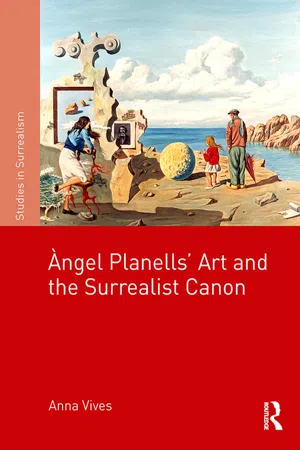
Having been mistakenly perceived as a follower of Salvador Dalí, Catalan surrealist painter and writer Àngel Planells (1901–1989) has passed through the history of art practically unnoticed. Yet his work suggests an influence on a number of works by Dalí, proving that a fairer way to define their relationship is as an artistic dialogue. His participation in the groundbreaking International Surrealist Exhibition in London in 1936 is in itself a marker of his quality as an artist, but Planells' contribution to surrealism is remarkable for his use of astronomy, fantastic scenes redolent of Edgar Allan Poe's narrative as well as ludic elements and meta-pictorial techniques that contest Fascism.
- 138 pages
- English
- ePUB (mobile friendly)
- Available on iOS & Android
eBook - ePub
Àngel Planells’ Art and the Surrealist Canon
About this book
Information
1 Planells and Dalí
Reevaluating Their Relationship
Planells’ mesmerising painting Landscape Woman (1930) concocts a surrealist scene of erotic overtones (see Plate 3).1 The background represents the artist’s local landscape, in particular the small Catalan mountain range known as Montgrí. The portrait of the female character is made of a number of entities that work both as a part of a whole and independently. In particular, her nose resembles a pepper, her breasts are potatoes, and, according to an anonymous author, her mouth is a box of chocolates (1931: 3). Exhibited in Madrid in 1931, this artwork is reminiscent of Giuseppe Arcimboldo’s composite paintings such as those included in The Seasons (1573). Planells shares with Arcimboldo the deployment of food to create certain features of a human body, although the latter is much more extensive in this sense. Five years after the completion of Landscape Woman, the 1936 MoMA exhibition Fantastic Art, Dada and Surrealism included works by Arcimboldo, Goya, and Redon among others alongside dadaist and surrealist pieces, subsequently highlighting the status of these artists as precursors of the surrealist movement (McAra 2017: 26). Planells seems to be aware of the significance of Arcimboldo in surrealist circles before the New York exhibition.
The background landscape is clearly erotic, with breasts and lips forming part of the scenery. Given that the woman’s mouth is a box of chocolates and her breasts are potatoes, do these body parts belong to her? I would argue that there is a symbiosis between the woman and the landscape that forms her and likewise between the background landscape and the female body. It becomes difficult to establish boundaries among these different elements. In the context of these symbioses, it is unsurprising that a wide variety of animals form part of the woman’s body: two flies represent the pupils; a worm shapes the upper arm; a rabbit’s head appears next to the breasts-potatoes; a fish outlines the waist on the right; a beetle and a little fish are also seen; two more beetles are positioned on the woman’s hip; eight little beetles, four on each side of a coffee bean shell, form the shape of a V. This arrangement suggests the woman’s vagina, especially if one considers that seashells are meant to stand for a metaphor of this part of the female human reproductive system in different Hispanic cultures (Mariño Ferro 1997: 303). Next to the seashell, there is a clenched hand with an insect on it. A demonic-looking beetle is under the seashell and above half a bird whose wing seems to be made of stone as opposed to the rest of the animal. Further animals punctuate other areas of the woman’s legs: a bee and a butterfly.
As intimated above, it is difficult to distinguish between the animate and the inanimate. Apart from the animals mentioned, there are inorganic elements within the limits of the woman’s body: a box, a pipe, a tap, a ladder, a shoe, a musical instrument, four spherical containers, a little building, and some stones. Conversely, the organic qualities of the body are also underscored by the presence of leaves and flowers. The woman’s body is in stark contrast to her stone-like hair, which cascades down her total height. She is physically inseparable from the surrounding landscape as proved by the uninterrupted continuity between her legs and the foreground rocks. The posture adopted by the female character intimates that she is confident about her sexuality and the box with windows positioned around her belly area – two little hands show through one of the windows – tells us that her reproductive ability is important. Yet this reference to maternity does not seem a goal, but rather a consequence of her engagement with the erotic. Her portrayal as a character connected to nature and the depiction of a natural sexuality are redolent of Botticelli’s Venus, with elements such as water, the seashell, the long hair, and the figure’s size adding to this connection. Moreover, whilst Botticelli’s work is much larger than Planells’, 172.5 cm x 278.9 cm and 120 cm x 60 cm respectively, it is interesting to note that Landscape Woman is one of the largest surrealist artworks by the Catalan artist. Yet Planells’ painting is more overtly sexual in line with a surrealist aesthetic. The centrality of the landscape-woman figure and her chopped left arm anticipates 1932–1933 works such as Familiar Phantoms and The Shameless Woman, although these works represent female sexuality as a threat.
This artwork is testament to the importance of the local landscape in Planells’ production. It is also a good example of how the artist deploys his everyday natural surroundings to introduce surrealist elements. His local Catalan landscape inspires him to concoct fantastic and surrealist scenes. Landscape Woman also helps reflect on the question of landscape painting in Planells. The artist is not against using the local landscape in his works, but he is definitely uninterested in using it in a totally realistic manner. In this sense, many of the artworks that we will examine depict peculiar landscapes that are a direct result of the artist’s imagination.
Despite Planells’ originality and personal style in terms of engagement with the local landscape, representations of female sexuality, and reconsiderations of the work of Renaissance masters and surrealist precursors since early on in his career, critics have linked Àngel Planells to Dalí without giving too much thought to their peculiar relationship (Bota-Gibert 2002a: 18). In effect, Dalí has been shadowing Planells since they met in 1920. When researching his artistic trajectory one notices two distinct viewpoints of his work: an artist who has simply devoted himself to copying Dalí or as an equally interesting painter. Among those critics ‘against’ Planells we find Màrius Gifreda (1929: 7), E.F. Gual (1934: 7), Ramón Reig (1963: 116), Enric Jardí (1983: 138), Michel Remy (1986: 165), and Grace Glueck (2002). Regarding the exhibition Art Modern Nacional i Estranger at the Galeries Dalmau in 1929, Gifreda himself did not have any reservations in writing that ‘Angel Planell [sic] plagia d’una manera estulta una de les modalitats de Salvador Dalí’ [Angel Planell [sic] plagiarizes very well one of Salvador Dalí’s modalities] (1929: 7). However, his most fierce opponent was perhaps E.F. Gual, who believed that in following Dalí, Planells was irretrievably wasting his time (1934: 7). In British Surrealism – Fifty Years on, Remy writes inspired by Planells’ Familiar Phantoms (c. 1932) that ‘many of his [Dalí’s] mannerisms were copied without regard to a personal commitment on the part of the imitator. Planells was a Catalan, like Dali, and obviously one of his most fervent followers’ (1986: 165). Whilst it may be fair to suggest that Dalí influenced Planells, I would argue that the similarities between Planells and Dalí should be taken as an artistic dialogue.
As opposed to this group, Roland Penrose,2 Joaquim Molas (1983: 83), Josep Bota-Gibert (2002a: 18), Dawn Ades (2004: 266–267), Lourdes Cirlot (2004: 26–27), and William Jeffett (2006: 349) have recognised Planells’ artistic contribution. On the occasion of the 1936 International Surrealist Exhibition, Planells received positive criticism from the pages of The Evening News, in particular for his ‘absolute command of the most elaborate perspective effects, like Salvador Dali’ (1936: 6). Further proof of the interest produced by Planells’ work stems from the fact that the International Surrealist Exhibition ‘produced virtually no sales’ (Dunlop 1972: 201–202). Yet of 400 items, only one work by Breton, three paintings (two by Chirico and one by Picasso), one collage by Max Ernst and some artworks by English surrealists were bought by Penrose (Hartley 2001: 15–16). To this list, one should add an oil by Planells, Midday Sorrow (1932), which was probably bought by Penrose after 12 December 1936. In 1946, Penrose also bought Familiar Phantoms (c. 1932) and both paintings were subsequently stored in Farley Farm House, his countryside house in Sussex. It was in Farley Farm House in the late 1970s that Ades saw for the first time works by Planells. Her first reaction was a comparison with Dalí, yet it was clear to her that these were not works by the artist from Figueres. As with Penrose, Ades knew she was in front of something special (2004: 266). Yet Sebastià Gasch is arguably the critic who supported Planells the most. In an interview to Guillem-Jordi Graells, Gasch claimed that Planells has been the most authentic Catalan surrealist ever (1974: 37). He also added that surrealism in Catalonia did not crystallise as a movement, but rather there were a number of individuals with links to it such as Dalí, Foix, and Planells (Graells 1974: 37).
In chronological terms, this means that the current state of affairs is that critics tend to propose looking at Planells in a more independent manner, although very little has been done to readdress the issue of his standing in the field of the history of art and the analysis of his oils is practically non-existent apart from my own work (2014). In the field of Planells’ poetry, there is an illuminating chapter by Jacqueline Rattray (2014), but it underplays the symbiosis between his poems and his plastic art. My contention is that Planells’ poems have a pictorial quality, but his paintings have a poetic quality too, therefore concentrating only on one of the two (poetry or painting) risks neglecting essential elements of the artist’s oeuvre.
Erroneous Attributions, Collaborations, and Dialogues
Planells and Dalí met in Cadaqués in the former’s bakery in 1920. Dalí had been informed by his nanny about a young man whose drawings were brimming with fantasy and decided to meet him, thus becoming immediately interested in Planells’ art. As Alícia Viñas indicates, Planells produced collage before being acquainted with Max Ernst’s work and was a practising ‘surrealist’ even before Dalí joined the movement officially (2010: 150). Relevant to this sort of anticipation of surrealism are Planells’ words regarding Joan Massanet’s pictorial production: ‘[C]reo debe ser un caso parecido al mío, como de intuición del movimiento surrealista no mucho antes de que se produjera’ [I think he must be a case similar to mine, as if intuitive of the surrealist movement not long before it took place] (Guillamet 1973: 4). Joan-Josep Tharrats notes how Planells’ knowledge of official surrealism was mediated by Dalí, especially with regard to Max Ernst, Freud, and Lautréamont, and how he benefited from the artistic atmosphere in the Cadaqués of the late 1920s, when Federico García Lorca, René Magritte, André Breton, Gala, Paul Éluard, Marcel Duchamp, and Luis Buñuel visited the area (1993: 121). Yet it is important to note that Planells negates the mediation of Dalí in his knowledge of Lautréamont (Bota-Gibert 1983: 13). In the interview that Planells offered to Joan Borràs, the artist convincingly rejects Dalí as a ‘pictorial master’, although he admits that the latter had advised him with regard to literature, particularly Freud’s works (1986).
Planells’ artistic connections with Dalí as well as the latter’s standing as an artist have arguably led to a number of erroneous attributions. Napoleon’s Harp (undated) was detected in the market with a Dalí signature but it is a Planells (Frisach 2003a: 53).3 In my view, this case is a sign of the perceived pictorial similarity between both artists, but it also indicates that some may be too ready to use the Dalí brand in order to make some handsome profit. In reality, this case can be equally negative for Planells and Dalí, discrediting the former’s work and giving bad publicity to the latter. Planells’ Basket of Bread (1931–1932) also used to display a Dalí signature (Frisach 2003a: 53). Other cases would need further research. Ricard Mas argues that Bread and Grape
es podria atribuir al pintor de Blanes Àngel Planells, epígon dalinià que, durant els primers anys de la postguerra espanyola, havia fet composicions a la manera del Dalí realista. Si estudiem alguns quadres realistes del pintor de Blanes trobarem les mateixes castanyes – fruit que Dalí no va pintar mai –, el mateix pa i fins i tot els mateixos plecs del tovalló. El que no es pot afirmar amb tanta rotunditat és si va ser signat pel mateix Planells o per un tercer, probablement comprador [could be attributed to the painter from Blanes and epigone of Dalí, Àngel Planells, who during the early Spanish postwar had produced works reminiscent of Dalí’s realist work. If we study some realist paintings by the painter from Blanes, we will find the same chestnuts – fruit that Dalí never painted –, the same bread and even the same folds of the napkin. What cannot be asserted so blatantly is whether it was signed by Planells himself or by a third party, probably a buyer.]
(2003: 266)
Mas also adds that Bread and Walnuts (1925) and Bread and Eggs (undated) by Planells display a Dalí signature (2003: 267). Whilst no further investigations have been conducted regarding the potential misattribution of Bread and Grape since the news broke at the end of 2003, we know that the Museum of Montserrat has removed the painting from the wall and placed it in storage. Fèlix Fanés, ex-director of the Centre for Dalinian Studies, conceded that the attribution of this painting is dubious and that as far as he can see it may not be a Dalí, although he also adds that the...
Table of contents
- Cover
- Half Title
- Series Page
- Title Page
- Copyright Page
- Table of Contents
- Figures
- Plates
- Abbreviations
- Translations
- Unpublished Texts by Àngel Planells
- Images
- Acknowledgements
- Introduction
- 1. Planells and Dalí: Reevaluating Their Relationship
- 2. Planells: Between the Fantastic and Surrealism
- 3. Planells’ Participation in Two Major Exhibitions
- 4. Planells’ Interaction with War and Dictatorship
- 5. Astronomy in Planells’ Paintings, Drawings, and Literary Texts
- Conclusions
- Index
Trusted by 375,005 students
Access to over 1.5 million titles for a fair monthly price.
Study more efficiently using our study tools.
Frequently asked questions
Yes, you can cancel anytime from the Subscription tab in your account settings on the Perlego website. Your subscription will stay active until the end of your current billing period. Learn how to cancel your subscription
No, books cannot be downloaded as external files, such as PDFs, for use outside of Perlego. However, you can download books within the Perlego app for offline reading on mobile or tablet. Learn how to download books offline
Perlego offers two plans: Essential and Complete
- Essential is ideal for learners and professionals who enjoy exploring a wide range of subjects. Access the Essential Library with 800,000+ trusted titles and best-sellers across business, personal growth, and the humanities. Includes unlimited reading time and Standard Read Aloud voice.
- Complete: Perfect for advanced learners and researchers needing full, unrestricted access. Unlock 1.5M+ books across hundreds of subjects, including academic and specialized titles. The Complete Plan also includes advanced features like Premium Read Aloud and Research Assistant.
We are an online textbook subscription service, where you can get access to an entire online library for less than the price of a single book per month. With over 1.5 million books across 990+ topics, we’ve got you covered! Learn about our mission
Look out for the read-aloud symbol on your next book to see if you can listen to it. The read-aloud tool reads text aloud for you, highlighting the text as it is being read. You can pause it, speed it up and slow it down. Learn more about Read Aloud
Yes! You can use the Perlego app on both iOS and Android devices to read anytime, anywhere — even offline. Perfect for commutes or when you’re on the go.
Please note we cannot support devices running on iOS 13 and Android 7 or earlier. Learn more about using the app
Please note we cannot support devices running on iOS 13 and Android 7 or earlier. Learn more about using the app
Yes, you can access Àngel Planells’ Art and the Surrealist Canon by Anna Vives in PDF and/or ePUB format, as well as other popular books in Art & Art General. We have over 1.5 million books available in our catalogue for you to explore.